I was a teenager on a cruise when I first saw ocean pollution up close. Late at night, I heard a noise over the railing. I looked down and saw crew dumping garbage into the ocean. A stream of trash stretching off toward the horizon. That image stuck with me.
But that garbage spilling into the ocean was just the tip of the trashberg. And that trashberg… is mainly plastic. Plastic makes up about 80 percent of marine pollution.1 And it doesn't always come from where you'd expect.
Most people think of waste plastic as straws, bottles, and grocery bags washing off beaches. But when a Dutch nonprofit called The Ocean Cleanup sailed out to the Great Pacific Garbage Patch to scoop it all up… they found something else entirely. More than three-quarters of the plastic wasn’t consumer trash... at all. It didn’t even come from the shore! Even worse, cleaning it up was a lot harder than anyone hoped.
So, they did something surprising. They turned around, returned to shore, and started tackling the plastic problem upstream.
This is the story of what The Ocean Cleanup discovered once they started studying the problem up close… and why solving ocean plastic might mean turning off the tap, and not just mopping up what's already spilled.
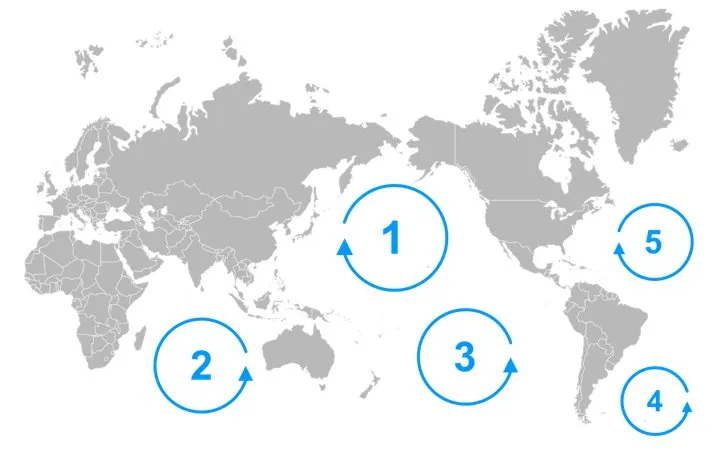
Not all ocean plastic ends up on a beach. Some sinks. And some drifts, pulled by currents into giant, slowly-spinning vortexes in every ocean basin. The largest is the Great Pacific Garbage Patch between Hawaii and California. It covers an area twice the size of Texas or three times the size of France. It contains roughly 80,000 metric tons of floating plastic. That's about 1.8 trillion pieces.23
Newspapers and television crews painted a picture of an island of floating bottles and other household trash blown in from litter and open landfills.45
However, the Dutch nonprofit, The Ocean Cleanup, found something completely different when they sailed there. The biggest surprise? It wasn’t just bottles and bags from land. More than 75% of it was debris… from the fishing industry.67 It wasn't cruise ships dumping trash bags. It was an entire industry losing its equipment at sea.
Almost half of it is ‘ghost nets’ and ropes abandoned or lost at sea. This gear keeps fishing when the fisherman have gone home. It entangles turtles, sharks… even whales.8 Much of the rest of the plastic is fishing gear like floats and crates.7
What makes plastic such a problem is that it doesn't go away on its own. Over time, this plastic breaks into smaller pieces that end up in the stomachs of seabirds and fish. Eventually, it fragments into microplastics that are impossible to recover.3
This fishing gear is stranded in the middle of the ocean. Far from the countries that dumped it and left. 97
The Ocean Cleanup began trialling different cleanup systems at sea in 2018, hoping to clean the fishing gear up. But they faced major challenges immediately.
“There's a huge amount of plastic there… but it's dispersed over a large area. So it seems like… okay, it's there, you just scoop it up and bring it back. But actually it's constantly moving. It's a very difficult environment. The open ocean is far from shore.” - Henk van Dalen
That’s Henk van Dalen, the nonprofit’s VP of Science & Technology.
First, the organization tried using a passive system that let ocean currents do all the work to gather up plastic in a huge net. But the ocean was not on board; the net just drifted with the plastic… and then part of it broke.10
After three generations of designs, the organization settled on a system where two ships tow a giant net between them. The net stretches 2.2 km, roughly a mile and a third.11
And it works! In just one trash haul, The Ocean Cleanup can land as much as 11 tons or 25,000 pounds of trash!
But this approach comes with a catch. The garbage patch is still an ecosystem. Dragging a huge net catches not only plastic, but sea life … also known as bycatch. 1314
The Ocean Cleanup has been transparent about the animals caught up in its nets, from sharks, turtles, and fish to the tiny drifting creatures that live at the ocean’s surface. They've also modified the design of their nets to reduce their impact. Their latest system uses a bigger mesh to let more creatures pass through, plus escape hatches, and underwater cameras to spot turtles.1516
The Ocean Cleanup says about 99.9% of what it captures is plastic, with roughly 0.1% bycatch.16 That’s not nothing, especially when it involves protected species like turtles.
But there’s another approach to cleaning up ocean plastic… one that avoids fishing for plastic with a net. A California nonprofit called the Ocean Voyages Institute asked recreational sailors crossing the Pacific to tag ghost nets with GPS trackers. When those nets gathered in the same area, a wind-powered cargo ship headed out to collect them by hand.17181920 Over ten trips, they removed 362 metric tons of debris.
However, there are plastic hotspots we don’t need GPS trackers to find. Places where the trash flows right to the net: rivers. That cruise I took as a kid? The ship probably sailed right past rivers carrying more plastic than any garbage bag I saw go overboard.
Trash ends up in rivers when wind and storm runoff carry it into the water. Most of it washes up along coastlines or floats nearby.21 This is a whole different … and bigger … trashberg than what’s floating in ocean vortexes like the Patch.
Here’s the surprising part. The Ocean Cleanup found that, of more than 100,000 rivers around the world, just 1,000 or so carry about 80% of the plastic reaching the ocean.2223
“There's a thousand rivers but actually if we look a step closer we can identify 200 cities which are responsible for most of this outflow.” - Henk van Dalen
The organization is setting its sights on the roughly 1–3 million metric tons of plastics it estimates flows into the oceans from rivers each year.22 That’s the equivalent of about 600 dump trucks of trash … every single day.24
But exactly how will this work? And where? These are urban rivers, many of them in Asia. The people living along them typically generate less trash per person than Americans or Europeans.25 Part of the problem is that garbage collection and properly lined landfills cost money, and a lot of rapidly growing cities simply don’t have those systems in place.26 So, trash ends up on the ground. And the ground leads to the river.
The organization plans to tackle the 1000 most polluting rivers, working with local governments and communities, and adapting the tech to each location.2327
They have a whole system, and they call it “The Interceptor.” It does what it says on the label: it intercepts trash before it hits the ocean.
The interceptor comes in a couple different flavors, each suited to local conditions.
The Original model lets local boat traffic keep flowing in places like the Dominican Republic. But trash is funneled by a long barrier towards a conveyor belt that lifts debris out of the water and dumps it into a collection barge. When it’s full, it texts local operators for pickup, because…even though it's voracious, the Interceptor still has manners.28
The Ocean Cleanup has a different approach for places like the Rio Las Vacas outside Guatemala City, where seasonal rains send tsunamis of trash rushing down the river. It’s called the Interceptor Barricade.29 It’s a tall floating barrier designed to hold back massive surges of debris. In its first year anchored to the riverbanks of the Rio Las Vacas, it prevented more than 10,000 metric tons of trash from entering the Caribbean.3031
10,000 metric tons. Compare that to the 500 tons collected at sea. It's no wonder the Ocean Cleanup turned their efforts upstream.
But to me, operating within countries seems a lot more complicated than working at sea. I asked Henk how they navigate that.
“Before we go to a country… we want to understand what is the environment, what are the communities, if we deploy an interceptor in a certain area, who's affected by that, how can we make sure that this works for them, maybe there's local employment [to] be gained.” - Henk van Dalen
The organization doesn’t guesstimate the location and build of each Interceptor; it optimizes it after extensive surveys. That means placing cameras along rivers to track plastic with AI, flying drones to map debris hotspots, and sending GPS-tagged trackers downstream to see how trash moves.32 In Mumbai, India, The Ocean Cleanup found that 80% of the plastic comes from just 30% of the rivers. That’s allowed the organization to target their Interceptors for maximum payoff.32
Stopping plastic upstream doesn’t remove the debris already tangled in riversides, mangroves, and beaches. So alongside its Interceptors, The Ocean Cleanup works with local partners to remove that ‘legacy’ plastic.33
Today, Interceptors are operating in rivers across more than a dozen locations, from Guatemala and Jamaica, to Malaysia and Vietnam.27 Together, The Ocean Cleanup says these pilot projects are already preventing 2-5% of river plastic from hitting the ocean.
It’s not just the sea that’s seeing the benefits.
“Like local fishermen, they see the health of their rivers increase. People that live near the river actually, you know, they can swim in the river again.” - Henk van Dalen
The next step is scaling up. The organization plans to roll out Interceptors in 30 cities, which it says could cut the global flow of plastic into the ocean by as much as 1/3 by the end of the decade.34 Next up is Panama City … the one in Panama … and then Mumbai.34
Plastic problem solved… right? Well, not exactly. Pulling plastic out of the water doesn’t make it disappear. It just moves the problem back onto land, where we already struggle to recycled it … though I recently covered how that’s starting to change.35
Where local infrastructure exists, some river plastic is put to use. PET bottles get recycled. Organic waste gets composted. The rest goes to landfills or incinerators.36
Also, river cleanup doesn’t touch the plastic that’s already out there, circling in the Great Pacific Garbage Patch. Most of it came from fishing boats. There's no river to trace it back to. But given how much easier and cheaper it is to catch trash in rivers than out on the open ocean, I asked Henk,
“Why focus on the garbage patch at all?” - Matt
“If you have a bathtub which is overflowing, you can close the tap, but you still need to mop the floor, empty the bath and do all that stuff.” - Henk van Dalen
For me personally, I'm all in on mopping up the plastic in the Patch, but we have to do it in a way that benefits the ecosystem out there. We don't want to make the situation worse.
There's a whole community of creatures living right at the ocean's surface. By-the-wind sailors, sea dragons, blue buttons. They're called neuston. And the cleanup nets run right through their habitat. Scientists know so little about how neuston live and reproduce that one study found cleanup could devastate their populations… or barely affect them at all.14 No one knows for sure yet, but The Ocean Cleanup isn’t worried. It says these species reproduce quickly, and that populations at the edge of the patch can help reseed it.3738
The Ocean Cleanup is weighing the cost of its plastic removal method against the cost of leaving the plastic there. Their own environmental assessment put it bluntly. Cleanup operations hurt some marine populations in the short term, but leaving plastic in the ocean lets it break into microplastics that could do more damage in the long run.39 It’s a difficult balance.
For carbon at least, the math looks promising… if not yet settled. The Ocean Cleanup admits that sending diesel-powered ships after plastic will produce carbon emissions.39 But leaving plastic in the ocean has its own carbon cost. Plastic hurts phytoplankton, the tiny plants that absorb CO2 as they grow. It also harms the zooplankton that eat them. When both die, they sink, carrying carbon to the ocean floor. Disrupt that chain, and less carbon gets buried.40
A ten-year cleanup of 80% of the patch may release 0.4–2.9 million metric tons of carbon in total. On the flip side, microplastic harm to plankton populations could cost 15–30 million metric tons of carbon every year, according to the Ocean Cleanup’s in-house study.39 The diesel bill could be paid back many times over. The more efficient the cleanup gets, the better that equation looks.
The Ocean Cleanup has been collecting data in the Great Pacific Garbage Patch long enough to clock a serious rise in plastic fragments: 5-fold in just 7 years. The organization says that, by volume, there’s now more plastic in the patch than fish and other critters.41 The problem is accelerating. And yet The Ocean Cleanup has hit ‘pause’ on… ocean cleanup.34
In a way, it makes sense.
Recovering plastic at this scale is expensive. So the organization has shifted its focus to learning how to do it more efficiently. What we saw with Ocean Voyages Institute’s GPS-tagging approach is that knowing the exact location of the plastic is most of the battle.
In 2025, The Ocean Cleanup asked sailors in the Transpacific Yacht Race to tag ghost nets, and deployed another 144 trackers in a remote region of the Patch. These trackers pinged satellites over months, helping model how plastic moves and clumps together.42
The organization is also mounting cameras on cargo ships, which use AI to detect and photograph plastic, recording its GPS location.43 But to pinpoint plastic more precisely, The Ocean Cleanup is betting on drones.
“We actually get more accuracy… being out there in the patch itself, flying with drones, getting more information about where these hotspots are.” - Henk van Dalen
The idea is that better data leads to smarter cleanup. The organization says its new approach could drop the cost and timeline for cleanup nearly in half.44
“I do hope that in 5 to 10 years time, The Ocean Cleanup no longer exists. We've achieved our mission and everybody says, “Wow, I never thought that would happen,” but we all prove them wrong.” - Henk van Dalen
That would be amazing. But cleaning up the plastic already in the Patch won’t stop fishing gear from being lost next year, or plastic continuing to wash into rivers. Without fixing how much plastic we make and how it’s handled, ocean cleanup becomes maintenance, like an annual beach clean-up. And that means more cost, and more disruption to the ecosystem.45
The UN has been negotiating a global plastics treaty since 2022, but talks have stalled over whether to focus on waste management or cut production itself.4647 For now, the treaty is dead in the water… along with a lot of plastic. But many nations and groups, including The Ocean Cleanup, are still pushing to make it happen.
“We are part of lobby groups there... We bundle our strengths. And I think what the Ocean Cleanup brings to the table is a lot of data showing actually the problem itself… We're also showing that there are solutions available.” - Henk van Dalen
Here's where I land on this. Cleaning up the ocean is worth doing. Intercepting plastic in rivers is worth doing. We gotta mop that plastic up.
For now the tap… it’s still open. As hard as it is to clean up plastic at sea, turning off the tap to new plastics may be the biggest challenge of all.48 It comes down to money, policy, and whether we're willing to change how we make and use this stuff in the first place. And right now, global plastic production is still growing.49
But here's what sticks with me. I saw a cruise ship's crew dumping bags of trash, but the real problem was always bigger than that moment … and so are the solutions. In El Quetzalito, Guatemala, the organic waste pulled from the Rio Las Vacas gets composted. And the wood? It goes to nearby communities hit by deforestation. Families use it as cooking fuel.36 Trash from a river, literally keeping people warm. That's not going to solve the plastic crisis. But it shows that even partial solutions still help, especially for the people living closest the problem.
- Impact Economist – The data story of ocean plastic ↩︎
- Wikipedia – The Ocean Cleanup ↩︎
- The Ocean Cleanup – What is the Great Pacific Garbage Patch ↩︎
- Business Insider – You're Being Lied To About Ocean Plastic ↩︎
- SF Gate – Continent-size toxic stew of plastic trash fouling swath of Pacific Ocean ↩︎
- Nature Reports – Industrialised fishing nations largely contribute to floating plastic pollution in the North Pacific subtropical gyre ↩︎
- The Ocean Cleanup – The Other Source: Where Does Plastic in the Great Pacific Garbage Patch Come From? ↩︎
- The Guardian – Hidden problem of 'ghost gear': the abandoned fishing nets clogging up oceans ↩︎
- Cambridge University Press – The Prospects of the High Seas Treaty Decisively Reducing the Negative Biodiversity Impacts of Distant-Water Fishing Operations ↩︎
- ABC News Australia – What happened to The Ocean Cleanup — the system that would rid the oceans of plastic? ↩︎
- The Ocean Cleanup – System 03: A Beginner’s Guide ↩︎
- ABC News – Ocean cleanup group removes record 25,000 pounds of trash from Great Pacific Garbage Patch in one extraction ↩
- The Atlantic – How Plastic Cleanup Threatens the Ocean’s Living Islands ↩︎
- Peer J – Estimating the impact of new high seas activities on the environment: the effects of ocean-surface macroplastic removal on sea surface ecosystems ↩︎
- Wired – The Harmful Side Effect of Cleaning Up the Ocean ↩︎
- The Ocean Cleanup – System 002 and Marine Life: Prevention and Mitigation ↩︎
- Ocean Voyages Institute ↩︎
- Ocean Voyages Institute – Ghost Net Tagging and Retrieval ↩︎
- Hydro International – How GPS trackers and drones help locate floating debris ↩︎
- Dialogue Earth – Could ocean plastic cleanups be doing more harm than good? ↩︎
- Our World In Data – How much plastic waste ends up in the ocean? ↩︎
- Science Advances – More than 1000 rivers account for 80% of global riverine plastic emissions into the ocean ↩︎
- The Ocean Cleanup – River plastic emissions to the world’s oceans ↩︎
- The Upfit Insider – Dump Truck Capacity Chart 2025 | How Many Tons Does a Dump Truck Hold? ↩︎
- Big Think – Where Is the Plastic in the Ocean Coming From? Try Asia. ↩︎
- The CSR Universe – The Ocean Cleanup’s India Imperative: Scaling Technology, Data and Citywide Action to Close the Plastic Tap ↩︎
- The Ocean Cleanup – FAQ ↩︎
- The Ocean Cleanup – Interoceptor Original ↩︎
- The Ocean Cleanup – Intercepting trash in rivers ↩︎
- The Ocean Cleanup – Introducing Interceptor 021: Could this be the end of plastic pollution in an important part of the Western Caribbean? ↩︎
- The Ocean Cleanup – Our Biggest Trash Catch Ever & More: The Ocean Cleanup 2024 in Review ↩︎
- The Ocean Cleanup – This smart data-driven tool solves plastic pollution in cities ↩︎
- The Ocean Cleanup – Developing a comprehensive solution to solving ocean plastic pollution ↩︎
- The Ocean Cleanup – The Ocean Cleanup launches 30 cities program to cut ocean plastic pollution from rivers by one third by 2030 ↩︎
- Undecided with Matt Ferrell – Plastic Recycling Not Requiring Sorting Could Be Coming ↩︎
- The Ocean Cleanup – Rethinking Waste: Towards smarter management solutions ↩︎
- The Ocean Cleanup – Neuston in the Great Pacific Garbage Patch and the Impact of Cleanup ↩︎
- The Ocean Cleanup – The Ocean Cleanup and the Neuston ↩︎
- Nature Scientific Reports – Evaluating the environmental impact of cleaning the North Pacific Garbage Patch ↩︎
- Nature Sustainabilty – The potential impacts of plastic on the marine carbon cycle ↩︎
- The Ocean Cleanup – The Ocean Cleanup: Nearly five-fold increase in Great Pacific Garbage Patch plastic fragments, seven-year study reveals ↩︎
- The Ocean Cleanup – Behind the Scenes of the Pacific Data Expedition ↩︎
- The Ocean Cleanup – ADIS: Automated Debris Imaging System ↩︎
- The Ocean Cleanup – The Great Pacific Garbage Patch can be Cleaned for $7.5 Billion ↩︎
- One Earth – Moving from symptom management to upstream plastics prevention: The fallacy of plastic cleanup technology ↩︎
- Wikipedia – Global plastic pollution treaty ↩︎
- Dialogue Earth – Could voting break the plastics treaty deadlock? ↩︎
- Hakai Magazine – Scooping Plastic Out of the Ocean Is a Losing Game ↩︎
- Berkeley Lab – Climate Impact of Primary Plastic Production ↩︎