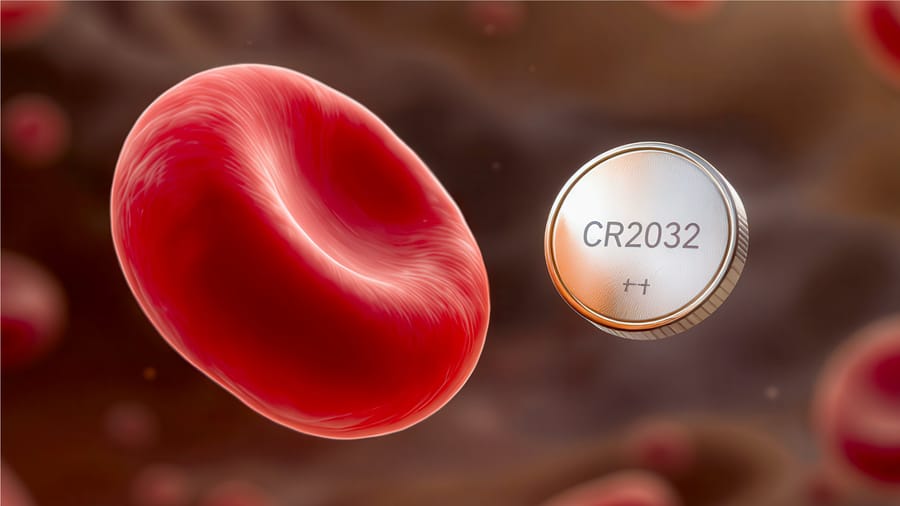
Bigger batteries take longer to charge. Right? We charge our phones in under an hour, and leave the EV plugged in overnight. But what if today's batteries are the exception, not the rule? Researchers in Australia just built and tested a battery that turns everything we thought we knew about them upside down. The larger they made it, the faster it charged.
You've heard of quantum computers, well this is a quantum battery. By operating at a quantum scale this battery juices up super-fast in a “super-absorption” event.
And it gets weirder. The scientists who made this quantum battery, the very first, didn’t even charge it with electricity. They charged it with light. From a laser. It’s the kind of breakthrough that could revolutionize how batteries get built, and what they can do.
So, how do quantum batteries work? And are they just a laboratory curiosity? Or might we someday see them in our phones or cars?
I talk a lot about the future of batteries … like a lot a lot. What can I say, battery talk just charges me up. But usually when I talk about the future of batteries, I'm talking about changes to battery chemistry. Like the potential shift to solid state batteries (which is a shift we're still waiting on).
Quantum batteries go further than chemistry. We're talking about a revolution in battery physics.
A battery that charges more quickly the larger it is? It's the kind of weird I can't leave alone. What's next, a car that goes more forward the faster it goes backward? It kind of breaks my brain.
Dr James Quach, from Australia's national science agency CSIRO, built this proof-of-concept quantum battery with help from the Royal Melbourne Institute of Technology, RMIT. It does a full battery cycle; it charges, stores energy, and discharges.1
But that’s where the normal battery behavior ends. Instead of juicing it up with electricity, researchers used what physicists call “quantum effects” to charge it in a flash using light from a laser.2
That sounds like the sci-fi dream of remote charging: energy beamed in from a distance with no need for a cord or even a charging pad. Quach told the Guardian,1
Once the technology matures … you would no longer need to stop your car at a petrol station to charge it up; you could charge it on the go.
I don’t know if that, or some version of it, will ever happen. But I want to find out why a physicist thinks it could. To do that, we need to answer a simpler question: what exactly is a quantum battery? And how does it charge all at once?
Quantum Tantrum
First off: we gotta clear up just what is meant by the quantum realm. The real one, not the one Marvel execs keep sending Paul Rudd to. Down at the scale of atomic and subatomic particles, things get very weird, and the classical laws of physics aren’t enough to explain what's happening. Those laws can tell you exactly how a ball will fall, but they can’t predict what a single electron will do. For particles that small, we’ve got a whole other handbook, called quantum mechanics.3
A quantum is the smallest whole unit that can interact, like a single photon, which is a single quantum of light.4
In atoms, electrons gain or lose energy in whole units called quanta, too. Hit an electron with a photon and the electron’s energy climbs up a quantum or two, like taking steps up a ladder. The electron always lands with its foot on a specific rung, never in between.4
And there’s something funny about the ways these quanta of light and matter behave.3 Instead of acting individually, they can behave “collectively,” as a system. And these “collective effects” are why quantum batteries can charge faster when you add more storage units.5
Quach explains it this way,5
Let’s say your quantum battery has N storage units, and each unit takes one second to charge. Collective effects mean that if all units are charged at once, each unit will take only 1 ∕√N seconds to charge.
1 ∕√N means that each time you double the units, you cut charging time by another 30%. That’s nuts.
That happens because the energy states in the storage units of quantum batteries are entangled.
I think of entanglement like the synced-up movements of dancers in a flash mob. If you know what one dancer is doing, you probably know the dance move of the next guy over.
In a quantum battery, the energy levels of electrons can get synced up, or entangled, too.6 If one storage unit is jumping to a higher energy state, they probably all are, in a super-fast-charging event.
And this is more than theory. Quach demonstrated these collective effects in his first quantum half-battery in 2022.5 Which half? The charging part. The fun with lasers.
Working with a team in Italy and the UK, Quach used ultrafast laser pulses to bump the battery’s storage units from a low-energy ground state to a higher-energy excited state.75 Those storage units were molecules of a dye called Lumogen-F Orange, which jumps from a low to high energy state as it absorbs photons, and sounds more delicious than it probably tastes. Although actually, it looks like it tastes pretty good too. 8
In theory, the more dye molecules you put in the battery, the faster it charges, thanks to collective effects.79 That’s the exact theory Quach’s team set out to test.
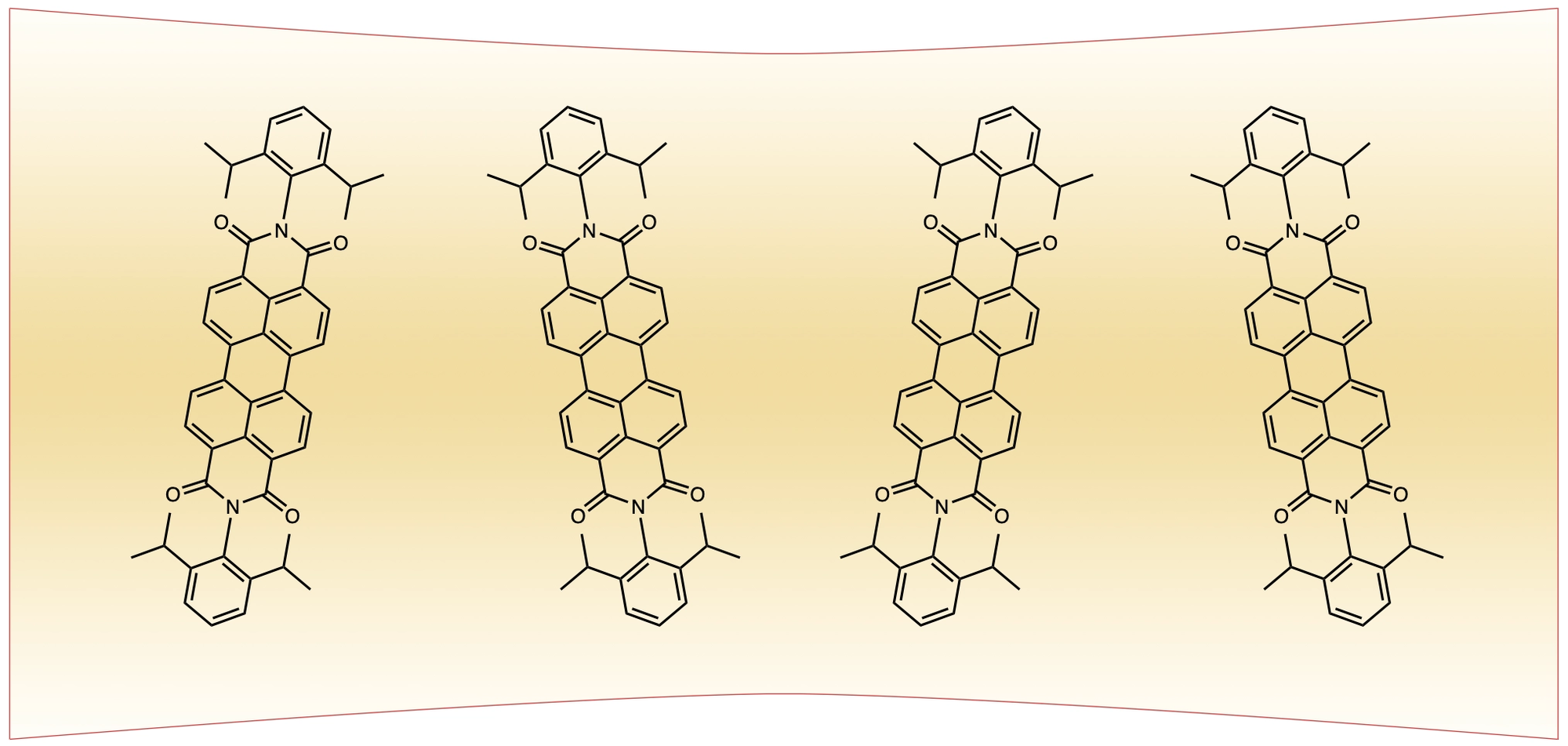
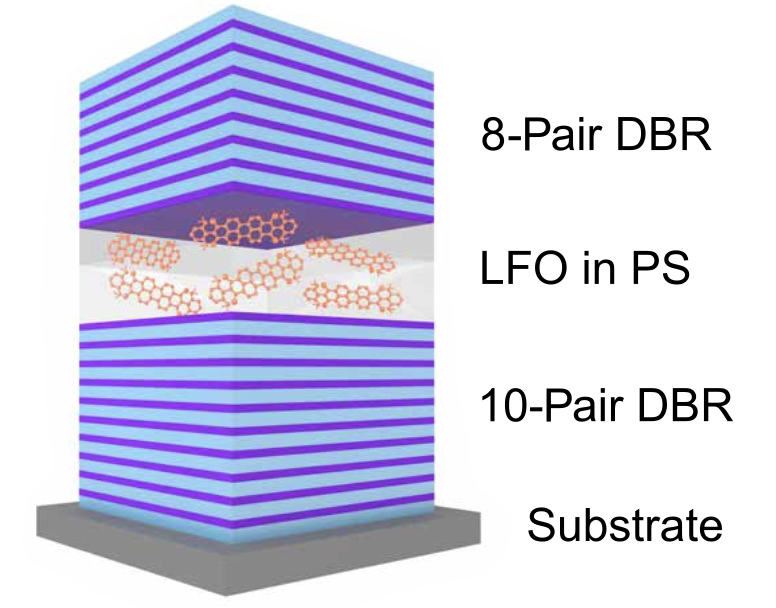
To build the battery, the team embedded dye molecules in a resin inside an optical cavity with special mirrors on the top and bottom that trap the photons inside.10711
By testing different concentrations of dye in the cavity, Quach was able to show that charging sped up when more dye was packed in.10
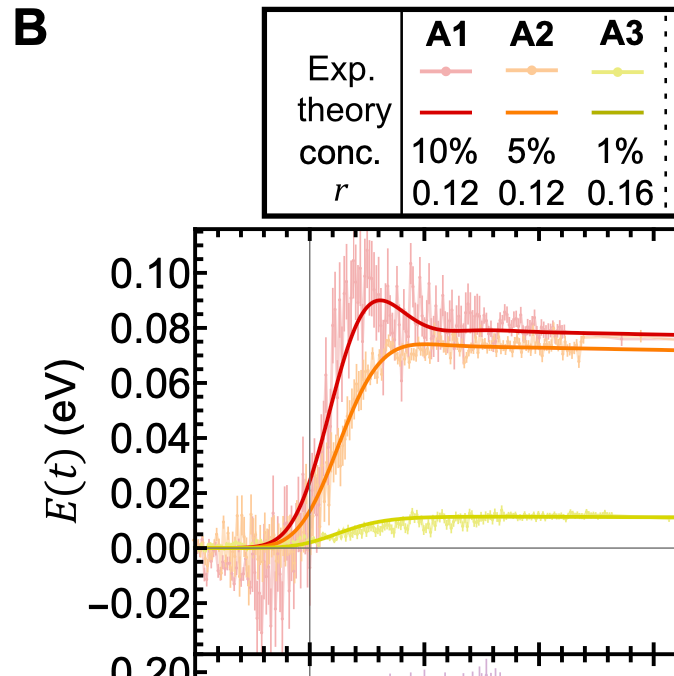
Those orange and red lines? They’re superabsorption. Super-fast charging. The exact pay-off scientists hoped for. But that battery? It’s tiny. How much energy did it even hold? We’ll get to that.
But even if it's small, and very strange, this quantum battery does what a battery should. It charges, stores energy and discharges electricity.
To make it, they needed more than just an optical cavity. They needed a full battery sandwich, with conductive layers that can convert stored energy into electrical current.5
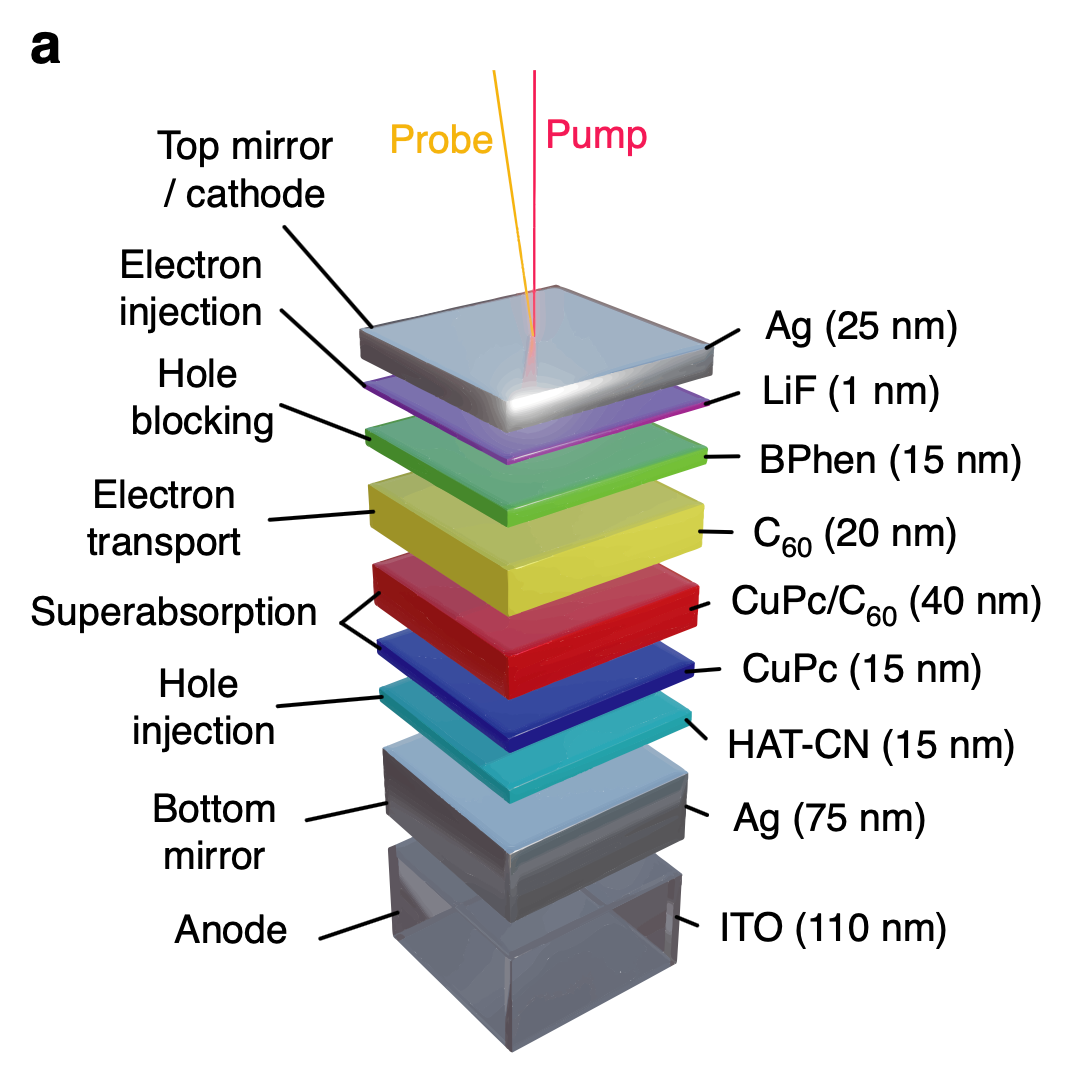
I’m so hungry for lunch, I could swear that’s lettuce, cheese and ham in that sandwich. But the middle bits are a dye called phthalo blue (CuPc).912 Quach's team switched to pthalo blue for this full quantum battery because its excited state is even longer-lived; it lasts about six orders of magnitude longer than the pulse of light used to excite it.9 That’s a million times longer! Which sounds fantastic …. until you find out just how long the charging pulse lasted.
Here’s the part the quantum scientists never predicted: remember how the quantum battery charged faster as it got bigger? Well, it discharged faster, too.9 And the ability to push energy in or out super-fast means these batteries could store a lot of energy and deliver a lot of power.13
Might. Someday. But today, a phone battery holds around 10kJ of energy. This quantum battery prototype holds less than a nanojoule.75
Turns out, there’s an upper limit to how much dye they could pack into the optical cavity. Too much and the dye molecules stopped supercharging with their neighbors and started blocking each other, in little quantum backyard disputes. But Quach’s team already has ideas for other dyes that might play better with others.7109
And although the battery held its charge six orders of magnitude longer than it charged, we’re talking about incredibly short timescales. The battery took femtoseconds to charge (quadrillionths of a second). And the energy was stored for just nanoseconds.1 That’s not long enough for a proper telephone call unless, of course, it’s a telemarketer on the line.
So we’ve got, on the one hand, the world’s first full-cycle quantum battery. On the other, it holds hardly any energy for hardly any length of time. I’m feeling Schrodinger’s excitement; I’m simultaneously in total awe and total meh.
But for a wild new battery design that was only proposed in 2012, the progress is impressive:14 one decade to prove the charge mechanism works, and just a few more years to build a whole actual battery.109
So how close are we to putting quantum batteries in actual devices?
Quach doesn’t think quantum batteries are set to replace traditional batteries in everyday electronics anytime soon.7 He says the next steps are scaling up the battery’s size and lengthening the amount of time it holds a charge.5 One way researchers are looking to increase storage time is to stack materials: one that superabsorbs light and another that can hang onto the energy for much longer.15
Quach’s teammate James Hutchinson at the University of Melbourne… told Live Science he expects quantum batteries to one day have even a higher energy density and greater durability than today’s batteries, on top of super-fast charging.13 Whether they'll ever hold their charge long enough to be the battery in an EV is an open question.
Laser remote charging is, surprisingly, plowing ahead. Just last year, we saw the US military's advanced research agency, DARPA, use an infrared laser to beam energy to a spot more than 5 miles away. They transmitted 800W of electricity in under a minute to a receiver made of solar panels at a distance of 8.6km.16
So as skeptical as I am that we’ll be charging our drones or EVs on-the-go with lasers… we’re kinda already on the way. Sometimes science advances slowly and sometimes … it beams down out of thin air.
But long before quantum batteries show up in cell phones or EVs … again, if they ever do … we might see them in quantum computers and quantum sensors first.57 That’s because quantum batteries could be built right into quantum computers, and even entangled with the qubits that do the calculations.17
- The Guardian – Is this the world’s first quantum battery? Australian scientists say so ↩
- Science Daily – World’s first quantum battery could enable ultra fast charging ↩
- Wikipedia – Quantum Mechanics ↩
- Wikipedia – Quantum ↩
- The Conversation – A world‑first quantum battery charges faster when it gets bigger – but it’s tiny and only lasts nanoseconds ↩
- Wikipedia – Quantum Entanglement ↩
- Nature Reviews Physics – Opportunities and challenges of quantum batteries ↩
- Polytechnique insights – Quantum batteries: rethinking energy storage is possible ↩
- Light: Science and Applications – Superextensive electrical power from a quantum battery ↩
- Science Advances – Superabsorption in an organic microcavity: Toward a quantum battery ↩
- Physics World – Quantum batteries harvest energy from light ↩
- Wikipedia – Copper phthalocyanine ↩
- Live Science – Quantum battery charges in a quadrillionth of a second with a laser — larger prototypes could last for years after charging for just a minute ↩
- arXIv – Extractable work from ensembles of quantum batteries. Entanglement helps. ↩
- Advanced Materials – Quantum Batteries: A Materials Science Perspective ↩
- Notebook Check – Wireless electricity transmission achieves a new milestone: The longest distance to date ↩
- Physical Review X – Powering Quantum Computation with Quantum Batteries ↩