You're listening to me right now through speakers run by magnets. Your smartphone might have another 18 of them.1 They're in your earbuds, your car, the wind turbines feeding the grid. And most of us never think about them until the supply chain breaks.
China throttled rare earth exports last year. That squeezed the raw materials behind the most powerful magnets on Earth that help make our world go ‘round.
But there’s a new magnet in town. One potentially as powerful as neodymium rare earth magnets but made with only iron and nitrogen. Yup, two of the most abundant elements on Earth. The ground has already been broken on the Niron factory that’ll make them at scale in Minnesota.
Just to the south at the Ames National Laboratory in Iowa, scientists are inching closer to an alternative to the samarium-cobalt rare earth magnets used in hot motors. It’s made from abundant manganese and bismuth and, bizarrely enough, becomes more dependable the hotter it gets.
So, how do these stack up against the magnets we use today? And is this the beginning of the end for rare earth magnets? Or a sign of how hard they’ll be to replace?
There’s a reason magnets show up in so much of the tech I cover on this channel. They help turn electricity into motion to drive our EVs. They also do the reverse, turning motion into electricity for the grid.2 Magnetic bearings, magnetic cooling, … we need magnets.
When engineers need maximum magnetic force in a tiny package, they reach for a magnet that’s as strong as possible for its size, one made with rare earth elements like neodymium or samarium.3
And that’s a problem.
Despite the name, rare earth elements are pretty common. What’s rare is getting them out of China as easily as we used to. From mining to processing to finished magnets, China spent decades undercutting global markets to build a near-monopoly across the rare earths production chain.4567
Then in 2025, when the US placed new tariffs on Chinese goods, China retaliated by imposing new controls on rare earths and magnets, making companies worldwide apply for licenses to ship them abroad. Magnets are still flowing, but export licenses sometimes require information companies usually treat as industrial secrets, and exports tied to military uses are getting blocked.849 That’s left manufacturers scrambling, from Japan and Korea to Europe and the United States.1011
The question is … can we make powerful magnets without rare earths? Turns out, the answer may be Yes. A new magnet made from just iron and nitrogen could be the most powerful magnet ever.12 And another, made from manganese and bismuth, gets more dependable as it heats up, where rare earth magnets start to weaken as temperatures climb.13
So, are these drop-in replacements for rare earth magnets? And just how soon will we find them in our ear buds, car motors, or MRI machines? Before we look at these questions, we have to answer, how is this new iron-nitride magnet any different from the old school ferrite magnets that struggle to hold a single photo to the fridge door?
They’re both made with iron, but that’s about where the similarities end. Because iron nitride magnets are iron and nitrogen precision-engineered into a delicately-balanced crystal lattice I’m still wrapping my brain around.
University of Minnesota professor Jian-Ping Wang figured out how to reliably synthesize it about 15 years ago.114
Wang told Design World that before that,15
“Almost nobody thought these magnets could be made.”
and
“Its magnetism couldn’t be explained by any existing theory.”
Today, a University of Minnesota spinout, Niron Magnetics, is commercializing iron nitride magnets.
The secret to the magnet’s strength is distorting the iron crystal lattice in just the right way, then stabilizing that distortion with nitrogen atoms.161512 Wang calls it strain engineering.15 It’s a little bit like locking a rubber band in a stretched position, but instead of storing potential energy, that distortion locks in incredibly strong magnetism.17 The catch is that this only works in a very narrow sweet spot. Push the structure too far, and the magnetism you were trying to lock in starts slipping away.
One way to measure a magnet’s strength is flux density, measured in tesla. Top neodymium magnets are around 1.3-1.4 tesla. According to Niron’s CEO Jonathan Rowntree, pure, perfect iron nitride could theoretically reach 2.4 tesla. That’s nearly twice as high.
Rowntree told Twin Cities Business,12
“Now, we haven’t fully extracted all that power yet. We’re already above 1 tesla… We’ve only unlocked 40% of its potential.”
At 1 tesla, Niron’s magnets still sit below top neodymium magnets. But they’ve still got 2–5x the flux density of ferrite magnets.18 Niron says that’s plenty enough for a lot of consumer electronics and robots, plus electric vehicles and some industrial motors, too.191220
That may be enough of a tradeoff for a magnet that lets us pivot away from rare earth mines and their toxic, radioactive waste.21 The iron in these magnets comes from cheap, abundant iron salts that are a byproduct of steel-making.12
Niron’s big claims have led to big investments. The company has now secured $150 million in development funding, including from car manufacturers like General Motors and Stellantis, plus hard-drive maker Western Digital.2214
They’ve broken ground on a first commercial plant in Minnesota, aimed at producing 1,500 tons of magnets each year starting in 2028.231 They’re already eyeing a second site for a 10,000 ton plant.24 That’d cover a significant chunk of the about 40,000 to 50,000 tons of rare earth magnets the US uses each year.1225
So, rare earth magnets will be obsolete in just a few years, right? Not exactly.
Strength alone doesn’t make a magnet useful. For motors especially, magnets must also stubbornly maintain their sense of direction. That’s because the magnets on the rotor are constantly tugged at by the forever-rotating magnetic field inside the stator. Those sideways and opposing forces can twist a magnet’s internal compass, causing it to slowly demagnetize. When that happens, the motor slows down and loses power.2627
A magnet’s resistance to having its polarity twisted is called coercivity. And iron nitride magnets? They have less than half as much coercivity as neodymium magnets at room temperature.2616 That puts a big question mark on whether iron-nitride magnets could work as drop-in replacements for the neodymium magnets in the most compact and powerful motors.28
Some in the industry are even questioning whether iron nitride can really be considered a “hard” permanent magnet, or whether it’s at best “semi-hard.”16 Doping the crystal with tiny amounts of other atoms might help pin that magnetism in place.15 But until Niron releases full demagnetization curves, we won’t know how well they’ve solved the coercivity problem.
What the available data do show is that, as temperatures rise, neodymium magnets lose their coercivity pretty fast where iron nitride’s coercivity stays steady.2926 Niron says that at operating temperatures, iron nitride is still pretty competitive.26 And for many magnet applications, like speakers, lower coercivity isn’t such a big a deal anyways.30
That's the good news. The catch is that the theoretical 2.4 tesla is for a perfect crystal, and building dense, bulk magnets that actually hit those numbers is still an unsolved manufacturing problem. In the Patreon extended cut of this video, we dig into why.
Then there’s the question of whether iron nitride magnets will ever achieve those 2.4 tesla. Niron’s biggest claim is that their magnet could widely replace neodymium. Their CEO Jonathan Rowntree told Twin Cities Business,12
The magnets we’re producing today can replace about 2/3 of the rare earths magnets that are out there in terms of performance. In a few years it’ll be more like 80-90% and a few years after that hopefully, you know, 100% as we continue to improve the performance of our technology.
![[^JMMM] energy density (BH) of permanent (hard) magnets as room temp.](https://undecided.tech/content/images/2026/07/jmmm-energy-density-bh-of-permanent-hard-magnets-as-r.png)
Remember how iron nitride’s crystal lattice has to be distorted oh-so-perfectly to lock in all that magnetism? That same futzy structure is also its weakness. It’s metastable, which means it can hold that high-energy arrangement for a while, but heat and time can nudge it toward a more stable, less magnetic state.32 Think of it like a slap bracelet. It can stay stick straight for years. But slap it, and it snaps into the lower energy shape it wanted all along.
Metastable magnets are the same. They can stay strongly magnetic for years. But heat them up to near 200°C, or about 400°F, and they can start to lose nitrogen atoms as nitrogen gas.28163334 And a bit of the magnet’s strength floats away, too.
Iron nitride’s theoretical 2.4 tesla is for a perfect crystal lattice.12 But the strongest, densest magnets are made using high-pressure and high-heat sintering, which could destabilize the iron nitride crystal.
Niron is still ironing out their manufacturing method.12 Last I heard, they’re making first-generation magnets by mixing magnetic powder with a polymer, with plans to nail down a “cold” sintering technique for future generations.26 Industry critics point out that making a fully dense magnet at low temperatures would be a real engineering feat.1628
If bulk iron nitride magnets ever reach their theoretical maximum strength, and the jury is out on that, it probably won’t happen in the next few years. But the commercial bar may be lower than perfection. If Niron can make magnets that are good enough, cheap enough, and available outside the rare earth supply chain, some manufacturers may be willing to redesign around them.
So will iron nitride magnets be a drop-in replacement for neodymium magnets? Not anytime soon.
Their strength just isn’t quite there yet. And their coercivity and other parameters are different enough that motors need to be designed around the magnet’s limitations.26 That’s exactly why companies like General Motors and Stellantis are getting in on this already, to begin designing and testing motors that can use these rare-earth-free magnets.26
In the meantime, this magnet does seem to have a place in the market, right inside the giant gap between budget ferrites and high-performance neodymium magnets.35
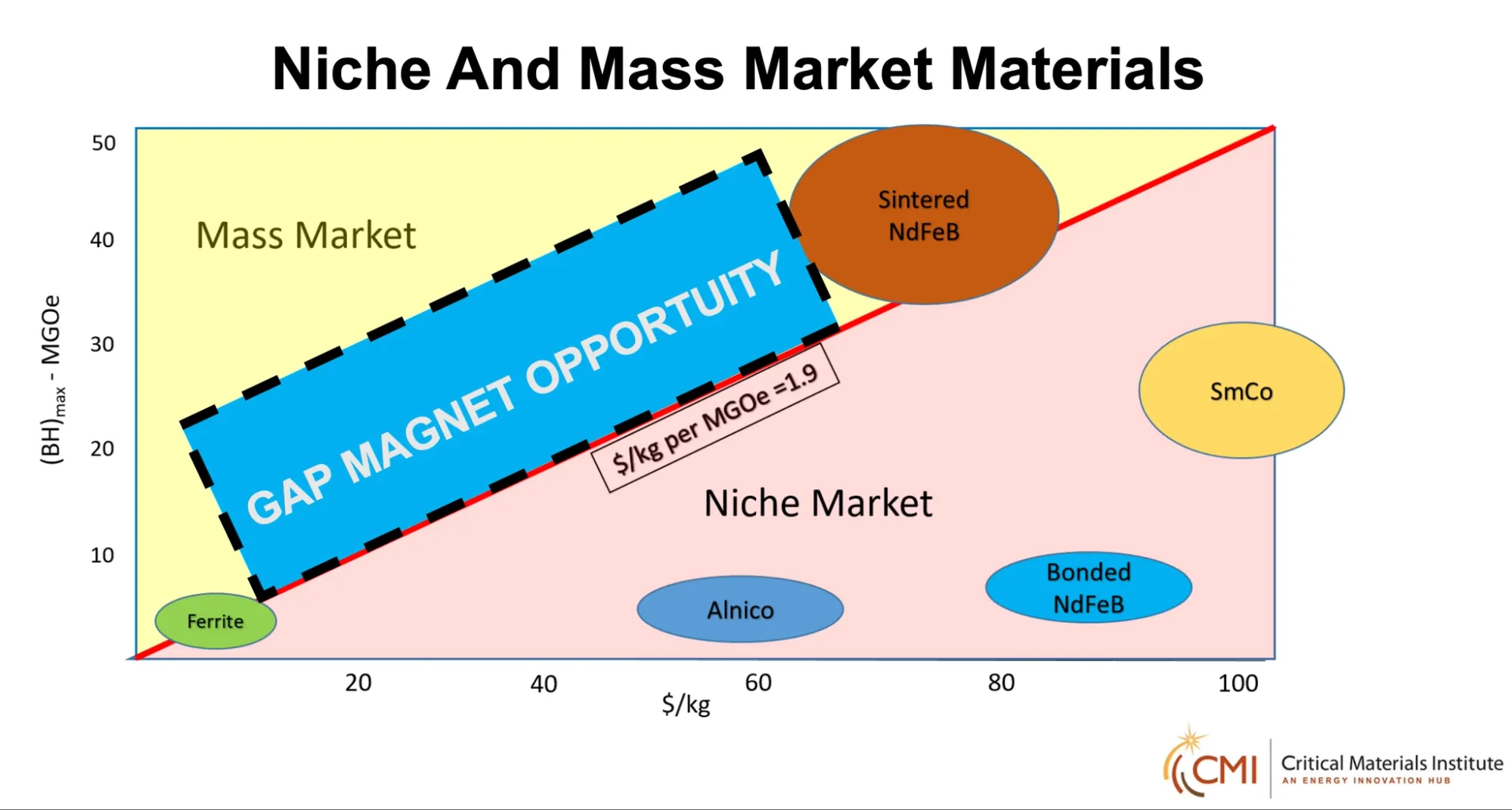
Both are mass market magnets because of their pretty compelling strength-to-price ratios. That’s in comparison to niche magnets like the current hot shot for high heat applications, samarium cobalt (SmCo). Niron just has to make magnets strong enough and cheap enough to land in that gap, and they might attract a sizeable chunk of the mass market.
That’s because neodymium magnets are often used in applications that don’t require nearly their full strength, applications that just need more oomph than ferrite can provide.2 For these applications, iron nitride could be a no-brainer.
That’s devices like these YG Acoustic loudspeakers, which just debuted with Niron magnets.36 Or this electric motorbike prototype by India’s MATTER, with Niron magnets in its variable-flux motor.37
Iron nitride is powerful enough to take some of the pressure off rare earths. For applications that need even harder magnets, there’s good news: another player has entered the magnetic field. It’s a rare-earth free magnet that is highly coercive. In fact, this one gets more coercive as it heats up.13
It’s made from manganese and bismuth (MnBi), and when temperatures rise to about 120ºC (or about 250ºF), it becomes nearly twice as resistant to losing its magnetism than at room temperatures.13 That’s because heat changes its crystal lattice in a way that makes it an even better magnet.15 I just find that so cool.
Manganese bismuth magnets are being developed by a team led by Dr. Jun Cui at the Ames National Laboratory in Iowa.13 They’re not quite as strong as neodymium magnets or even those hot shot samarium ones. But they might still be perfect for an emerging motor class called permanent magnet-assisted synchronous reluctance motors (PMa-SynRM). Say that five times fast … I’m surprised I could say it once. In these motors, the magnet’s brute strength matters less than its coercivity at high temperatures.3839
That’s the takeaway for me: iron nitride and manganese bismuth don’t have to be drop-in replacements for rare earth magnets. Manufacturers are scrambling for new magnet options free of rare earths. Some are happy to design their products around new magnet specs. And in the case of manganese bismuth, its unique specs may even help a new motor technology gain traction.
But neither of these rare earth-free solutions happened overnight. They’re both the result of decades of investment in pie-in-the-sky materials that happened to pay off. And those investments were made long before a trade war squeezed rare earths.
That’s the part I keep coming back to. The solutions we need in a crisis usually come from research that looked impractical years earlier.
- Wall Street Journal – Does the World Need Chinese Rare Earths? Not Necessarily, Say These Companies ↩
- Ceramic Materials - Present and Future – Ceramic Materials - Present and Future ↩
- Wikipedia – Rare Earth Magnets ↩
- BBC – Why the US needs China's rare earths ↩
- Intereconomics – Rare Earths in the Trade Dispute Between the US and China: A Deja Vu ↩
- Foreign Policy – Why Rare Earths Are About to Cost a Lot More ↩
- Wikipedia – Rare earth industry in China ↩
- Chatham House – On ‘liberation day’, President Trump revealed America’s strategic vulnerabilities ↩
- Renewable Matter – RESourceEU, 3 billions for Made in Europe critical minerals ↩
- Center for Strategic and International Studies – China’s New Rare Earth and Magnet Restrictions Threaten U.S. Defense Supply Chains ↩
- Chatham House – China’s new restrictions on rare earth exports send a stark warning to the West ↩
- Twin Cities Business – How Niron Magnetics Plans to Build a Global Magnet Giant in Minnesota ↩
- AMES National Laboratory – Scientists develop rare earth free magnet for use in industrial motors ↩
- University of Minnesota – University of Minnesota startup reinvents permanent magnets for a sustainable future ↩
- Design World – The coming revolution in high-strength magnets ↩
- Magnetic Society – Fe₁₆N₂: Hype, hope, or heavy hitter? A critical review ↩
- ElectroPages – Rare-Earth-Free Magnet Could Reshape Global Supply Chains ↩
- Stanford Magnetics - What’s the Difference between Neodymium Magnets and Ferrite Magnets ↩
- University of Minnesota – University-born startup’s Clean Earth Magnet named a TIME magazine best invention of 2023 ↩
- Niron Magnetics – Applications ↩
- Yale Environment 360 – Boom in Mining Rare Earths Poses Mounting Toxic Risks ↩
- Crossing the Valley – The $150M Bet on American Magnet Independence ↩
- Niron Magnetics – Niron Magnetics Changes Game by Breaking Ground on Rare-Earth-Free Magnet Facility ↩
- Niron Magnetics – Niron Magnetics Advances U.S. Permanent Magnet Manufacturing Plans ↩
- New York Times – How Japan Built a Rare-Earth Supply Chain Without China ↩
- E-mobility Engineering – Freedom from rare earth magnets? ↩
- EMWorks – Demagnetization in PMSM Rotors: Understanding the Causes and Preventing Performance Loss ↩
- SDM Magentics – Iron Nitride Magnets: A Realistic Perspective on the Recent Hype ↩
- University of Minnesota – Environment-friendly bulk Fe16N2 permanent magnet: Review and prospective ↩
- Bloomberg Originals – The Hunt for a New Kind of Magnet to Power the Future | Bloomberg Primer ↩
- Journal of Magnetism and Magnetic Materials – Environment-friendly bulk Fe16N2 permanent magnet: Review and prospective ↩
- Wikipedia – Metastability ↩
- Technical University of Darmstadt – Iron nitride Fe16N2 : intrinsic properties, synthesis, stability and bulk magnets ↩
- AIP Advances – Theoretical study of thermal stability range of α″–Fe16N2 within the iron nitride binary phase diagram ↩
- Magnet Applications – Rare Earth Magnets: Yesterday, Today And Tomorrow ↩
- Niron Magnetics - YG Acoustics, Scan-Speak and Niron Magnetics Debut World’s First Loudspeakers Powered by Rare-Earth-Free Iron Nitride Magnetics at High End Vienna ↩
- Niron Magnetics – MATTER and Niron Magnetics Unveil Next Generation Rare-Earth-Free Variable Flux Motor ↩
- Ames National Laboratory – A new kind of magnet for industrial motors | R&D 100 Winner ↩
- Nature Reviews Clean Technology – Advances and Challenges of Permanent Magnets for Advanced Technologies (in press) ↩