When we talk about the circular economy, we picture batteries stripped for their metals, factory floor scraps spun into sweaters, and agricultural waste transformed into biogas. We don’t picture mucking out the barn to collect material for surgical masks and food packaging.
Engineers are constantly looking for ways to take waste streams and turn them into profit. Recent developments have made this literal: waste, yes, that waste, may be used in new household products. Cow manure is on its way to a new kind of field. It’s now possible to spin it into high-tech, biodegradable plastics and textiles or use it as glue inside lithium battery electrodes. And as for the urine we send down the drain, it might someday help build our cities with better concrete.
You could say that researchers in Germany, the US, and the UK are engineering new ways to let number one and number two finally live up to their names. So, is this the next leap in sustainable design — or just a steaming pile of hype? And how close are we to building a cleaner, greener future from human and animal waste?
There are some really interesting advances in the realm of putting waste to work in plastics, building materials, and even batteries that I’m going to get into. Before getting into those, it shouldn’t be too surprising that this is a thing. If you wanted to make a bang in the 1800s, you’d mix urine and manure in a compost heap and extract saltpeter for gunpowder.1 Need to dye cloth a bold red? You’d fix the pigment with pee.2 Run out of firewood? You’d burn dried dung to cook your meal, the same way humans have since the Neolithic period.3
Waste doesn’t have to be waste.
Today, the compost pile has been replaced by chemical plants, which generate nitrates, ammonia, and carbon-based materials through energy-intensive processes. Modern chamberpots flush to waste treatment centers and cow manure can’t even get a lift to the fields.
Less than 8% of US cropland got any manure in 2020 because chemical fertilizers are cheaper to transport and easier to apply.4 That means most of the 1.4 billion tons of cow manure generated in the US each year5 are piled up or stored in open lagoons, releasing methane, ammonia, and other pollutants into the environment.67
But what if cow patties could replace petrochemicals in plastics and synthetic textiles?
Cow Pie Bioplastics?
Plastics are just polymers, chains of carbon-based molecules that can be manufactured with a variety of shapes and levels of flexibility8 — kind of like one of the biggest components of cow pies: cellulose.7
Cellulose is the most abundant natural polymer on Earth and forms the structural backbone of plants.9 It consists of linear chains of thousands of sugar molecules linked together, forming a stiff, carbon-based skeleton.10 These chains bundle together into microfibrils within plant cell walls, giving them incredible tensile strength. It’s this strength that’s made wood a choice material for homes, ships, tools, and more for centuries.
Today, wood is pulped to extract cellulose for far more than paper and cardboard. Cellulose puts the cell in cellophane, that crinkly, transparent wrap around food. It’s wallpaper paste, the sponge on your kitchen sink, anti-caking agents, and fillers in prescription pills. In medicine, it’s used for wound dressings and as scaffolds for growing new tissue.9 I recently shared a biodegradable battery that uses cellulose to absorb electrolyte and separate anode and cathode layers.11 You might even be wearing cellulose right now: rayon, viscose, and lyocell are all made with cellulose spun into smooth, wearable fibers.10 And unlike plastics, cellulose is biodegradable. Because as tough as cellulose is, its sugar backbone can be broken down by bacteria and fungi in the compost heap.
All this cellulose comes at a cost…in the form of trees. Over 200 million metric tons of wood are pulped each year12. Yes, trees are renewable, and paper is recyclable, but rising global demand still contributes to deforestation.13
Pulping isn’t the most eco-friendly process. After trees are felled, they’re sent through wood chippers into hot, pressurized chemical baths. If you have ever passed a papermill, you never forget the smell of this stinky process. Most of the world’s cellulose is extracted using the Kraft process, which relies on sodium hydroxide and sodium sulfide to strip cellulose from other plant matter.14 Some of that sulfide escapes as sulfur dioxide, a major air pollutant and contributor to acid rain.15 Plus, if you’re aiming for high-performance cellulose — like the nanofibers used in advanced textiles or composites — you’ll burn a lot of energy shearing that pulp down to nanoscale threads.16
Or…you could just ask a cow. She might look like she’s just standing there, chewing her cud. But she’s right there running a cellulose processing plant in her gut, with fermentation outsourced to microbes that break down plant matter into small fibers, including cellulose nanofibrils.17
These fibers are tiny — just 5 to 60 nanometers wide — but they can run hundreds of times longer, stretching several micrometers.167 That high aspect ratio gives individual cellulose nanofibrils exceptional mechanical properties, with a tensile strength exceeding 2 gigapascals and a stiffness approaching that of steel.7
These are the strong, flexible, yet biodegradable fibers now being spun into high-performance plastics. And instead of pulping new trees, researchers at University College London and Edinburgh Napier University developed a new method to extract quality nanocellulose fibers from nature’s unlikely care package: the cow pie.7
The team mixed sodium hydroxide and sodium hypochlorite (AKA bleach) with powdered cow manure from a local farm to strip away proteins, fats, carbs, and other plant matter. What remained was mostly cellulose, which they blitzed into a smooth white slurry that looks an awful lot like milk.7 But trust me: you don’t want to put this in your cereal.
To turn cow goo into bioplastics, the researchers invented a spinning method your great-great-grandmother wouldn’t recognize. It’s called nozzle-pressurized spinning, or NPS, and it’s a twist on the fiber-spinning method used to make fabrics like lyocell.187 Dried cellulose from cow manure is dissolved in a solvent and forced through tiny nozzles mounted on the side of a chamber rotating at 12,000 revolutions per minute. That high-speed rotation aligns the fibers as they shoot into a water bath just one centimeter away, where the solvent is rinsed out and the cellulose stabilizes into long, continuous threads. As the team stepped up the amount of cellulose in the slurry, they went from producing thin films, to ribbons, to full-on fibers, each with its own applications in bioplastic manufacturing.
By skipping the pulping process entirely and starting with manure, these cow pie plastics are poised to save energy, chemicals, and cost. This could make bioplastics cheaper, cleaner, and more circular than ever.7
Yes, cleaner plastics from poo. Somehow, extracting cellulose from actual poo is less smelly than industrial pulp processing.
Cow Pie Batteries?
Plastics aren't the only everyday objects that can be made from cow pies. More sustainable batteries are also possible. Evermore Technologies, headquartered in New York City, has turned cow dung into a binder for the composite silicon-carbon anodes in their lithium ion batteries.19 Binders are tricky in silicon-based electrodes, since silicon expands dramatically — by more than 300% in volume —when lithium ions enter during charging.20 Evermore says their dung-based glue binds the anode materials strongly, but flexibly, helping to minimize damage as the battery charges and discharges.
To make it, dung from grass-fed21 cows is turned to char in a high heat furnace, pulverized, mixed with silicon, then coated with graphite and polymers.19
By sourcing the binder from waste and skipping synthetic materials, Evermore aims to cut both emissions and cost, while still delivering a high-performance battery.1921 The company is reporting an initial Coulombic efficiency over 92%, more than 95% capacity retention after 500 cycles, and a specific capacity of 1500 mAh/g.[EVM] These batteries may be full of it, but if those specs aren’t bull, they could take flight in drones as early as next year.21
Another big piece of the sustainability puzzle is construction.
Pee Cement?
Most of the population is concentrated in concrete jungles, where concrete is simply Portland cement mixed with sand and gravel to form concrete.22 Over 4 billion tons of cement are poured each year, generating about 8% of the world’s annual carbon emissions.23
That’s because cement is an emissions double-whammy. To make it, limestone, or calcium carbonate, is heated in kilns to around 1,450 C (or 2640 F), burning vast amounts of fuel and releasing CO2 in the process.2423 Inside the kiln, calcium carbonate breaks down into lime and CO2, directly emitting even more carbon.
The solution is to skip cement altogether and grow concrete using microbes. In a process called microbially-induced calcium carbonate precipitation, or MICP, microbes trigger a chemical reaction that locks up carbon dioxide with calcium, forming fresh calcium carbonate crystals.25 Not only does this process sequester carbon, it also avoids the energy-intensive kilns used to produce cement, making MICP a solid double in the carbon-saving game.
Now, researchers at the University of Stuttgart in Germany have brought it home by powering the whole process with waste. So what’s the surprising secret ingredient in this sustainable concrete? You may be relieved to hear… it’s urine.
The team at Stuttgart used ureolytic bacteria, which break down urea — the chemical that gives urine its name — into carbon dioxide and ammonia. Unfortunately, ammonia is what gives urine its smell. But fortunately, ammonia also raises the water’s pH, which shifts carbon dioxide into bicarbonate and carbonate. Add calcium and boom: calcium carbonate crystals spontaneously form.25
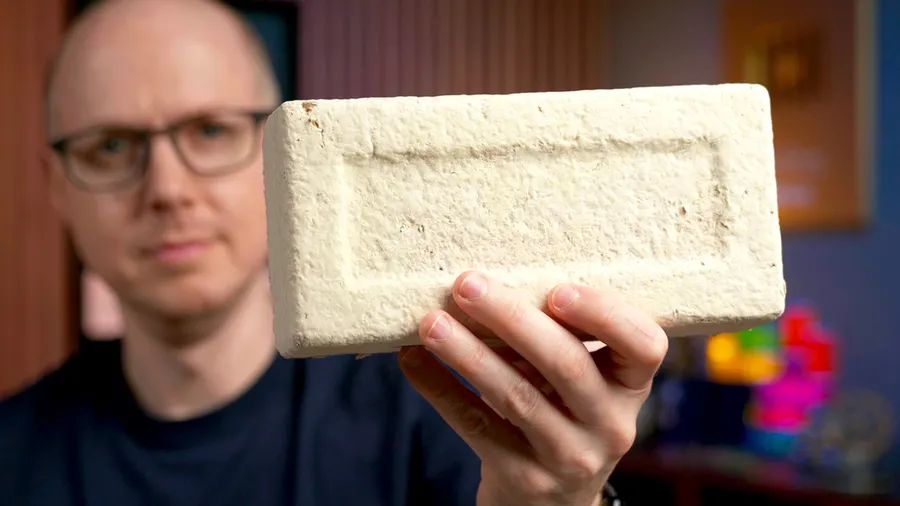
The team played three clever tricks to get the strongest MICP bricks ever made. First, they optimized the mix of small and large sand grains to reduce the space between particles, so less bio-cement was needed to fill the gaps and hold everything together. Second, they flushed fresh calcium and urine through this mixture every 4 hours during the 3-day growth period, keeping key ingredients circulating to ensure even cementation throughout the brick.24 Third, to avoid washing away the microbes with all that flushing, they pre-mixed the sand with a freeze-dried powder of bacteria embedded in larger calcium carbonate particles.25
It worked, forming a solid structure similar to natural calcareous sandstone24 with a maximum growth depth of 14 cm.25 When the team used chemical urea in loo of urine, they reached a compressive strength of 52.5 megapascals (MPa), significantly stronger than previous attempts at biomineralized concrete. With artificial pee, they reached 20 MPa. And with human pee, 5 MPa.24
So there’s still work to do before true waste streams can fully replace lab reagents, but researchers say a strength of 30 to 40 MPa would be enough for low-rise structures up to three stories. Next, the team plans to identify which parts of urine are slowing things down and how to leave them out.24
But where exactly are we going to get enough urine to make biocement commercially viable? Places with lots of people, like Stuttgart Airport in Germany. Or, you know, the ballpark. We might soon be returning to the days of ancient Rome, when urine was collected at public urinals and traded like any other raw material.2
Pee Hydrogen?
Back then, urine was liquid gold…for whitening togas.2 Today’s engineers are tapping it for something else: hydrogen gas.
The generation of so-called “green” hydrogen uses electricity from renewables like solar to split water into hydrogen and oxygen. But bottling sunshine as liquid hydrogen is expensive, especially compared to “gray” hydrogen made with fossil fuels.26
Still, as a fuel, hydrogen is about as green as it gets: its only exhaust is water. I covered a range of hydrogen breakthroughs in a recent episode27, but pee-powered hydrogen gas I did not see coming.
Researchers from the University of Adelaide in Australia 28 have figured out how to pull hydrogen straight from urine. Using urea to make hydrogen isn’t new, but manufacturing urea is energy-intensive and can release harmful nitrates and nitrites.26 This team engineered a platinum-based catalyst on a carbon support that extracts hydrogen directly from urine, without the usual corrosion issues caused by chloride ions in pee.
Instead of generating nitrates, their system produces harmless nitrogen gas, the same gas that makes up 78% of Earth’s atmosphere. Their process also uses between 20 and 27% less electricity than water-splitting technologies.26 Next, the team aims to replace the scarce and pricey platinum catalyst with something cheaper to make the technology viable at scale.
Any circular economy depends on capturing as many outputs as possible and feeding them back in as inputs. So maybe it’s not that surprising that what comes out of the back end of a cow — or down the drain of a urinal — is now being tapped for sustainable materials and manufacturing processes. Manure and urine are loaded with carbon, urea, and other compounds that can be re-engineered from problems into solutions.
- Joseph LeConte – Instructions for the Manufacture of Saltpetre ↩︎
- Smithsonian Magazine – From Gunpowder to Teeth Whitener: The Science Behind Historic Uses of Urine ↩︎
- Journal of Anthropological Archeology – Beyond identification: Human use of animal dung in the past ↩︎
- USDA Economic Research Service – Despite Challenges, Research Shows Opportunity To Increase Use of Manure as Fertilizer ↩︎
- USDA Agricultural Research Service – Animal manure production and utilization: impact of modern concentrated animal feeding operations ↩︎
- Wikipedia – Anaerobic Lagoon ↩︎
- Journal of Cleaner Production – Harnessing cow manure waste for nanocellulose extraction and sustainable small-structure manufacturing ↩︎
- Wikipedia – Plastic ↩︎
- Cellulose – An Update on Overview of Cellulose, Its Structure and Applications ↩︎
- Wikipedia – Cellulose ↩︎
- Undecided with Matt Ferrell – How This Battery Runs on Sugar… Seriously ↩︎
- Timberland Investment Group – Global Wood Pulp Market Structure and Dynamics ↩︎
- World Wildlife Federation – Pulp and Paper ↩︎
- Wikipedia – Pulp (paper) ↩︎
- Wikipedia – Environmental Impact of Paper ↩︎
- Wikipedia – Nanocellulose ↩︎
- Wikipedia – Ruminant ↩︎
- Wikipedia – Spinning (polymers) ↩︎
- Evermore – Product Catalog ↩︎
- Wikipedia – Lithium Silicon Battery ↩︎
- PV Magazine – Cow poop (and more) on the floor at Intersolar ↩︎
- Wikipedia – Concrete ↩︎
- Wikipedia – Cement ↩︎
- TechXplore – Bio-concrete from urine: Researchers develop sustainable building material ↩︎
- NPJ Materials Sustainability – High strength bio-concrete for the production of building components ↩︎
- Science Daily – Urine, not water for efficient production of green hydrogen ↩︎
- Undecided with Matt Ferrell – How a Hydrogen Breakthrough is Closer Than Ever ↩︎
- Nature Communications – Urine electrooxidation for energy–saving hydrogen generation ↩︎