With solar on your roof and a battery in your garage you can make your own power … today. But, there's one essential you can't make at home: water. Well, now there's a machine that can do just that.
It pulls drinking water straight out of the air, even air dry enough to give you a nosebleed. The material it uses to collect water is so revolutionary, its inventors just won the Nobel Prize.
This tech could bring water to places too far inland for seawater desalination, and to communities and backyards aiming for self-sufficiency.
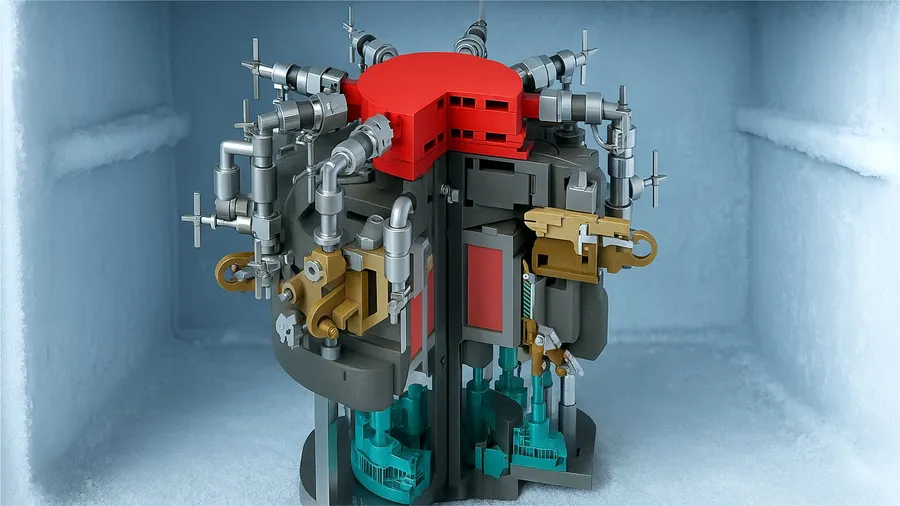
Inventor Omar Yaghi’s Southern California company Atoco makes an atmospheric water harvester the size of a shipping container. The company claims it can produce up to 4,000 liters of water a day. That’s over 1,000 gallons.
The potential here is massive, you might say oceanic.
But there are big questions: does it truly work in the driest air? Could you actually drink the water it makes? And can it beat the alternatives on cost?
Earth’s atmosphere contains more than six times the volume of water in all the world’s rivers.1 When it gets cold enough, water vapor condenses into liquid water and drops back down as rain or collects on the ground as dew. Atmospheric water vapor is constantly renewed as water evaporates off the oceans. Compared to what's available on the ground, it's inexhaustible.2
Down here, on the ground, freshwater is scarce. In places like the Southwest, the Mediterranean, and the Middle East, and even in humid places, like small islands, it's a real problem. Today, more and more communities are relying on desalination to meet their growing needs.3
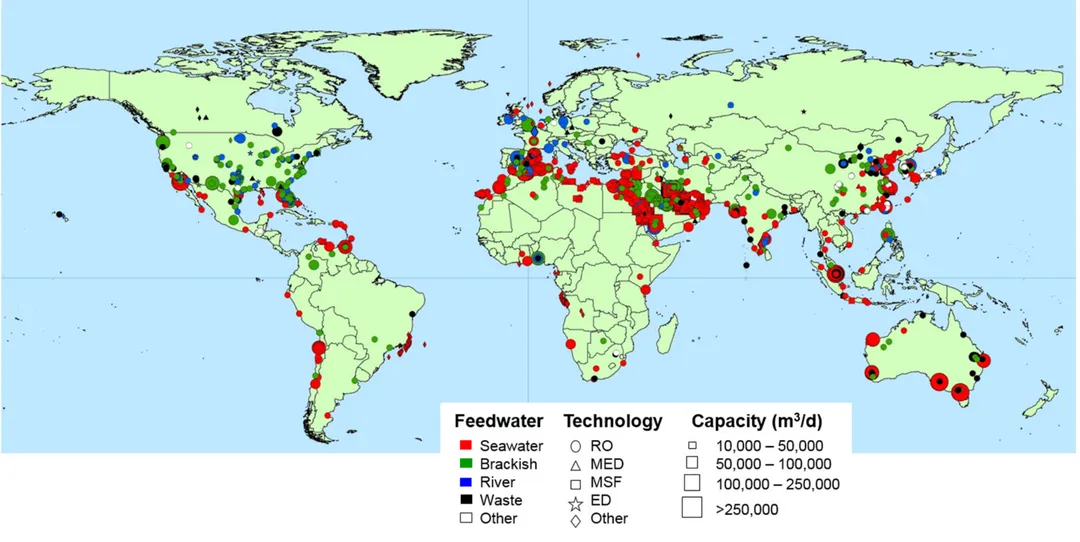
But it takes a lot of energy to turn saltwater into freshwater. And you can only do it if there’s an ocean or brackish water nearby. That’s less helpful in remote inland places … or my backyard. I’ve got solar panels and geothermal heating, and I still rely on the city for water.
So, when I heard about a machine that pulls freshwater out of the air using about 1/3 the energy of a dehumidifier, I wanted to know what’s inside. The core of the technology is a nano-structured material so incredible it earned Omar Yaghi the Nobel Prize for Chemistry in 2025.
His company Atoco in Southern California has developed a machine in a 20-foot (or 6-meter) container that uses this nano-structured powder to collect atmospheric water.
Hook it up to power and Atoco says it’ll produce up to 4 cubic meters, or 19 rain-barrels of water each day.4 An off-grid version still makes a quarter of that, and drives the water back out of the powder using energy from solar panels or low-grade waste heat.456
The powder is made from abundant and cheap chemical building blocks. And Yaghi says it can make water once a day for five or even six years. 1
But the claim that surprised me most is that it can pull water out of the air when relative humidity is less than 20%.5 That’s Death Valley dry.
So, how is it possible to make drinking water from desert air?
Making It Rain
A long time ago, in a galaxy far, far away, moisture vaporators pulled water right out of the air.7 So why don’t we just run giant dehumidifiers in the outdoors?
These machines cool air to condense water vapor into liquid water. And that takes a lot of energy. In dry climates, it takes even more. That’s because the drier the air, the colder it has to be chilled to harvest water. The dewpoint is the temperature at which water condenses out of thin air, and in dry climates, that can be single digits Fahrenheit. 68
That’s a lot of energy for a little water. Yaghi’s powder does the same job with far less. It’s been molecularly engineered to collect water vapor from the air. It’s in a class of materials called a MOF, or metal–organic framework.
MOFs are extended 3D structures made of metal ions like these joined together by organic, carbon-based linkers in a pattern that repeats ... and repeats some more. 91011
Yaghi pioneered a whole class of these crystals, each one riddled with tiny internal pores. The MOF used for water harvesting is one of them.
The pores inside these crystals give MOFs an incredible internal surface area. Like the TARDIS from Doctor Who, each one is a marvel of counter-intuitive interior design. The current internal surface area record holder is called DUT60. Just a gram of this powder has the surface area of 7,839 square meters.1213 That’s the area of a soccer field … on a spoon.14
All that surface area inside the crystal is like a “parking lot for molecules.”4 The exact chemical structure of a MOF determines which molecules are welcomed in, and which are kept out.
The water-harvesting MOF is MOF-303, made with aluminum and an organic linker I won’t even try to pronounce.
How does it work on a molecular level? Water vapor first binds the organic linker, and as more and more water clusters into the pores, it forms a water network throughout the MOF.15 The MOF ‘mofs’ up the water in the air.
Vary the metal and the linker, and you can engineer your MOF to capture different molecules and ions, including lithium ions.16 You might remember MOFs from my interview with Teague Egan. His company EnergyX, based in Austin, Texas, is using a lithium-loving MOF embedded in a membrane to more efficiently extract lithium from brine.17
MOFs earned a Nobel because they give chemists a powerful new way to engineer materials.
Back when Yaghi was earning his PhD, he says chemistry was quote “shake and bake.”1118
Chemists would heat starting materials to extreme temperatures — often over 500 °C and simply hope for the best.
But with persistence, Professor Yaghi and his students found a way to reliably produce specific crystalline molecular structures.
The molecules linked up so predictably that they could tinker with the ingredients to get new crystals with different and better properties. That opened up a whole new field called reticular chemistry.
And it left the old Shake ‘N Bake where it belongs: my lunch plate.
The ability to build crystals from metals and linkers like the bolts and bars of an Erector set has let scientists synthesize over 100,000 MOFs in the lab. And trillions more MOFs are possible. 19
There are MOFs that target water, lithium ions, and even large molecules like the forever chemicals called PFAS. Scientists are hoping MOFs can be used to clean up all sorts of pollutants from contaminated water.20
A pilot program by the Canadian company Svante used a MOF that soaks up carbon dioxide (CO₂) to remove one ton of CO₂ each day from the flue gas of a Canadian cement plant.21 Nuada in Northern Ireland claims their MOF carbon-capture technology uses up to 90% less energy than alternative amine-based technologies.21
MOFs could be useful in environmental and medical sensors, too. MOFs selective for glucose in the blood or acetone in the breath could serve as sensors in medical tests and monitors.21
The potential applications are endless. And commercialization has begun. Chicago-based Numat is already manufacturing gas cylinders that use MOFs to store and deliver gases for the semiconductor industry.2116
All these MOFs sound great on paper, or on a spoon, but how well does MOF-303 actually collect water from the bone dry air of a desert? And how much energy does it take to get the water back out?
So, can MOF-303 really pull water out of air so dry it’d give you a nosebleed? Yes, it can. Yaghi’s team proved it in the field.
This is a mini atmospheric water harvester Yaghi’s team at UC Berkeley set up in Death Valley National Park, which straddles California and Nevada. During the test, temperatures peaked at 61°C (or 142°F). And the highest average nighttime humidity was only 26%.22 That’s firmly in nosebleed territory, according to Cleveland Clinic.23 At the driest test site, Furnace Creek, nighttime humidity averaged just 14%, and the device still made water.22
The device made water using only energy from the sun.
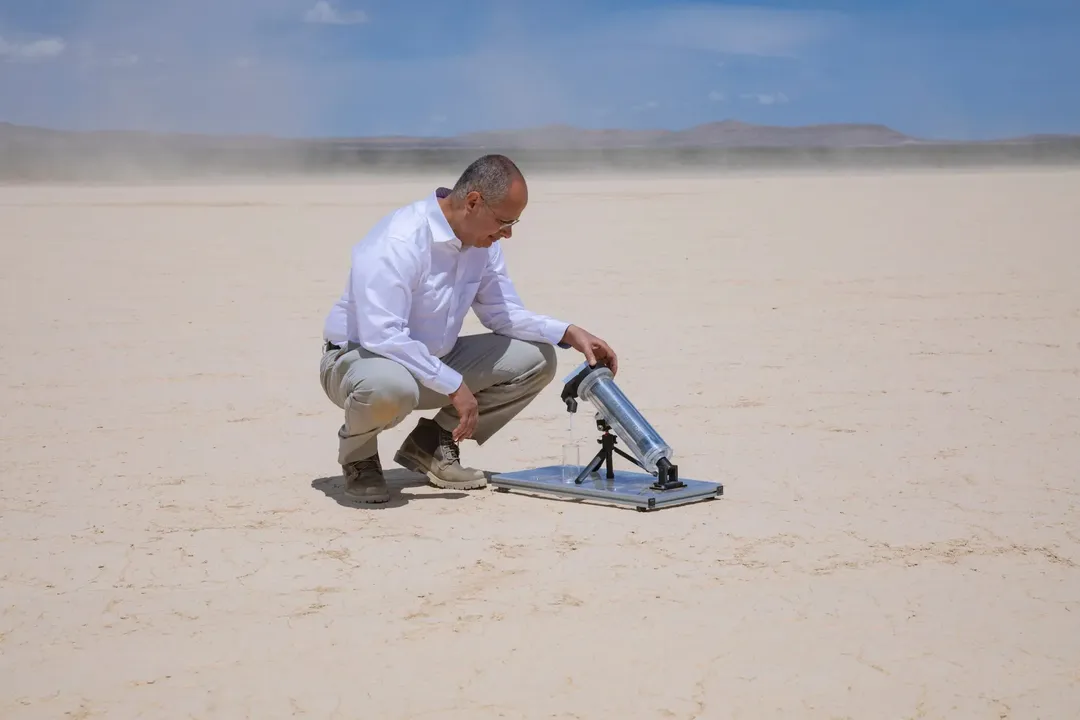
Here’s how this bare-bones water harvester worked. A cartridge held discs of MOF powder that alternated with discs of nickel foam to ensure good air flow.
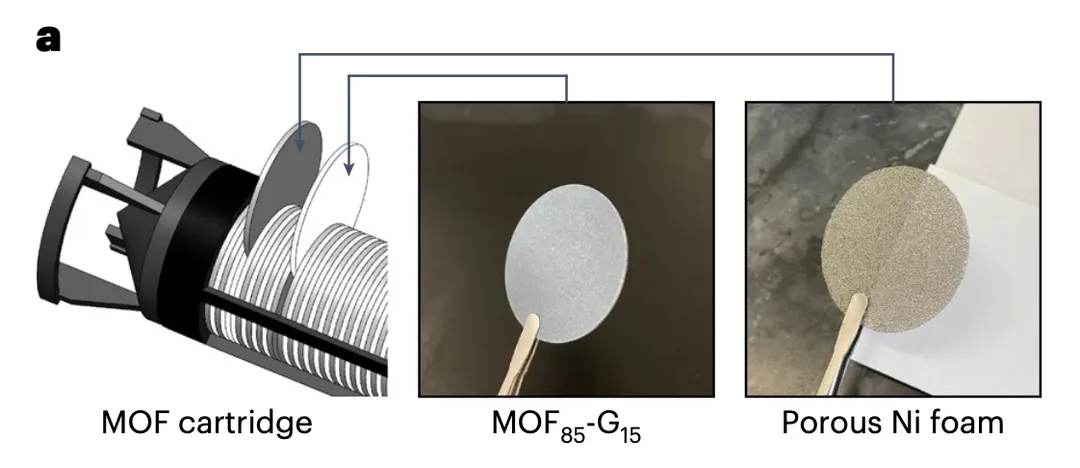
At night, when relative humidity rose, the MOF took up water vapor from the desert air. During the day, the sun heated the MOF cartridge inside its clear casing. As the heat built, it drove water vapor out of the powder. Then, at an aluminum heat sink at the head of the unit, the water vapor condensed back into water.
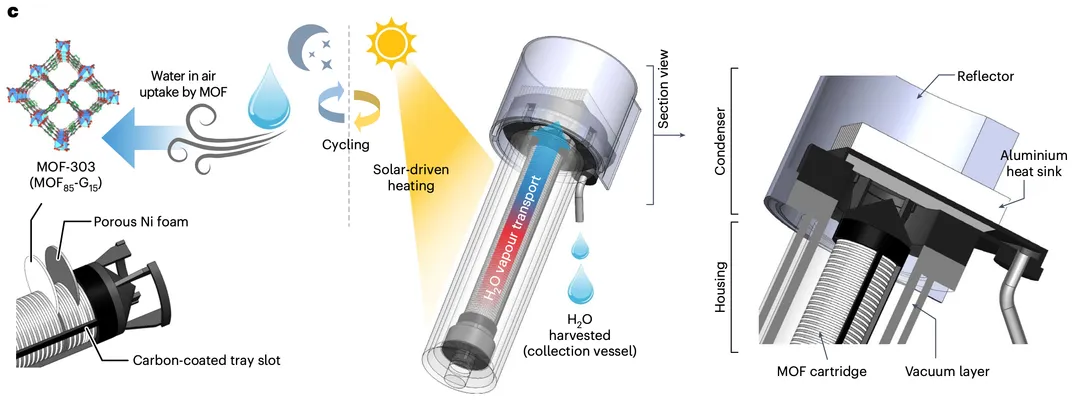
An air supply, a heat source, and a cold surface. That’s all it takes to squeeze water out of desert air using a MOF.
That’s because MOF-303 likes water enough to pull it out of the air even when relative humidity is low. But it doesn’t love water so much it won’t let it go.4
Compare that to silica gel desiccants, like the ones that ship with electronics. Those packs need hours in a hot oven to dry back out. And they still taste awful.424
Yaghi says temperatures above 45°C, or 113°F, are enough to start driving water out of the MOF and back into vapor, which is then condensed into drinking water.25
That means comparatively little energy is needed to run a water harvesting cycle. Atoco’s VP of Business Development, Magnus Bach, who has potentially the most European name I’ve ever come across, claims their container-sized grid-connected machine uses one third the energy of today’s most efficient, dehumidifier-style cooling and condensing technologies.10
With electric heating and cooling … and electric fans to move air … you’re not limited to one water harvesting cycle per day. The harder you run the system, the faster it can cycle, providing 2,000 to 4,000 liters of water per day, depending on the local climate.26
When the heat comes from other sources, like geothermal or industrial waste heat, Atoco’s system makes up to 1,000 liters of water each day.426 That’s reclaimed heat below 150°C, or about 300°F, that geothermal power plants and industries like data centers usually produce.6
In fact, it’s looking like water-hungry, over-heated data centers may become Atoco’s first customers.2728.
What excites me most about this is the possibility of water independence.
This is personal for Yaghi. During his acceptance speech for the Nobel Prize, he spoke of growing up in a Palestinian refugee community in Jordan in the 1970s, where the water tap was turned on just once every week or two. He said,2930
I remember the whisper through our neighborhood, ‘the water is coming’, and the urgency as I rushed to fill every container I could find before the flow stopped.
Yaghi envisions water-harvesting devices large enough to supply villages. He estimates just one tonne of MOF-303 could supply 500 liters of water each day for five to six years.1
But would you actually want to drink that water?
Couldn't the MOF itself end up in the water it produces? Tests of water harvested using a different, zirconium-based MOF found less than 1 part per billion zirconium and no linker molecule in the water.31 The MOF seems to stay intact.
Yaghi says water his team collected from desert air using MOF-303 was tested for metals and organic pollutants and found to be pure.1 That said, air from urban or industrial areas might carry more risk of contamination.1 A simulation found that MOF-303 could theoretically take up the air pollutant sulfur-dioxide (SO₂).32
Atoco recommends that collected water be filtered and slightly purified.33 In Jordan, a research group brought harvested water up to national drinking water standards by filtering it through layers of activated carbon, sand, and limestone.34 This also remineralized the water for drinking.3410
So, how much does bottled water vapor cost?
Atoco’s own simulations suggest that water made at utility scale using waste heat would cost $2.50 per cubic meter, or about 1¢ per gallon.10 That’s on par with medium-scale desalination centers, but much more expensive than water desalinated at a municipal scale.3527 I wasn’t able to find a cost estimate for water produced “on-grid,” though local electricity prices would clearly factor in.
Atoco plans to ship its first couple hundred water harvesters in 2027.27 But they’re not the only company racing to bring a MOF-based water harvester to market.
Delaware-based AirJoule Technologies has made a water harvester it says can produce up to 2,000 liters a day.27 The company's first working units are already installed.
In September 2025, the company announced a full-scale system up and running in Hubbard, Texas, tapping low-grade waste heat from a municipal geothermal well to make water.36 In early 2026, they installed a machine at a climate-positive pilot housing development in Pescadero, California, called Red Dot Ranch.37
The company is also collaborating with The Net Zero Innovation Hub to pilot its water harvester at a Danish data center.38 And Japanese company Kubota plans to integrate AirJoule water harvesters into its water treatment system. A water-stressed condominium and retail development in Texas will be one of the first places to get a unit later this year.3940
The LA Times reported that a single AirJoule water harvester is expected to cost around $100,000-$200,000.40
That’s in the same ballpark as the ARK, a MOF-based water harvester developed by UK-based Ahbstra. The ARK is retailing at £150,000, or about $200,000. Ahbstra expects to install its first water harvesters in 2027, supplying up to 500L per day assuming temperatures around 30°C (or 86°F) and 30% humidity.41
That’s a much lower output, and Ahbstra estimates its water will cost about 20p per liter.42 That’s $264 per cubic meter of water, about 100x as expensive as Atoco estimates for utility-scale, off-grid water production. Ahbstra is betting that price will drop as production ramps up because their aim is to sell more than 1,000 units a year within five years. They also expect costs to fall “just as we have seen with EVs, home batteries and solar.”43 Ahbstra’s first customers will be developers and owners of off-grid properties in Spain’s Balearic Islands, where many residents’ wells are contaminated or running low.44
So can a MOF do for my water bill what solar and batteries did for my power bill? Probably not. At today’s price point, or even tomorrow’s, I’ll be holding off on installing one of these in my backyard. I also want to see whether these machines produce as much water as claimed, and whether they can do so reliably for years.
For communities in need of water, or in a crisis, this technology could be a game changer, especially if the price comes down as the technology scales up. If the technology does scale up, it might be possible to cool data centers in the desert. Current proposals have been met with extreme skepticism on the physics.
This could matter here in the US, too. Home builders in water-stressed places like California and Texas are struggling to secure enough water rights to get building permits.40 That’s one reason Kubota is putting an AirJoule unit in a Texas condo development.39 If machines like this can prove they work cheaply and reliably in city air, they might help ease the housing crisis, too.
- Nature – Fresh Water from Thin Air ↩
- Wikipedia – Water Cycle ↩
- Science of The Total Environment – The state of desalination and brine production: A global outlook ↩
- WIRED Middle East – This Startup Rearranges Atoms To Make Clean Air and Water ↩
- Interesting Engineering – Nobel laureate invents machine that pulls 1,000 liters of water from air daily ↩
- ATOCO – Fighting Desertification With Atmospheric Water Harvesting ↩
- Star Wars – GX-8 Condenser Unit ↩
- Wikipedia – Dew Point ↩
- Wikipedia – Metal–organic framework ↩
- Engineering and Technology – Can harvesting water from the air solve the global water scarcity problem? ↩
- Nature – The man of MOFs and more ↩
- Nature – World’s most porous sponges: intricate carbon-trapping powders hit the market ↩
- Cambridge Core – Most porous crystalline framework synthesized ↩
- ESPN – From gridiron to pitch: How NFL stadiums have transformed for the World Cup ↩
- Science – Evolution of water structures in metal-organic frameworks for improved atmospheric water harvesting ↩
- Chemistry World – Explainer: why have metal–organic frameworks won the Nobel prize in chemistry? ↩
- Undecided with Matt Ferrell – How This Nanotechnology is Changing Mining and Batteries - Explained ↩
- University of Illinois – Illinois alumnus Omar Yaghi wins Nobel Prize in chemistry ↩
- Northwestern University – Can We Really Discover New Nanoporous Materials on the Computer? ↩
- The Nobel Prize in Chemistry 2025 – Press Release ↩
- Aveva – Nobel-winning chemicals changing the chemicals industry ↩
- Nature Water – MOF water harvester produces water from Death Valley desert air in ambient sunlight ↩
- Cleveland Clinic – What Causes Nosebleeds While You Sleep? ↩
- Wikipedia – Silica Gel ↩
- Yaghi Laboratory – Research ↩
- AIChE – Atmospheric Water Harvesting: A Path Toward Global Water Security ↩
- Bloomberg – A Startup Confronts Water Shortages by Pulling It Out of the Air ↩
- Atoco – Data Center ↩
- The Guardian – ‘Reimagining matter’: Nobel laureate invents machine that harvests water from dry air ↩
- Time – A World Renowned Chemist Wants to Suck Water, and Carbon, Out of the Air ↩
- Nature Communications – Adsorption-based atmospheric water harvesting device for arid climates ↩
- Applied NanoMaterials – Nanoporous MOF-303 Performance for Atmospheric Water Harvesting in the Presence of Airborne Contaminants: GCMC and DFT Simulations ↩
- Atoco – Understanding Atmospheric Water Harvesting ↩
- Nature Communications – Environmentally adaptive MOF-based device enables continuous self-optimizing atmospheric water harvesting ↩
- NEWater – Seawater Desalination Plant Cost: How Much Does It Cost Per Cubic Meter ↩
- AirJoule – AirJoule Technologies Delivers Groundbreaking “Waste Heat to Water” System to Hubbard, Texas ↩
- AirJoule – AirJoule Technologies Announces First Quarter 2026 Results and Provides Business Update ↩
- AirJoule – AirJoule Technologies and the Net Zero Innovation Hub for Data Centers Announce Strategic Collaboration to Deploy Heat-To-Water Technology in Data Centers ↩
- AirJoule – AirJoule Technologies and Kubota Corporation Announce Deployments of Breakthrough Decentralized Water Infrastructure and Exclusive Sales Partnership to Unlock Water-Constrained U.S. Residential Development ↩
- LA Times – Japanese company bets on water-from-air tech to help water-starved areas in California ↩
- Ahbstra – FAQ ↩
- Ahbstra – Ahbstra launches ARK, breakthrough atmospheric water harvester in Barcelona ↩
- Financial Times – Ahbstra ARK atmospheric water harvester ↩
- Water Magazine – Water harvesting tech launches as drought grips southern Europe ↩