3 years ago, people were predicting the end of small modular reactors.
A Utah utility cancelled plans for Portland, Oregon’s NuScale to build the first of these novel nuclear reactors in the state. The estimated cost started at $3 billion in 2015. It hit $4.2 billion in 2018, $6.1 billion in 2020, and $9.3 billion in 2023, at which point the customers walked. 1
SMRs were sold as a faster, cheaper route to nuclear, but NuScale showed they could be just as slow, and just as expensive to build.
I've covered these things 3 times. Each time I said the same thing: promising, but unproven. So did 2026 finally change that?
Just a few years after NuScale’s collapse, it seems reports of the SMR’s death have been vastly overstated. In fact, 2026 is perhaps the best year for SMRs EVER.
Multiple projects are breaking ground, after a decade without any new commercial nuclear projects.
And the Trump administration wants to help, with a pro-nuclear agenda, and $900 million available to support the SMR industry. $94 million of that has already been awarded. 2 34
So, now we’re back to rosy headlines.
You’d be forgiven for having a case of small modular whiplash. So, what’s happening here? Are small modular reactors about to play a major role in our energy system or are they a waste of time and enriched uranium?
The hypothetical case for SMRs
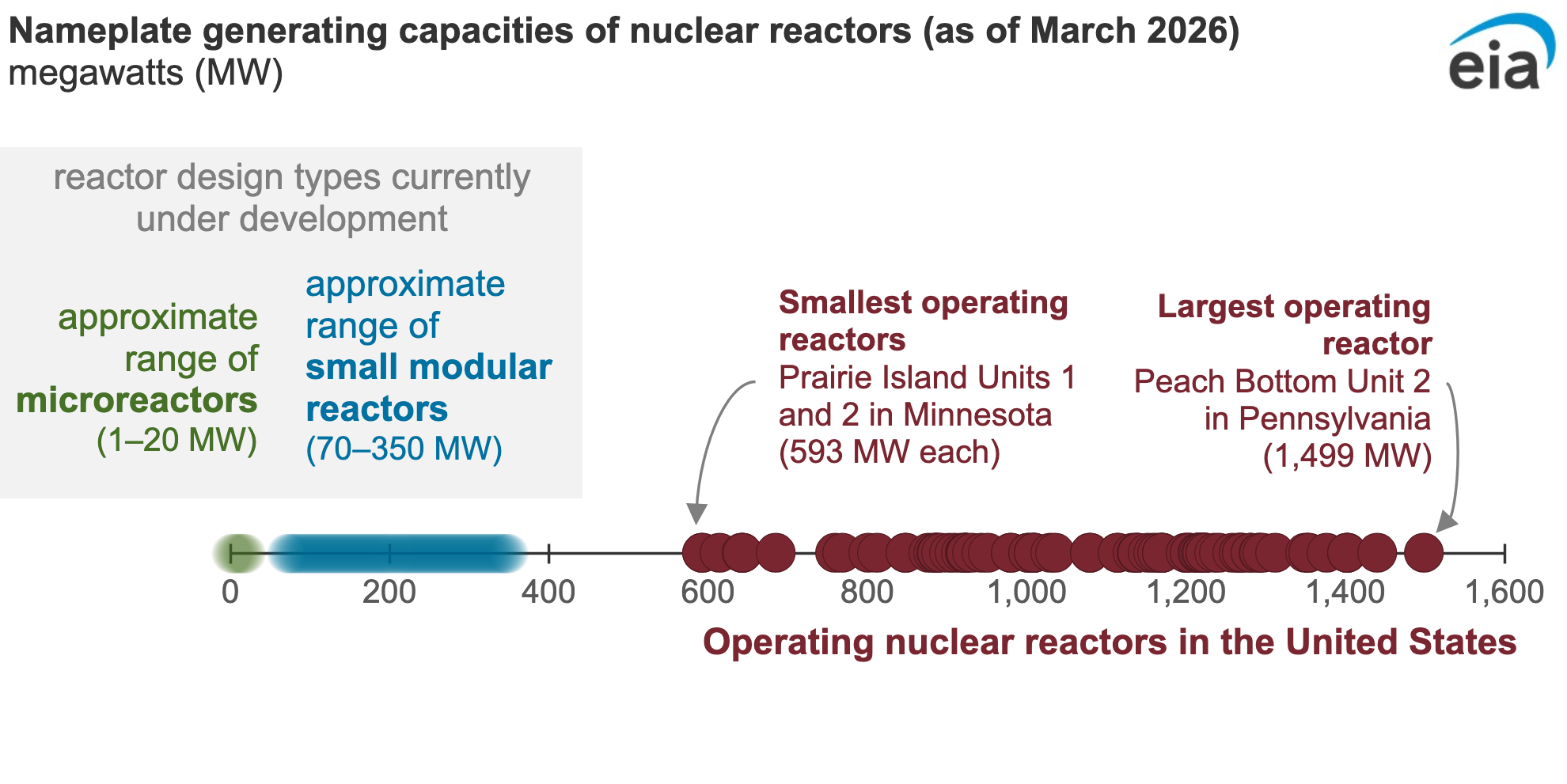
Big reactors put out 600 to 1,500 MW. Small modular reactors, or SMRs, are built for 70 to 350 MW. 5
SMRs are supposed to fix the problems associated with big, honkin' reactors. Although America has more nuclear power than any country in the world, and nuclear supplies about 20% of US electricity, the reactor fleet is old, most of it was built before 1990. 67
Over decades, nuclear reactors have gotten more and more expensive, and taken longer and longer to build. The most recent US nuclear reactors at the Vogtle facility in Georgia took 7 extra years to build, and produce energy at more than 7x the cost that nuclear cost in the 1970s6.
New nuclear can’t compete with renewable energy in terms of cost. The levelized cost of electricity from nuclear is between $175 and $255 per MWh. That’s much more expensive than utility scale solar which has an LCOE between $40 and $98, or onshore wind which is between $37 and $99 8.
If nuclear wants to compete in an era of increasing electricity demand, that won’t cut it.
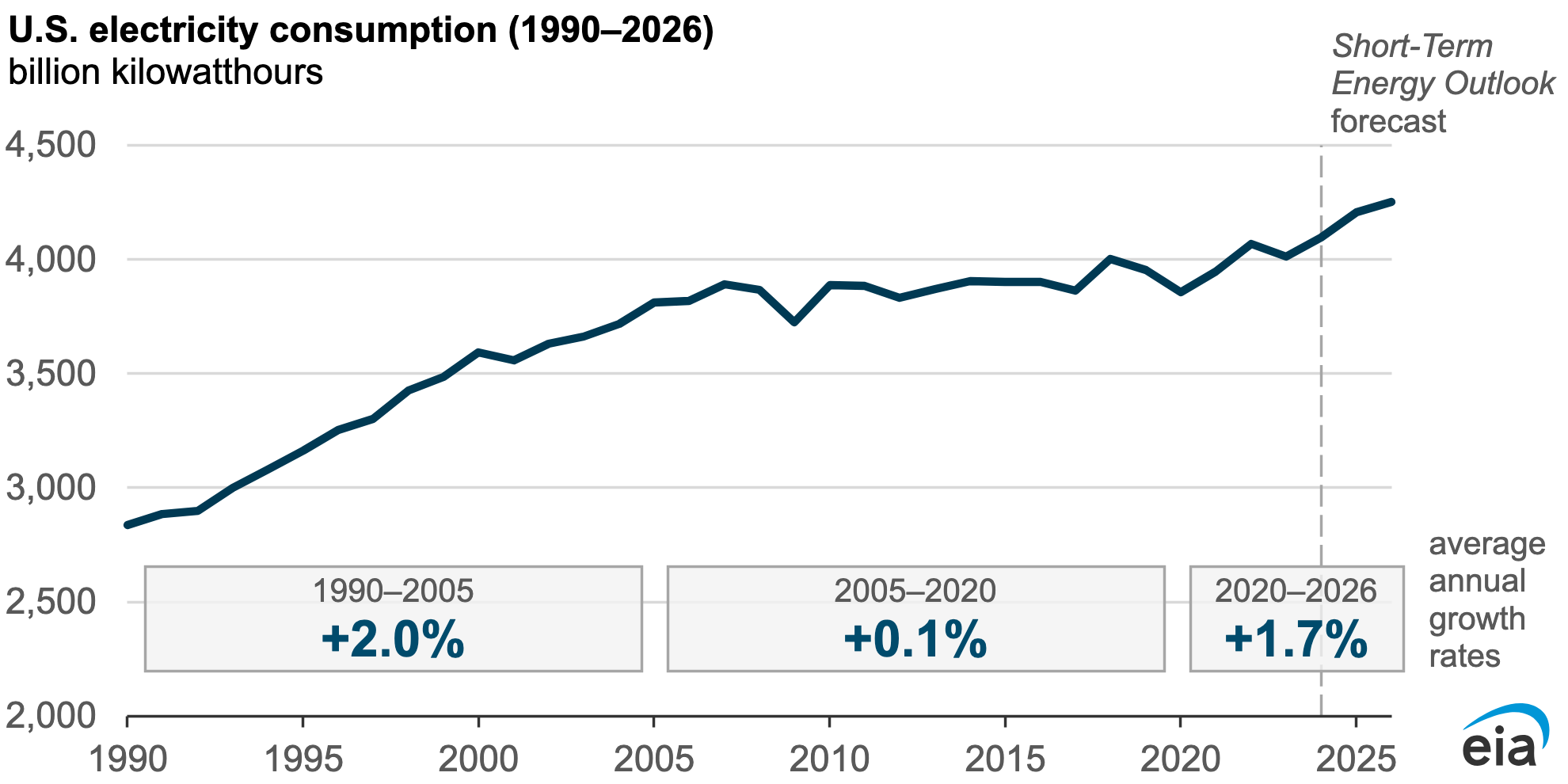
SMRs are supposed to make nuclear competitive again. They are supposed to be cheaper and quicker to build, and have more places they might fit. 10
As I’ve mentioned on the channel whenever nuclear comes up, the prospect of a clean, firm source of power is incredibly appealing today. New nuclear capacity reduces dependence on fossil fuels, and compensates for the intermittency of renewables.
Also, I am aware of claims that SMRs will be safer from malfunction than traditional reactors, and that they will produce less hazardous waste. We’ve gone into that in detail in other videos if you’d like to hear more about it.
When we say SMRs are small, that refers first and foremost to how much power they make.
Modular means that most of the components can be built in a factory, shipped and then assembled rather than built on site. 10
In a recent Reuters column, Gavin Maguire describes it like this: “The vision is straightforward: turn nuclear power from a construction business into a manufacturing business.” 11
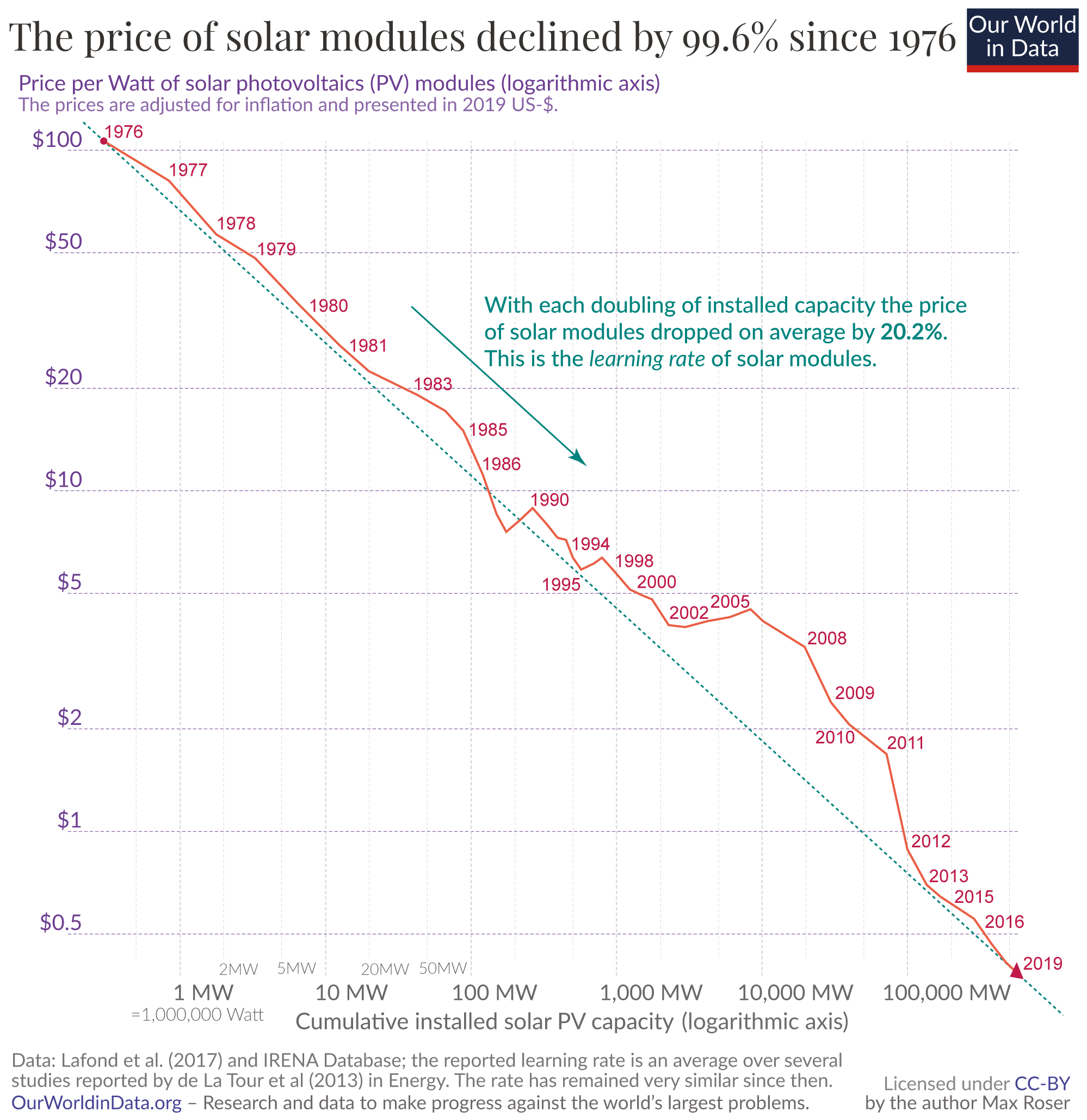
The idea is that over time, it will get cheaper and easier to build the pieces of these reactors. This is what happened with solar panels.
We also know that finished, working SMRs are possible. There are sample projects in China and Russia, which is something we’ll return to later.
Put all this together and you can understand the dream. Smaller, safer, and cheaper nuclear developed in the US and exported for profit. You see this rosy future painted on the US Department of Energy’s Website, which reads “If a sufficient number of SMR units were ordered, it would provide the necessary incentive to develop the appropriate factory capacity to further grow domestic and international sales of SMR power plants.“ 10
The big if, and the big problem with assessing SMRs
Now that’s a big if! And it’s a big problem. IF there were a large number of a specific SMR in the development pipeline, we could assess if mass production actually decreased cost, at what point, for which specific technology. The current levelized cost of electricity for SMRs, before any cost decrease from factory learning, is $214/MWh. That’s higher than every source of renewable energy. 8
Without those orders, we can’t fully assess its potential. It’s like a middle schooler saying they’re going to be an NBA All-Star once they grow to be 6’10”. Sure, we can’t totally rule it out, but skepticism is appropriate.
It’s even harder to make an assessment because currently there are a huge number of different SMR designs taking off all over the world. Well over 100. With that many designs, it's possible that the market may become too diluted for any one design to be mass produced cheaply.
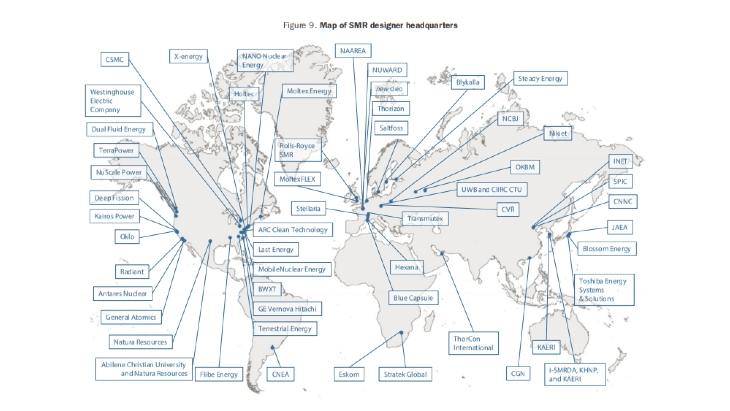
So what are some of these reactor designs? Earlier this year the US Energy Information Administration looked at all the US projects under development and compiled a report. 5
One of the main SMR types under development are light water-cooled reactors. These run the same playbook as many existing large reactors, and use the same fuel, which probably makes them more likely to work out. They use hydrogen in water as a moderator, which slows neutrons for fission.
Another category under development are high temperature gas reactors. Like the name says, these things get hot, around 750 degrees Celsius. That’s enough heat for a lot of industrial processes. According to the Department of Energy these “use helium gas and ceramic materials to stabilize the fission process inside the reactor core.” 14. They rely on either Tristructural Isotropic (TRISO) particle fuel, which is an advanced fuel made for super high temperatures beyond current reactors, or a high assay of low enriched uranium … also known as HALEU, which we’re going to dig into in more detail in just a minute.
After that, things get salty with molten salt reactors. Others use liquid metals as coolants, including sodium. Molten salt reactors use liquid salt, either with the fuel dissolved in it or as a coolant around solid fuel. Sodium-cooled reactors use liquid sodium instead of water to carry heat away from the core. Some of these designs require advanced fuels such as HALEU or TRISO.
On the one hand, the growing number of designs for small modular reactors show the very real interest in the technology. But it’s also a problem. All these designs compete for the same investment dollars. That makes it harder for any one of them to get built over and over. And without that repetition, the cost savings never show up.
It’s sort of weird! The flurry of innovation in SMRs is creating a bottleneck to their adoption. It’s like a factory where 50 teams are making 50 kinds of car. One team might be cooking up a Model T, but there’s so much traffic to get out the door, it’ll never have the chance to prove itself on the road. Also, remember that one of the key components needed to reduce cost is the ability to mass produce them. If the same market for SMRs is divided between 100 teams versus 5 teams, mass production may not be possible.
When I covered these 3 years ago, I figured the field would have thinned out by now. A couple of designs pulling ahead, everybody else quietly dropping off. The opposite happened. There are more designs chasing the same pile of money than the last time I looked.
The fuel challenge for some SMRs
There are some SMRs we can probably count out from taking off, just from the kind of fuel they plan to use.
You wouldn’t buy a car if it ran on gas from a special gas station that hasn’t been built yet. But that’s effectively the plan for some SMRs.
Many SMRs and advanced large nuclear reactors in the works plan to run on high assay Low-enriched uranium, or HALEU. This is more enriched than that low-enriched uranium fuel used by most current reactors. 5
HALEU has a higher burnup than low enriched uranium, so you get more energy from the amount of uranium. This is key to claims of increased efficiency and less waste for many SMR designs. 5
But there’s a problem. The only commercial HALEU right now is produced by Russia, which is a non starter, given a law called the “Prohibiting Russian Uranium Imports Act of 2024,” which does exactly what you think it does. 15
What this means is that a serious chunk of SMR designs can’t take off until a domestic supply chain can be built. 16
The US is putting a lot of effort, and by effort I mean cash money, into meeting this potential demand. A company called CENTRUS in Bethesda, Maryland proved it could produce 900 kilograms of HALEU. Then it won a separate $900 million contract, this one to commercialize its operations. According to the company “The initial build-out will include 12 metric tons of annual HALEU production capacity” as well as LEU. The plan is for the facility to be built out by 2029. 17
It’s a step in the right direction, but it won’t be nearly enough to meet demand, which could reach 50 tons a year by 2035 according to the Department of Energy. 18
Assessment: SMRs vs. big nuclear, and real-world SMRs
So there’s a chunk of SMRs that have no chance of breaking out, because of their fuel. But set the fuel problem aside for a second. What happens when you stop reading the pitch decks and go look at the reactors that are already running?
Big nuclear did try to standardize designs to make construction cheaper, the way SMRs are supposed to. It just didn’t work. According to a 2020 study by Eash-Gates and colleagues, the cost escalation comes down to lower labor productivity and soft costs. I guess modularity isn’t all it’s cracked up to be. 15.
Let’s look at actual SMRs. 2 of these things are in commercial operation right now. Almost nobody talks about how they're performing. The numbers here are bad.
China's HTR-PM ran 27 hours out of a possible 8,760 in 2022. Russia's KLT-40s units performed at 26.4% and 30.5% of capacity. 1920
While they were being built, they had the cost and time overruns of regular nuclear. According to Goldman Sachs, Russia and China’s SMRs ”experienced cost overruns of between 300 and 400% over initial estimates,” which aren’t likely to go down until economies of scale develop. 21
And just like boring large nuclear, these SMRs took forever to build! China’s HTR-PM took nearly a decade to complete. Russia’s KLT-40s was projected to take 4 years to build, but required 13! 15
The boom in SMRs is real
Despite the troubled track record, the effort going into SMRs is very real. Like I said at the beginning, this is an incredible year for SMRs.
2 US projects broke ground earlier this year. Bellevue, Washington’s TerraPower received the go ahead for a 345 MW facility in Kemmerer, Wyoming, with storage that can push output to 500 MW at peak demand 227, and the Alameda, California based company Kairos broke ground on a demonstration project in Oak Ridge, Tennessee. 7
Energy hungry hyperscalers are linking up with SMR companies to power the data centers increasingly central to the US economy. 23
Investment money is flowing into the space. According to Michael Johnson, managing director for JPMorgan Chase, this recent round of SMR enthusiasm started in 2024, when Amazon made a deal with Rockville, Maryland’s X-energy. He told the Wall Street Journal it was “real support from Amazon that had people believe not just in the future of X-energy, but in the future of small modular reactors.” 24
Look, if you’d want anyone on your side to build your SMR, it would have to be one of the most profitable companies on the planet. But how much should we weight excitement from finance and big tech against everything else we know?
Honest assessment: an SMR is more big nuclear reactor than PV panel
Here’s my take. SMRs are a hard sell. For all of the activity in the space, we’re not seeing anything like what they’ve promised every time we’ve covered them. This is now the fourth time I've looked at these. I keep waiting for my answer to change.
Even people working to develop SMR companies don’t expect the tech to break out. Ray Rothrock is an investor in several reactor companies. He expects very few SMR startups will survive. “It’s a single digit,” he told the Wall Street Journal. “It’s not a double digit.” 24
The big problem is that a small nuclear reactor is more like a large nuclear reactor than a PV panel. It faces the same regulatory hurdles and process challenges. A reactor a tenth the size is just as complex to produce. It needs the same design work, build attention, and paperwork. And at first, it makes less power for more money.
Here’s how the Chief Executive of TerraPower Chris Levesque put it to the Wall Street Journal: “Because this is a smaller reactor doesn’t mean a smaller design effort because it’s still fission.” 24
A factory cranking out PV panels can produce millions of a specific design in a year. That leads to lower costs.
Comparatively, right now there’s just a trickle of SMR projects, without even a single design proving itself to iterate on into the future.
In an era of ubiquitous solar backed up by batteries, the case for massive SMR investment is thin.
But there’s still a case for them. An IEA report last year predicts that globally “SMRs are poised for rapid growth.” The IEA's baseline scenario has SMRs hitting 40 GW by 2050. 25
And to be fair to nuclear, 40 GW of reactors running around the clock out-produces a year of US solar installs by a good margin. The problem is the calendar. The US installed that much solar last year. 26 SMRs get there in 2050. But it’s still something. There are plenty of places they might be useful. Military installations, small outposts way off the grid, and of course the data centers that keep coming online. Cuz I know how much we all love a good datacenter.
Increased energy demand and climate change make any new source of clean energy worth pursuing. SMRs are being pursued, but their central mechanism to lower cost and speed adoption, has yet to be proven. It likely won’t be anytime soon, or maybe even ever.
Right now solar and batteries are dunking on SMRs. It’s not a fair comparison really, for a technology that is still some years away, at best, from reaching the rim.
- Utility Dive – The collapse of NuScale’s project should spell the end for small modular nuclear reactors ↩
- DOE – FACT SHEET: The Golden Era of American Nuclear Energy Has Arrived ↩
- DOE – Energy Department Awards $94 Million to American Companies… ↩
- DOE –$900 Million Available to Unlock Commercial Deployment of American-Made Small Modular Reactors ↩
- EIA – Small modular reactors and microreactors under development in the United States ↩
- MIT – Are nuclear power plants too expensive to build? ↩
- Wall Street Journal – America’s First Commercial Nuclear-Power Projects in a Decade Just Broke Ground ↩
- Lazard – Lazard's 2026 LCOE+ Report ↩
- – EIA– After more than a decade of little change, U.S. electricity consumption is rising again ↩
- DOE – Benefits of Small Modular Reactors (SMRs) ↩
- Reuters – The little reactors that could? How SMRs became nuclear's best bet ↩
- Our World In Data – Learning curves: What does it mean for a technology to follow Wright’s Law? ↩
- Nuclear Energy Agency – The NEA Small Modular Reactor Dashboard: Third Edition, page 38 ↩
- DOE – Nuclear 101: What Is a High-Temperature Gas Reactor? ↩
- Progress in Nuclear Energy – Challenges of small modular reactors… ↩
- CleanTechnica – Nuclear Scaling Requires Discipline. SMRs Deliver Fragmentation ↩
- CENTRUS – Centrus Signs Contract with Department of Energy for $900 Million Award ↩
- IAEA – HALEU: Power for a new generation of reactors ↩
- Power – A Closer Look at Two Operational Small Modular Reactor Designs ↩
- Mycle Schneider Consulting – World Nuclear Industry Status Report 2023 ↩
- Goldman Sachs – The New Nuclear Age ↩
- NPR – Wyoming celebrates 'nuclear renaissance' as feds approve license for a new reactor ↩
- Carnegie – Beyond the Hype: Assessing Hyperscaler Nuclear Commitments Against U.S. Energy Realities ↩
- Wall Street Journal – Inside the Race to Build America’s First Nuclear Reactor in a Generation ↩
- IEA – Outlook for nuclear investment ↩
- SEIA – Solar Market Insight Report 2025 Year in Review ↩