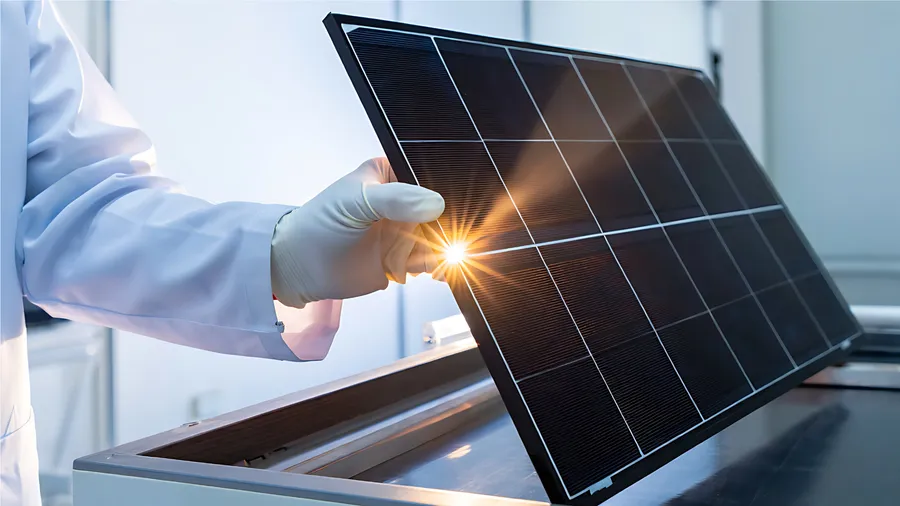
Solar panels were built for one job. Turn sunlight into electricity, but a team of scientists at Germany’s University of Hohenheim think solar panels can do something else. Something surprising…
They think solar panels can help make it rain ... in the desert.
The United Arab Emirates just handed the team up to $1.5 million to test their theory, selecting them out of 120 submissions from around the world.
Their earlier simulations estimate that the right solar farm could make it rain enough to provide water for 125,000 extra people per year.1
But before we grab our umbrellas and make a beeline for the Sahara, let’s stop, think, and pull our heads out of these imaginary rain clouds. This is complex stuff, and when my team and I dug into how solar panels might double as geoengineering tools, things got messy, fast. Making rain from solar panels might actually be possible. Whether we’d want it is the much harder question.
So how can solar panels make it rain in the desert? What do sulfur emissions from ships have to do with it? And will this surprising approach to geoengineering deliver on its promise?
The world is getting drier. Climate change, overgrazing and increased water consumption have spread arid conditions. A 2024 study found that between 1960 to 2023, there was a total increase of 9.99 million km² in arid areas globally … that’s about one whole Canada of dryness.2
Without consistent rainfall, people face food insecurity from poor harvests and crop failure. In the semi-arid Sahel region, about 1 in 13 people struggle with hunger and malnutrition everyday. This is a humanitarian crisis.34
And it's not a problem we're immune from here in America. Along the Colorado River, severe droughts just forced a 20% cut in annual water usage.56 Lack of rainfall is already affecting our lives.
So how do solar farms become a potential water solution? As solar took off over the last decade, researchers started looking at how this new and increasingly massive physical infrastructure impacts the ecology and climate. Think about it like this … If you cover 400 square km with black panels made to take in light from the sun and turn it into electricity, SOMETHING is going to happen to the surrounding environment.
That's the idea animating the work of Dr. Oliver Branch and Professor Volker Wulfmeyer, who are specialists in Earth system science and meteorology. In a 2024 paper, they looked at how heat absorbing surfaces like solar farms could unintentionally generate rainfall. They ran a computer simulation looking at how spreading light absorbing black surfaces "made of black mesh, black-painted, or solar photovoltaic (PV) panels" could influence rain in the United Arab Emirates. The results were promising.
With a pair of 20-by-20 km black surfaces, and assuming geoengineered rainfall events happen 10 days in a year, their simulation predicted enough rain to supply water for more than 31,000 extra people per year in the UAE. 1 A pair of 50-by-50 km surfaces raised that to more than 125,000 people.
One thing to note is that the artificial black surfaces, or ABSs they used in these simulations are not exactly the same as a solar farm. Solar panels absorb less sunlight than an ABS does. It’s not the perfect model, but they’re off to a bright start.
To bring this to the real world, the team has received a new grant from the UAE to take their research to solar farms in the Arabian Peninsula.
With their recent grant, Branch and his colleagues plan on using LiDAR and high-resolution simulations to determine the optimal location, size, and design of solar parks to geoengineer the desert.78
He says that since “solar parks are becoming so large, particularly in the UAE, it’s given us a fantastic opportunity to do measurements.”9
On the surface, this sounds like a brilliant solution to the water crisis.
Solar power is the dominant source of renewable energy and every year we're building more. 101112
In 2025, investment in solar, both utility-scale and rooftops, was expected to reach $450 billion.13 14 The cost of building a 21 square km solar park in Abu Dhabi was approximately $1 billion in 2022. 1516
If we use this as an estimate for a rain-making solar farm, the math gets ugly fast. One 20-by-20 km surface is about 19 times the size of that park. Call it $19 billion. You need a pair, so that’s $38 billion. Roughly 8% of the $450 billion the world invests in solar in a year, spent on two farms. Go up to the 50-by-50 km pair and you’re north of $200 billion. Governments are already funding utility-scale solar, but nothing close to that, and not for rain. I mean … the gig economy is booming right now, so why not expect more from our solar panels? If they can make electricity, why shouldn’t they pull a second shift in the precipitation biz?
Well I hate to rain on this parade, or any parade really. But getting rain from solar won't be so easy, or so cheap, or potentially, so harmless. But before we get into that, let's shed some… light on how solar panels can make it rain at all.
Solar panel weather machines
Dark surfaces are much better at absorbing light than bright surfaces.
Think about wearing a dark shirt versus a light shirt on a hot summer day. It feels hotter in a dark shirt because it absorbs the sunlight instead of reflecting it like a light shirt. If we recorded these videos outside, you'd probably see me switch up my wardrobe. In any case, that’s the same principle at work in the desert.11718
Branch says solar parks cause a “darkening of the land surface and you get an increase in radiation absorbed.” 9
Solar panels can't convert all the sunlight that hits them into electricity. In fact, this seeming limitation, is the only reason this rain-making theory might work. It’s an important caveat, and I’ll be getting back to why there’s a hidden irony in the theory later.
Most of the sunlight that hits a solar panel turns into heat. This heat radiates out from the panels, forming currents of warm, less-dense air that rise up in the atmosphere.
It’s the same reason heating air makes a hot air balloon float up.
If those currents hit moisture-carrying air, they drag that moisture up with them. High in the atmosphere it condenses into clouds. Clouds can trigger rain. It’s also worth noting that moisture-carrying air is necessary for this to work. That's why Branch is focused on creating rain in coastal deserts, not just any desert, anywhere.
Rain only comes if enough heat is generated to form these rising air currents to change convection patterns … and with enough ground covered, that’s what Branch’s team found could happen. When a pair of 10-by-10 km artificial black surfaces were used, they noticed very little impact on rainfall.1 But when they scaled up to 20-by-20 km, they saw a noticeable increase in precipitation. That’s 400 square km of dark surface. Each.
Referring to the heating effect on solar panels, Branch says that existing solar farms “may be not large enough to sustain that effect for long enough to create convection initiation.”19
Right now there aren't many places this could happen. According to Global Energy Monitor (GEM), as of February 2026, there are more than 81,000 operating utility scale solar phases around the world. Almost none come close to 400 square km. Only two do, Hobq and Talatan, both in China, and neither sits in a coastal desert where the sea breeze carries the moisture.2021 This could be one of the reasons why we haven’t really seen any rainfall events triggered by solar farms … yet. They just aren’t big enough, and the few that get close are in the wrong place. This is why Branch believes a large enough solar farm in the path of a sea breeze can trigger rainfall in a coastal desert.
This plan sounds far fetched, and I get that, but we’ve already been geoengineering the planet by accident.
In 2020, the international maritime organization put a cap on how much sulfur could be released from ships, and there was an unexpected rise in global temperatures. It turns out all the sulfur polluting the air was deflecting sunlight and helping cool the planet. The tiny sulfur particles were acting like microscopic mirrors in the air. They reflected incoming sunlight back into space before it ever heated up the Earth.
Without this sulfur screen, temperatures shot up.2223
This feat of accidental geoengineering makes the idea of solar panel induced rain seem less wacky. But it's also a warning.
One change to the atmosphere we do like, could result in many we don't. It's the unintended consequences that concern me. The potential effects could be felt on a local and global scale … and they might even make solar panels less effective.
The impact of solar panels on local vegetation is not definitive, though most sources point towards an improvement in the local microclimate. 242526 A simulation by researchers from Lund University in Sweden looked at what would happen if 20% of the Sahara desert was covered with solar panels. Let's remember for a second that the Sahara desert is about the size of the continental US, so a little unlikely. Still, the model predicted a positive feedback loop that encouraged more rainfall.18
Positive feedback loops are kind of like holding a microphone too close to a speaker. The speaker amplifies the mic, the mic picks that up, and each cycle builds until you get that screech. In the desert, the same loop amplifies rain and vegetation. More rain means more plants. More plants release more moisture. More moisture means more rain.
But what's good for the Sahara might not be so great for the world. The scientists found 20% solar panel coverage on the Sahara would cause significant changes to global weather. Similar to what happened after ships cut their sulfur emissions.
The projected global effects of the imaginary Sahara coverage amplified unpredictable climate patterns. The simulation predicted rising global temperatures, reduced precipitation in the Amazon rainforest, and more tropical cyclones in the Northern Hemisphere.18 I like the idea of turning the desert green, but I'm not loving the prospect of all this chaos elsewhere.
Now again, covering a fifth of the Sahara in solar panels is not going to happen anytime soon … or ever. A project that large would produce approximately 4.7x more energy than the world currently needs.1827 But the study points towards a limit of how far we can push this technology and its potential impact. 27
Another thing to consider is the changes to solar radiation if we have more rainy days in the desert.
A later simulation study on the impact of solar panels across the Sahara found that with increased cloud cover, the amount of sunlight solar panels are able to absorb will be reduced.27 It's obvious when you think about it. When solar panels make it rain, that rain might make them less effective at producing electricity. You could say solar panels are quite sun-sitive to their environment. Yeah, sorry … I had to do it … in memory of my mother who loved a good pun.
The study predicted that with more cloud cover, solar radiation would decrease for regions like the Middle East, India, Eastern China, and Southwestern US. Ironically, these are regions that are aiming to increase their solar output.27 But with less incoming sunlight, increasing solar panel efficiency will be the fix … right?
But if solar panels get significantly more efficient, they won't be able to make it rain!
Remember, solar panels don’t convert all the sunlight they absorb. Typically, only 15% becomes electricity.17 The rest turns into heat. Make panels more efficient and that heat disappears, along with the convection that drives the rain. The whole theory only works because solar panels are not that good at their day job. On the other hand, if solar farms get really good at making rain where it’s needed, we might be fine with panels that make less electricity. That’s the irony. Working two jobs is exhausting, and solar panels are just like the rest of us.
A sunnier outlook
So how should we think about this? Even though solar panel weather machines might be possible, at a large enough scale they could produce unpredictable and undesirable outcomes. The ongoing research in the UAE is just a small step in that direction.
But it's one we need to consider very carefully. The world’s climate system is like a giant, wet, Rube-Goldberg machine. Set off one event, in one place, and a slippery series of interactions might end up affecting someone on the opposite side of the globe.
Professor Eloise Marais, an atmospheric chemist from the University College London, has said that geoengineering has not really been done to scale because “there are so many unintended consequences”. She says that “careful ethical forethought [is] needed before we adopt geoengineering.”28
Careful planning isn’t easy either. Collecting that much real-world data takes years, which is why almost everything we know about this comes from simulations. They use real data, but they don’t fully capture how weather actually behaves.
And it’s not that we don’t have alternatives to helping people living in the desert. There are less radical approaches to reduce desertification that already work.
For example, changes in farming practices in the Sahel led to an improvement in harvests in the last 30 years.29304
But more importantly, we know solar farms can help make life better in desert environments without explicitly trying to change the weather. Take the Talatan solar farm in China. The farm's panels act as wind barriers reducing moisture evaporation on the surface. The result? An increase in vegetation around the panels. 3132 I’ve got a video about agrivolatics you might want to check out to learn more about these kinds of systems.
It is worth pointing out these solutions are focused on increasing vegetation and do not directly address the lack of water. Still they show we have options beyond geo-engineering clouds, even in the desert.
Using solar panels to make rain sounds like science fiction … and it might be better off that way for now. Climate change has already made the weather unpredictable for all of us and if we throw another player into the mix, we might be biting off more than we can chew. I mean who would have thought by cutting sulfur emissions to create less pollution, we would heat the planet? But at the same time, the effects of not making that change would be far worse.
If Branch and his colleagues can find a sweet spot where solar panels can geoengineer more rainfall without exacerbating global climate change, we should really pay attention. But that's way down the line. Right now, they're just collecting data to better model the possibility of creating rain in the coastal desert, in one small country. That's not too much cause for concern. But again, I'm not sure solar panels need to make it rain, to make the desert better.
Remember the Talatan solar farms in China I just mentioned?
The solar panels were so effective at rewilding the land that local authorities brought in 20,000 “photovoltaic” sheep to graze, stopping weeds from blocking solar panels.32
This has been great news for the local community, and its economy. One local herder used to walk 10 km to find forage, but is now earning about $14,000 a year from tending the photovoltaic sheep.32
To me, this seems like a much sunnier outlook than using solar panels to mess with the weather.
- Earth System Dynamics - Scaling artificial heat islands to enhance precipitation in the United Arab Emirates ↩
- Nature Communications Earth & Environment - Growing aridity poses threats to global land surface ↩
- European Commission - Sahel ↩
- World Food Programme - From hunger to harvests: how land restoration is transforming the Sahel ↩
- The Canadian Press - Federal officials announce water cuts as Colorado River supplies continue to plunge ↩
- Public Policy Institute of California - The Colorado River ↩
- pv Magazine - German scientists explore whether solar power plants can induce rain in deserts ↩
- UAEREP - Electricity & Rain: Solar parks and artificial dunes could trigger rain in deserts ↩
- Youtube - UAEREP Interviews | Dr. Oliver Branch ↩
- Renewable and Sustainable Energy Reviews - Solar energy for future world: - A review ↩
- pv Magazine - India installs 15.3 GW of solar capacity in Q1 ↩
- Global Energy Monitor - Global Integrated Power Tracker ↩
- International Energy Agency - World Energy Investment 2025: Executive Summary ↩
- Dhafrah Energy - Al Dhafrah Solar Project ↩
- BNP Paribas - BNP Paribas Leads Financing of World’s Largest Single-Site Solar Power Plant in Abu Dhabi ↩
- Science - Climate model shows large-scale wind and solar farms in the Sahara increase rain and vegetation ↩
- Geophysical Research Letters - Impacts of Large-Scale Sahara Solar Farms on Global Climate and Vegetation Cover ↩
- Youtube - UAE Research Program For Rain Enhancement Science 6th Cycle Awardees Announcement ↩
- Global Energy Monitor - Global Solar Power Tracker ↩
- Wikipedia - List of photovoltaic power stations ↩
- Nature Communications Earth & Environment - Abrupt reduction in shipping emission as an inadvertent geoengineering termination shock produces substantial radiative warming ↩
- Science - Effect of Ship-Stack Effluents on Cloud Reflectivity ↩
- Solar Energy - A global assessment of the effects of solar farms on albedo, vegetation, and land surface temperature using remote sensing ↩
- Environmental Research Letters - Ecological synergy of solar development on the Qinghai-Tibet Plateau: a decade of ecosystem service change assessment at Talatan Solar Park ↩
- Nature Scientific Reports - Assessment of the ecological and environmental effects of large-scale photovoltaic development in desert areas ↩
- Nature Communications Earth & Environment - Large-scale photovoltaic solar farms in the Sahara affect solar power generation potential globally ↩
- npr - What scientists are learning about geoengineering from satellite pollution ↩
- Yale Environment 360 - After Decades of Drought, Water Is Rising in the African Sahel ↩
- Nature - Frequency of extreme Sahelian storms tripled since 1982 in satellite observations ↩
- Proceedings of the National Academy of Sciences - Rapid solar energy development in deserts: A missing element in desertification control and achieving Sustainable Development Goals ↩
- CGTN - Solar panels and sheep turn desert in China into eco-pastureland ↩