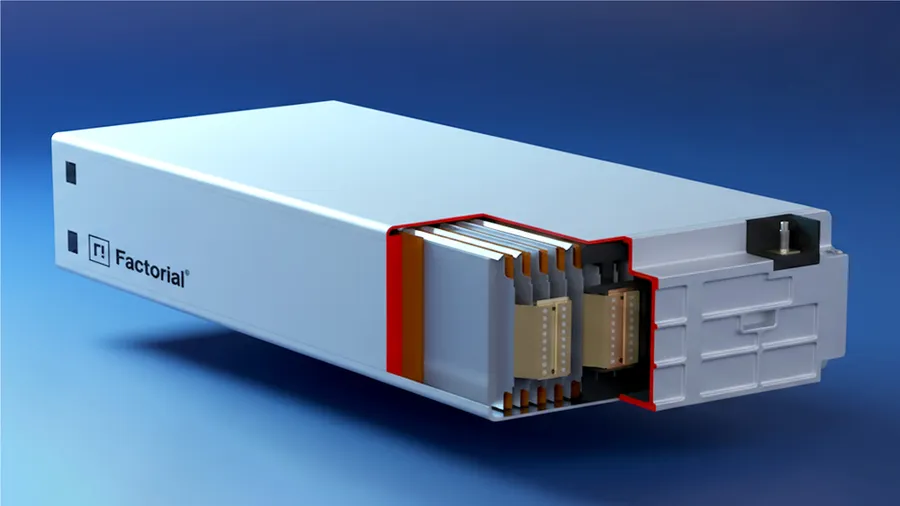
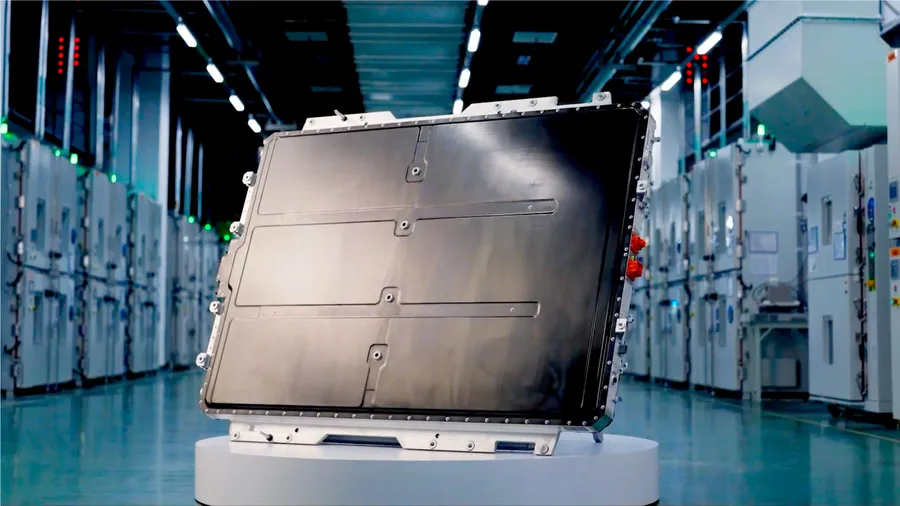
Lithium-ion batteries give you back about 90% of the electricity that you put into them. But this battery only returns about 40%. Even though it throws away more than half of the energy you give it, it’s still one of the most interesting things happening in energy storage tech right now.
And … it runs on rust.
Back in 2021, I made a video about a company called Form Energy, based in Somerville, MA, my old stomping grounds. They were building batteries out of rust, which sounded like a giant tetanus shot waiting to happen … but I liked the idea. Iron is cheap, accessible, and the electrolyte isn’t flammable. There was just one number I couldn’t get my hands on back then- their efficiency. I phrased it as, “Form was keeping its efficiency behind an iron curtain,” and that researchers figured this kind of system needed to hit 80% to work commercially.
Well, 5 years later, we have the number … and it’s 40%. During that time Form has raised over $2 billion in equity 1, built a factory in West Virginia, and is now building a 300 MW project in Minnesota for Xcel Energy to help power a Google datacenter.
So, how does a battery that wastes 60% of its power win deals like that? Where does it actually fit on the grid? And how does it hold up against other batteries? What do you say? Let’s get rusty.
Form’s Latest Developments
So, what does it look like for a battery company to grow?
Founded in 2017, Form Energy has taken iron-air from laboratory prototypes to commercial manufacturing. Its first product is a rechargeable iron-air system designed to store and discharge electricity for up to 100 hours. Form Energy has now tested more than 34,700 subscale cells, 6,200 full-scale cells and 170 modules, including grid-connected systems. Along the way, there were acquisitions, deals, and a factory.
In 2020, Form Energy acquired NantEnergy, a zinc-air battery company, to improve their air electrodes (keep this in the back of your mind for later). In 2022, the company signed agreement for a 15 MW project with Georgia Power, which is the largest utility in Georgia. 2
In 2023, Form Energy was awarded a $30 million grant from the California Energy Commission to deploy its first grid-connected system in California, which they built the same year. Form also signed contracts with electric companies including Xcel Energy. 2
In 2024, they completed construction of Form Factory 1, their first high-volume manufacturing facility in Weirton, WV. The same year the company was selected by the U.S. Department of Energy to deploy a 85 MW/8,500 MWh project in Maine. At the time it was the largest energy storage project by energy capacity announced anywhere in the world. 2
In 2026 the company went even bigger and broke that record with plans to deploy a 300 MW/30 GWh iron-air battery project with Xcel Energy, which will help power a new Google data center in Minnesota. 2
Form Energy says it began shipping its iron-air batteries internationally for a 10 MW/1,000 MWh project in Ireland and in August 2026 it raised another $750 million to expand manufacturing and accelerate commercial deployments. 3. If the Ireland and Minnesota projects proceed as planned, iron-air could move from “promising technology” to a genuinely significant grid-storage technology by roughly 2028–2030. 4
When I covered this last time, Form had just closed $240 million. Now, they're past $2 billion, which I didn’t see coming.
As the entire energy system turns to deal with increased demand from AI, Form Energy has bent itself in that direction too. The company recently partnered with Crusoe, the AI factory company. According to a press release, Form will “deliver 12 gigawatt-hours of multi-day energy storage systems to support the rapidly growing power needs of AI data centers starting in 2027”. 5 I know how much we all love a good data center … let’s not hold that against them.
Where Form … Fits in the Energy Economy
That tells us how the company has grown, but it doesn't tell us why. In today's energy economy, where does Form...fit?
Form Energy is one of a number of companies racing to supply Long Duration Energy Storage or LDES. There is no exact definition for what qualifies as LDES, but generally it's storage that lasts at least 8 to 12 hours. 6 LDES starts right were lithium-ion batteries get too expensive. Form's batteries store energy for 100 hours, putting them very far into the long duration territory.
LDES is necessary because sometimes the wind stops blowing and the sun stops shining. There's a German word for weather so bad that renewables can't generate anything: dunkelflaute. In English this translates to "dark wind lull," or "dark doldrums." 7 It's the stuff seasonal affective disorder is made from. In energy, dunkelflaute translates to more emissions. Because when wind and solar can't produce, and lithium-ion batteries run out, less sustainable methods become the best option.
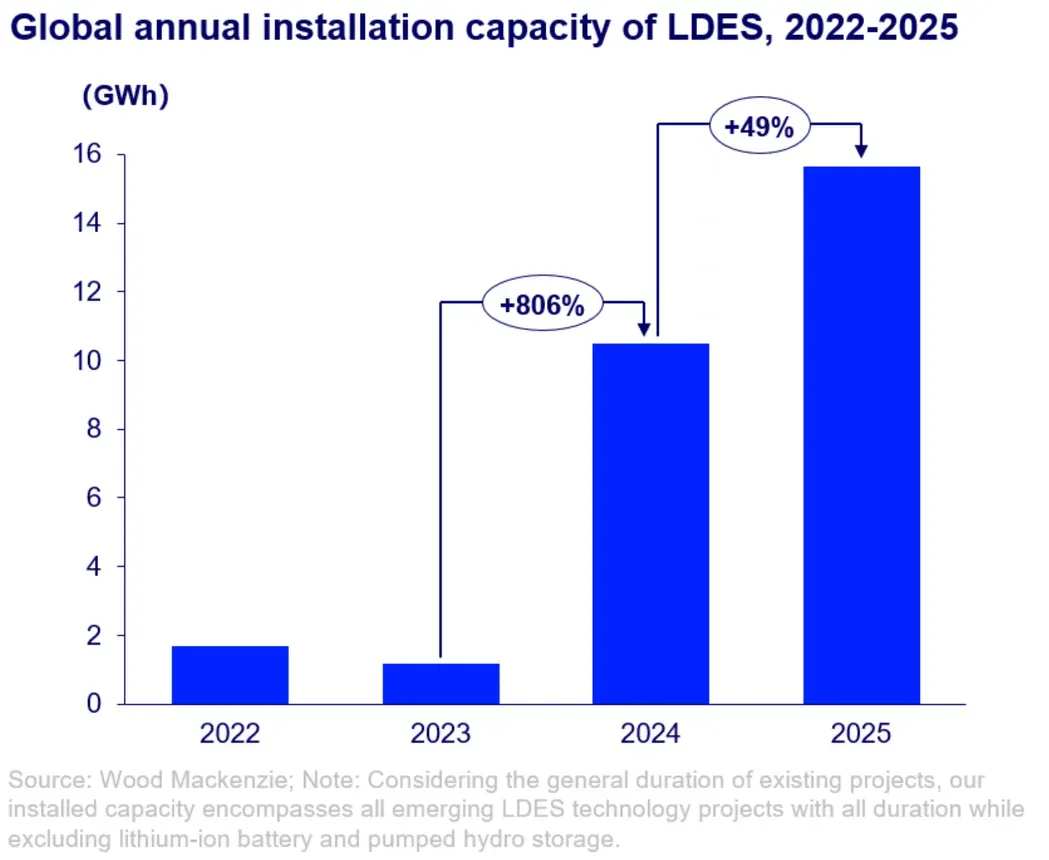
To get to net zero we'll need a lot of LDES. According to a recent report from Wood Mackenzie, "global average energy storage duration must increase from 2.5 hours to around 20 hours to maintain grid reliability while increasing intermittent renewable energy resources." 8
We're seeing installation capacity of LDES shoot up as the grid electrifies. Form is one of three companies with over a billion in funding vying to establish itself as the leader of LDES 8. But how exactly does their technology even work?
How do iron-air batteries work?
When iron reacts with oxygen, the iron becomes oxidized and gives up electrons. Instead of letting those electrons get trapped via corrosion, the battery forces them through an external circuit, where they can be used as electrical current. 9 10
Think of a revolving door. Instead of leaving through the door, the electrons go around again and power the battery.
The battery needs an iron electrode, an air electrode, and an electrolyte that allows ions to move between them. The air electrode gets its oxygen from the surrounding atmosphere, which means the battery doesn't need to carry oxygen inside the battery itself. 9
As the battery runs, the iron electrode gives up electrons and moves into oxidized forms such as iron hydroxides. Those electrons travel through the outside circuit, producing electricity. 11 10
At the other side of the battery, oxygen reacts with water and electrons to produce hydroxide ions. Those ions move through the electrolyte and help complete the overall chemical reaction, as they interact with the iron. 11
The result of this process is rusting on the iron electrode. The byproduct of this rust is magnetite, which, in its natural form, is the most magnetic occurring mineral on Earth. 12
Charging the battery essentially “un-rusts” the iron. The oxidized iron compounds that formed during discharge are converted back toward their original iron state, while oxygen is released back into the air. 12
Charging is like running that revolving door backwards. You have to stop it and shove it the other way, and that takes extra energy. Some of the electricity ends up making hydrogen gas through a competing reaction, which lowers the overall efficiency. 10 The iron electrode can also develop poorly conducting oxide or hydroxide layers that also make it harder for the reaction to continue. 9
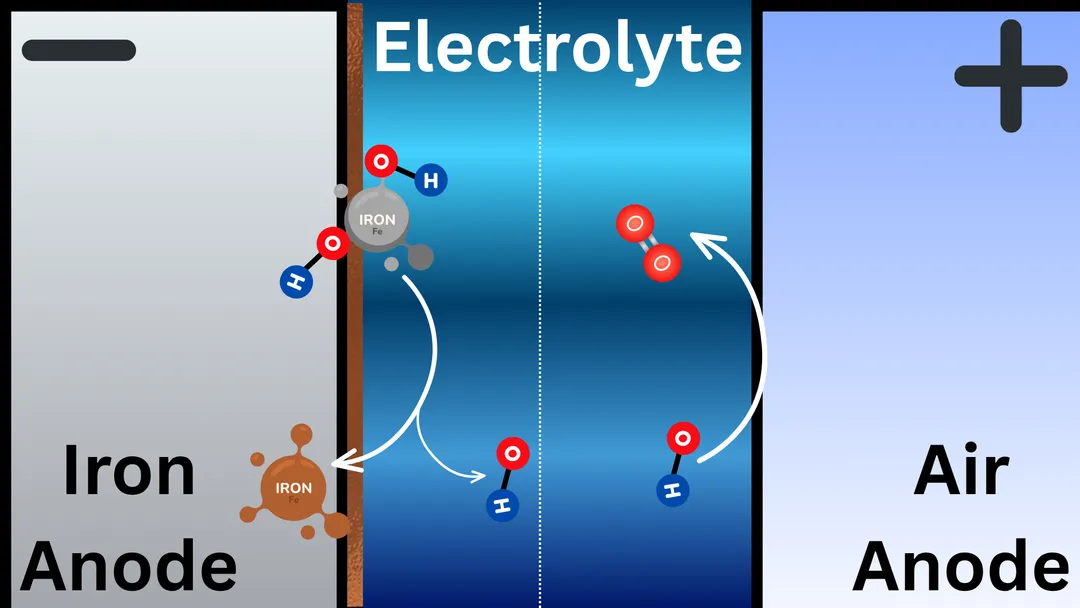
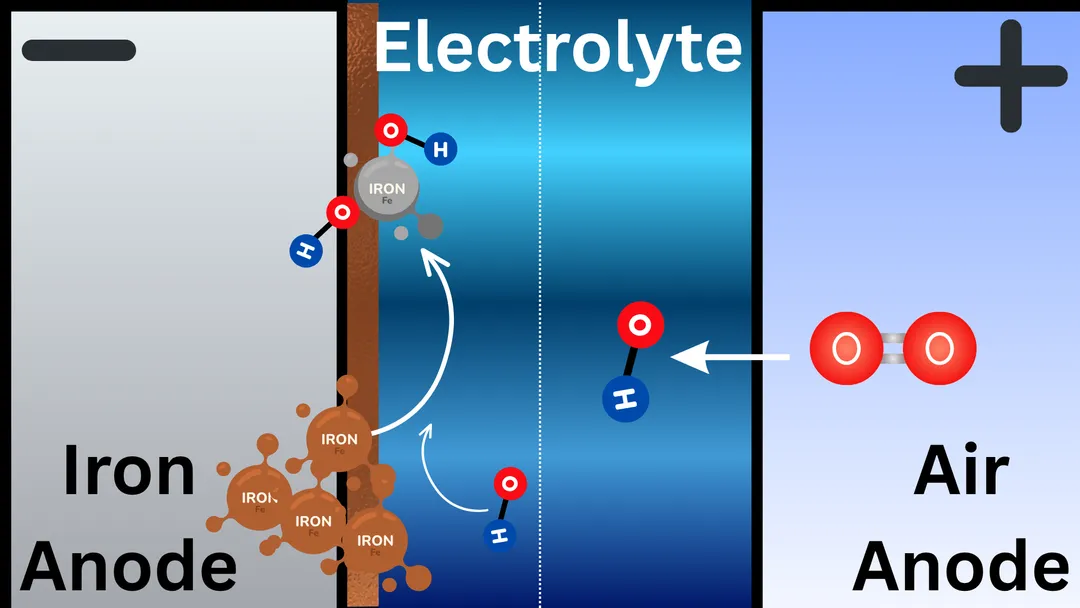
There are other versions of iron-air batteries including aqueous iron-air batteries. One of the most established approaches uses a water-based, or aqueous, electrolyte. The iron and air electrodes interact through this liquid electrolyte, which allows ions to move between the two sides of the battery. 9
While this technology may seem futuristic, it’s older than you think. NASA was the first to play around with the technology back in 1968, though it was hard to commercialize due to issues with the anodes and the electrolyte solution.
The companies Westinghouse, Siemens and Matsushita also conducted iron-air research in the 1970s, but couldn't crack it. Those efforts demonstrated the basic chemistry but also ran into problems with hydrogen evolution, corrosion and poor efficiency. 9
Over decades, researchers worked to improve the performance of these batteries. They figured out how to use small iron particles and conductive materials like carbon to increase the amount of iron that can participate in the reaction. They also developed catalysts and electrolyte additives to reduce hydrogen production, prevent surface buildup, and make the charging and discharging reactions more reversible. 13 11
While the science has finally helped make iron-air batteries viable for some companies, can iron-air batteries actually hold up to other battery types?
How do these batteries stack up against other batteries?
Let’s compare iron-air batteries to the commonly used lithium-ion battery.
For this comparison, we'll use Form Energy's system as our benchmark, because it’s the iron-air technology furthest along commercially. And we'll keep score. The rules are simple: each category gets one point to the technology that has the clearer advantage. A tie earns no point for either side.
Vs. Lithium Ion batteries
Let’s start with the more commonly used lithium-ion batteries.
Availability of materials: Iron is the 4th most common element on Earth, while lithium is about 2,000 times less available, and recycled less than iron is. Lithium-ion batteries also depend on more complex supply chains for materials than iron has, which makes them less widely available. 14
Score: Iron-air 1 — Lithium-ion 0
Capacity/Energy: Theoretical chemistry numbers can make iron-air look extremely energy-dense, as a 2014 study lists a theoretical energy density of 764 Wh/kg for iron-air 9. But the same table gives a practical specific energy density of just 50–75 Wh/kg for one iron-air configuration. That’s the number we’ll use moving forward
By comparison, modern lithium-ion cells are typically around 200–300 Wh/kg, with the U.S. Department of Energy citing cells around 220 Wh/kg for graphite-anode lithium-ion batteries. 15 So lithium has around 4 times the energy density compared to iron-air batteries.
Score: Iron-air 1 — Lithium-ion 1
Storage/duration: Lithium-ion batteries are extremely good at storing and delivering electricity efficiently over relatively short periods. 11
Iron-air batteries are designed around a different problem: storing electricity for many hours or even several days. Form Energy's first system is designed for up to 100 hours of discharge, while lithium-ion is generally more economically suited to shorter-duration applications. 4
Score: Iron-air 2 — Lithium-ion 1
Size: The flip side is that iron-air is enormous compared with lithium-ion for the same amount of stored energy.
A 50–75 Wh/kg practical specific energy means an iron-air system needs substantially more mass to store a given amount of electricity than a lithium-ion battery. An iron-air battery would be far too large and heavy for most of these uses. Form Energy says its battery systems are the size of “a shipping container,” making them too big for general use. 4
In 2021 I described these things as dishwasher sized, but they're shipping containers now. Everything about this company is getting bigger, except the efficiency.
That's why lithium-ion dominates applications like smartphones, laptops and electric vehicles, while iron-air is aimed at stationary grid storage. 11 Lithium gets the point here, because could you imagine laptops the size of shipping containers? Oh wait… that’s a supercomputer
Score: Iron-air 2 — Lithium-ion 2
Efficiency: Form's published target for its 100-hour system is a 40–45% round-trip efficiency, meaning that if you put 100 kilowatt-hours of electricity into the battery, you would get roughly 40–45 kWh back out. 4
That’s the number I couldn't get in 2021. I said back then that researchers wanted 80% efficiency and 5,000 cycles for a commercial system. Form is targeting 40 to 45%, which means the answer to my question is that it's half of what the bar was supposed to be. However, Form's argument is that the bar was wrong.
By comparison, lithium-ion systems can achieve roughly 90% round-trip efficiency, about 2x that of iron-air batteries 11. So, for every 1 MWh of electricity stored, a lithium-ion battery might return about 0.9 MWh, while Form's target iron-air system would return about 0.4–0.45 MWh.
Score: Iron-air 2 — Lithium-ion 3
Cost: Form has published a target of $15–$20 per kWh of installed capital cost for its 100-hour system at gigawatt manufacturing scale, although the company explicitly describes these as future targets rather than today's realized project costs. 4 That’s kind of nagging at me because I wrote about that $20 per kWh figure 5 years ago, and it’s still the “target.”
How do lithium-ion batteries stack up? They run around $100 kWh. That's a 5x difference before accounting for the additional costs and design differences between the systems.
The calculation illustrates one of the central arguments for iron-air batteries: if the cost per stored kilowatt-hour is low enough, it can become increasingly attractive as the required duration gets longer. So, iron-air wins this round.
Score: Iron-air 3 — Lithium-ion 3
Safety: Iron-air has an advantage as its aqueous electrolyte is nonflammable. 16 Form says that in 2024 its system passed UL9540A safety testing without flame or thermal-runaway propagation, which are common occurrences for lithium-ion batteries.
“The UL9540A cell-level test is the baseline for a battery’s safety profile,” said Matthew Paiss, Technical Advisor, Battery Materials & Systems at the Pacific Northwest National Laboratory. “Battery chemistries that demonstrate no thermal runaway at the cell-level represent a significant determination of inherent safety under extreme abuse conditions and eliminate the need for additional testing at the module or system level.” 16.
Meanwhile lithium batteries are considered generally safe under normal use, but they can be a serious fire risk if they’re damaged, overcharged, or poorly manufactured. Kind of like those batteries catching on fire during airplane flights. Iron-air wins this round.
Score: Iron-air 4 — Lithium-ion 3
So, does iron-air win over lithium? Iron-air is a better battery for a very different job. Lithium-ion wins when weight, size and efficiency matter. Iron-air is betting that those advantages become less important when the battery is sitting next to a power plant and the real objective is to store electricity for days at the lowest cost possible.
But there’s a caveat here
If the electricity being stored would otherwise be curtailed, for example, excess solar or wind generation that the grid can't use at that moment, then the value of the electricity going into the battery can be very low.
In that situation, the question becomes which battery stores the most electricity for the lowest cost … and keeps it available the longest. That is the economic argument for iron-air.
Iron-air isn't the only metal-air battery chasing this. Zinc-air works on the same basic idea, and it's more efficient, around 60 to 70% against Form's 40. 17 However, zinc has a dendrite problem that iron doesn't, and nobody is running zinc-air at gigawatt-hour scale yet. 18
Remember NantEnergy, that zinc-air company Form bought back in 2020? The iron-air company absorbed its closest chemistry rival to improve its own air electrodes. I ran the full zinc versus iron scorecard in the patreon exclusive version of this video if you’ve like to see more on that. The link to join is in the description.
Zinc-air is an even more interesting comparison because, like iron-air, it uses a metal and oxygen from the air. And unlike lithium-ion, zinc-air is also being developed with long-duration stationary storage in mind. It's a legit competitor. There are companies like Zinc8, which is now calling themselves ABOUND Energy, and Belgium's AZA Battery that are developing rechargeable zinc-air systems aimed at the same market. 19 So, to score them the same way…
Charging: Iron-air has an advantage in the mechanics of repeated charging. Rechargeable zinc-air batteries have to redeposit zinc onto the electrode. Over repeated cycles, that can lead to uneven zinc growth, including dendrites, as well as shape changes that degrade performance. 18
Iron-air has its own degradation problems, including corrosion and hydrogen evolution, but it doesn't have the same zinc-dendrite problem. We’ll call this a tie
Score: Iron-air 0 — Zinc-air 0
Efficiency: Earlier rechargeable zinc-air systems often achieved roughly 60–70% round-trip energy efficiency, although individual laboratory designs have performed considerably better. 17. One zinc-air system was observed reaching 61% energy efficiency, while other experimental architectures have reported efficiencies around 65–80% under very particular testing conditions.
Reminder, iron-air is 40–45% round-trip efficiency, almost half of what zinc-air is. 4
Score: Iron-air 0 — Zinc-air 1
Cost: Zinc-air has also produced some extremely low cost estimates, although they’re generally less mature than those for iron-air battery production.
In 2018, zinc-air company NantEnergy said it had reached manufacturing costs of roughly $100/kWh.
Zinc8 later said its system could eventually reach about $45/kWh installed when configured for longer-duration storage. 20 and 21
More recently, Belgian company AZA Battery has publicized a $20/kWh target at the cell level for its rechargeable zinc-air technology. 19
Again, just a reminder, Form has targeted $15–$20/kWh for their iron-air batteries. So perhaps a tie here since the cost is similar. 4
Score: Iron-air 0 — Zinc-air 1 (no points for either)
As for duration and track record, Zinc-air can go long, too. ABOUND Energy claims their zinc-air system is 8 hours and up, with over 100 hours of storage. 22 On paper, that matches Form. The difference is the proof. Form has grid-connected systems already running in the gigawatt-hour scale. Zinc-air's longest-duration claims are still on a spec sheets, so iron-air takes this round.
Score: Iron-air 1 — Zinc-air 1
Overall, it's kind of a draw. Zinc-air wins on efficiency. Iron-air wins on real-world progress. And both are still fighting with corrosion and degradation over time.
Conclusion: Coming Full Circle
So, Form has come a long way in just 5 years. They’re raised over $2 billion, have a running factory, and deals with utilities and AI data centers. The real questions all come down to execution. Can they prove 100-hour storage at scale out in the world? Can they hit that $15 to $20 per kWh target at gigawatt volume? And can they deliver on Ireland, Minnesota, and Crusoe between 2027 and 2030? How those answers shake out determines whether iron-air becomes a pillar of the grid or a very well funded experiment. Working alongside lithium-ion and zinc-air, it's an exciting prospect for powering the future. The fact we can use a cheap, readily available metal like iron to make batteries is electrifying to me. But how far can it go to electrify everyone else?
It’s also important to remember that there’s a lot of LDES competition growing fast behind them.
- Form Energy secures $270M credit facility to scale iron-air batteries ↩
- https://formenergy.com/about/#operations ↩
- https://undecided.tech/why-rust-batteries-may-be-the-future-of-energy-iron-air-battery-technology/ ↩
- https://formenergy.com/technology/battery-technology/ and https://formenergy.com/about/ ↩
- https://formenergy.com/form-energy-crusoe-announce-agreement-for-12-gigawatt-hours-of-iron-air-batteries-for-ai-data-centers/ ↩
- What is Long-Duration Energy Storage? ↩
- Dunkelflaute ↩
- Long-duration energy storage deployments rose 49% in 2025: WoodMac ↩
- https://chemistry-europe.onlinelibrary.wiley.com/doi/epdf/10.1002/cplu.201402238?saml_referrer ↩
- https://www.sciencedirect.com/science/article/pii/S1364032121000265 ↩
- https://link.springer.com/article/10.1007/s10008-024-05866-x ↩
- https://rmpbs.pbslearningmedia.org/resource/nvccz-sci-ironairbatteries/iron-air-batteries-to-store-renewable-energy-nova/ ↩
- https://www.nature.com/articles/s41570-024-00614-1 ↩
- https://www.iea.org/reports/global-critical-minerals-outlook-2025/beyond-nmc-batteries-supply-chain-issues-for-emerging-battery-technologies ↩
- https://www.energy.gov/sites/default/files/2021-06/FCAB National Blueprint Lithium Batteries 0621_0.pdf?_sp=aa88b5d1-9624-44a1-8387-6f90190064cd ↩
- https://formenergy.com/form-energys-breakthrough-iron-air-battery-technology-sets-a-new-benchmark-for-safety-in-energy-storage-systems/ ↩
- https://www.sciencedirect.com/science/article/abs/pii/S1364032121010406 ↩
- https://link.springer.com/article/10.1007/s40820-024-01328-1 ↩
- https://www.azabattery.com/ ↩
- https://www.greencarreports.com/news/1119299_zinc-air-battery-project-claims-100-kwh-cost-could-be-headed-to-vehicles ↩
- https://www.pv-magazine.com/2020/01/27/zinc-air-battery-aims-for-extremely-low-45-kwh-cost/ ↩
- https://www.abound.energy/technology/ ↩