Tandem PV: Is This the World's Most Efficient Solar Panel?
A California company called Tandem PV has built what's being called the most efficient tandem perovskite solar panel in the world, turning 30.4% of the sunlight that hits it into electricity.1 The best traditional silicon panels on the market today manage about 25%, and it goes on sale later this year.2 But before you get out your wallets, that 30.4% figure was measured by the company selling it, and the test module is only the size of a coaster. And on that same day, a rival announced an independently tested full-size panel that beats their claims.3
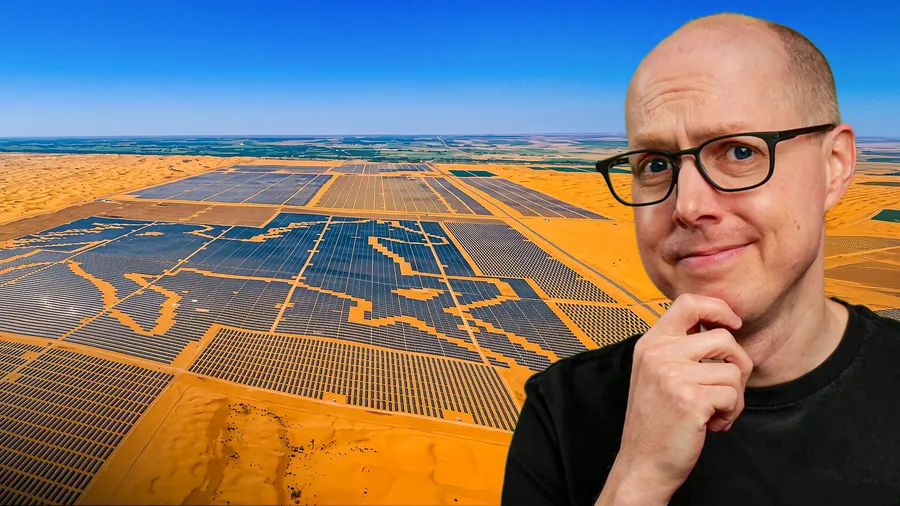
It would appear that perovskite solar is having a moment. I'm not Matt Ferrell, I'm his close friend Ricky from Two Bit da Vinci. But don't worry, Matt will be back next week. And if you're anything like Matt and me, you have to be excited about perovskite solar.
Matt has made countless videos about it over the years, but it's always had an Achilles heel. So have we finally figured out how to commercialize and build perovskite panels that last 30 years? Let's cut through the hype and headlines and figure out how this technology works and how impactful it could be.
The numbers
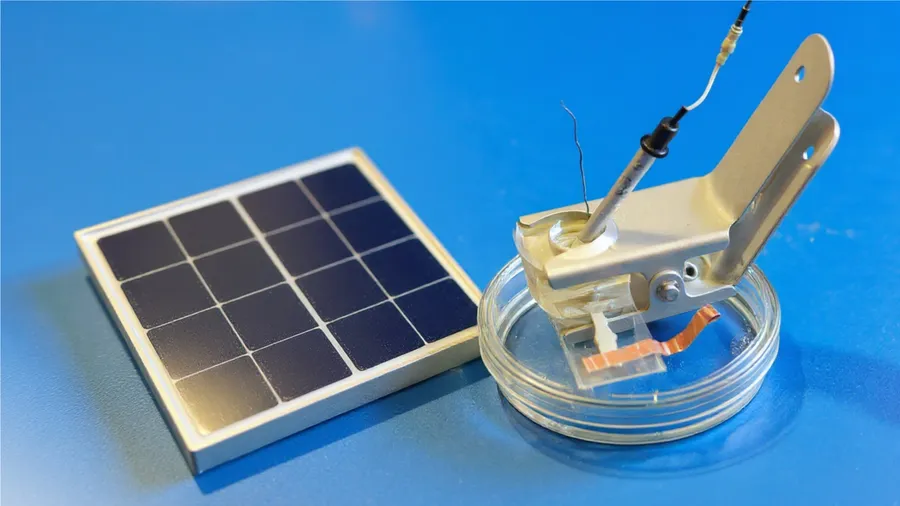
That 30.4% efficiency figure comes from a demonstration module Tandem PV announced in June that measured 100 square centimeters, roughly a square 10 centimeters on each side. And the testing was done in-house. At the time, that module was still working its way through third-party validation.1 The panel they intend to eventually sell is a standard utility module, which CEO Scott Wharton estimates will be 28% efficient at the panel level.2
That drop is pretty typical. Perovskite films are much harder to keep uniform across a whole panel than across a small test piece.4 And there's all the coatings and film and everything else. That's not bad.
Matt covered Tandem PV in his 2025 roundup,5 the year it received a $4 million grant from the California Energy Commission. And back when Wharton was promising panels for utility customers in 2026... well, it's 2026. And in late July, they shipped what they call their first production-quality panel.2 Tandem PV's 30.4% figure didn't come from perovskite grown on a silicon wafer, which is the approach big players like Trina and Qcells use.36
Instead, Tandem PV coats the perovskite onto the glass.1
Why perovskite is just 3 years away
First, let's back up a little. Silicon is the solar standard for good reason. It's tough and proven, but it has a hard ceiling. No single-junction solar cell can break what's called the Shockley-Queisser limit, which sits at around 33.15%, and in practice silicon tops out closer to 30%.7
Most panels you can buy today sit between 22 and 24%. So if a 400 watt panel is 22% efficient, a perovskite tandem panel of the same size at 28% would produce nearly 510 watts. Now, the ceiling exists because sunlight is a spectrum of wavelengths, from high-energy blue down to red and through infrared. What a cell can do with that light is defined by a property called its bandgap.
Silicon's bandgap sits at 1.1 electron volts, which suits it well for red and infrared far better than blue.
A single material either lets the low-energy light pass straight through or wastes the extra high-energy light as heat.
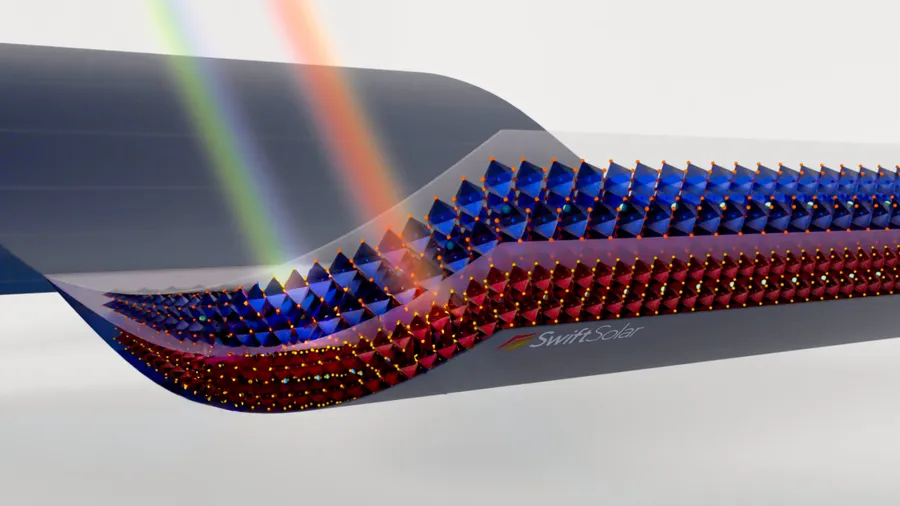
And that trade-off is what the Shockley-Queisser limit describes. So instead of asking one material to do it all, a tandem cell stacks materials tuned for different wavelengths on top of each other. A perovskite tuned somewhere between 1.6 and 2 electron volts sits on top and absorbs more of the blue end. Whatever it doesn't absorb passes through to the silicon underneath.7
Now, in the real world, nothing is perfect. Some light bounces off before it gets in. Some gets soaked up by the layers that make no power. And even the light that lands in the right place loses part of its energy as heat.4
Now, a tandem cell is starting to sound like kind of a no-brainer, but what keeps perovskite in the lab is its lack of durability. Perovskite struggles with moisture, heat, oxygen, ultraviolet light, and voltage.8 Not great for a material that needs to sit on your roof for 30 years in the scorching sun. And it's this durability limitation that's always kept it a couple of years away.9
So is it the most efficient panel in the world?
That's what makes this story so interesting. In June 2026, Tandem PV announced its 30.4% test module.1 That same day, Trina Solar announced a perovskite-silicon tandem module rated at 907 watts, with a full-panel efficiency of 29.2%. It was a complete module, roughly 4 feet by 8 feet, and Trina says the independent lab TÜV SÜD actually measured its efficiency.3
So Tandem PV has competition. But there's a second problem with the headline, and it's on Tandem PV's own website. The site promises "roughly 40% more power in the same form factor."10 That number only works if you compare the site's 30% figure to a 21.4% efficient panel, which is on the lower side of modern panels. If you instead compare their estimated full-panel efficiency of 28% to a top-of-the-line 25% efficient panel, well, the benefit shrinks to around 12%.
Still good, just not 40% better. Where Tandem PV can genuinely compete is time to market. Oxford PV launched tandem panels in the US back in 2024, but it's still making them on a pilot line, and it's targeting mass production in 2027.11 Trina doesn't expect to ship in volume until 2028 or 2029, and Qcells is still on a pilot line as well.6
Tandem PV plans to start selling this year and reach gigawatt scale in 2028.2 So a startup is right in the middle of a race with some of the biggest players in solar, and that is a real achievement if they can do it.
How it's made
So what does manufacturing actually look like? It starts with a sheet of glass that will become the front of the panel. Tandem PV coats one side of it with a thin film of perovskite, laid down from a liquid. For a full 80-pound panel, that's about five grams of that liquid, which Wharton says would fit in the size of a blueberry.2
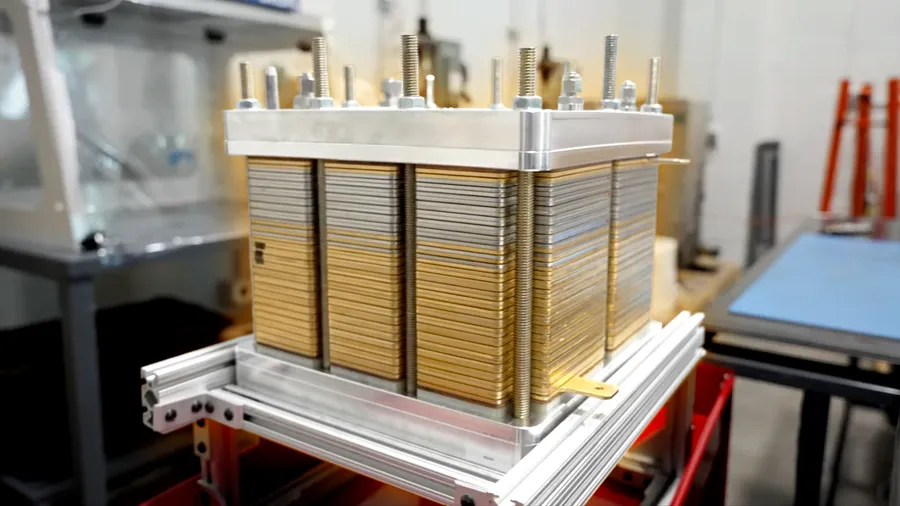
That film is sandwiched between two see-through electrodes, which make it a complete solar cell on its own, with its own pair of wires, while still letting the red and infrared light pass through. The coated glass then goes on top of standard silicon cells bought from another manufacturer, with the perovskite facing inward. The whole stack is sealed into a standard glass-glass panel, the same size as the ones developers already install.12 So the finished panel is really two solar cells stacked into one frame, each wired separately.7
That's important, we'll come back to that.
Yes, high efficiency numbers get the headlines, but honestly, this pragmatic, practical approach to manufacturing might be the more interesting part of this story. Oxford PV's chief executive, David Ward, said in January that there's nothing inherently expensive about the perovskite side of a tandem cell. In Ward's words, by far the largest share of the cost still comes from the silicon.11
The four-terminal architecture
The big players like Trina and Qcells make what's called a two-terminal tandem. You grow the perovskite directly onto the silicon wafer, and the two cells end up wired in series. The same current has to pass through both cells, so whichever one produces less sets the limit for the pair. Engineers call that current matching.
It means the perovskite has to be tuned precisely against the silicon beneath it, because if you get it slightly wrong, you lose output from both halves at the same time.7 So then, what happens if you don't wire them together? Well, a four-terminal tandem does exactly that, and it's the design Tandem PV is building. Now the two cells still share the same light, but each gets its own pair of wires and its own circuit, which the literature calls "optically coupled but electrically independent."7 With no current to match, the perovskite can sit anywhere in the 1.6 to 2 electron volt window. The stack also becomes less fussy about the color of light, which shifts all day as the sun climbs and clouds roll through. Now, two separate circuits do need more wiring, but electrically it's far more forgiving in terms of design. You can think of this as two separate solar panels on your roof, which is kind of what this is.
If you put them in series, shading on one panel would affect the output of both, whereas if you put them in parallel, they don't affect each other. That's in essence what they're doing here with Tandem PV's design.
Now this is interesting. Tandem PV's own numbers show what that looks like. Of the test module's 30.4%, the perovskite layer on the glass contributed 21.7%, and the silicon underneath contributed 8.7%, which adds up exactly to 30.4.1 Now, the Maxeon cell they used underneath is about 25% efficient on its own in open sunlight, and it's in perfect working order here too.
It's simply sitting in the shade of the perovskite, which takes most of the light first and leaves the silicon with what goes through. Exactly as intended, but like we mentioned before, it's not perfect. Those separate circuits matter to anyone who's eventually going to own these panels.
Long-term performance
Now, to find information on how well this design will actually work, I went looking for data on how these modules fail. A team at Ritsumeikan University, working with Sekisui Chemical, has tested exactly that on flexible perovskite modules. They put modules through 2,000 hours of damp heat at 85 degrees Celsius and 85% humidity. The damage showed up mainly as a loss of short-circuit current, which is the most current the cell can deliver. And even in the best-sealed module, that loss reached around 8% after 1,000 hours.
The cause was lead iodide buildup at the interface inside the cell, blocking the flow.13 Earlier this year, researchers at Delft University of Technology in the Netherlands modeled how fast that perovskite layer can fade before a tandem panel makes less electricity over its life than a plain silicon one. The answer depends on how long the panel would last otherwise. In their model, a panel in cool Delft takes about 48 years to fall to 80% of its original power, so the perovskite has to hold up for decades.14
It can only lose around 1.9% a year. In contrast, in hot, humid Lagos, moisture creeps into the plastic layers inside the panel and the heat speeds up the wear, so the same panel hits 80% in just 13 years. There, the perovskite can lose up to 7.6% a year and still come out ahead.15 The strictest limit in the paper is actually lower still, at 1.2% a year in Delft.
Now, it's this strict because the paper only models two-terminal tandems, where the two layers are wired in series. In a series stack, a perovskite that loses current throttles the silicon along with it. That's the same failure the damp heat tests kept finding. But remember that Tandem PV's panels are four-terminal, so each layer has its own wires.1
As the perovskite wears, it loses only its share of the power instead of dragging the silicon down with it. And if the perovskite does outright fail, the silicon underneath, on its own circuit, keeps working. A degraded perovskite turns into lead iodide or a yellow, inactive form of the crystal, and that material still lets through the red and infrared light the silicon already uses.8 So a dead top layer should leave the silicon making at least what it makes now, about 9% of the panel's 30 points overall.
Now, that's still a pretty bad panel, because a standard panel with no perovskite layer at all makes 22 to 24%. So yes, a four-terminal design helps if the perovskite layer fails early, but the panel would still badly underperform a plain silicon one. I couldn't find much research on how much a four-terminal panel really puts out once its perovskite layer has degraded, but that's a topic for another day.
Reality check
So four-terminal wiring, a simpler manufacturing process and road to market are great, but Tandem PV is still going to face some challenges. The first is certification and third-party validation, or the lack of it. In July, Qcells had their tandem technology certified to both the international IEC and the American UL reliability standards,6 and Trina says its panels have passed the IEC tests.3 But Tandem PV has a test module waiting in the queue and no published independent measurements for a full-size panel.1
The second is a warranty on a product we're still learning about. Tandem PV plans a 30-year warranty at 1% degradation or better.2 Losing 1% a year for 30 years leaves you around 70 to 75% of where you started. Mature silicon averages around 0.59% a year, which would leave you closer to 82 to 84%.
So even their promise is a little weaker than what traditional silicon already delivers. Oxford PV has been working on this since 2014 and already builds panels at its plant in eastern Germany. Its published roadmap targets a 15-year lifetime this year and 20 years in 2027, and it doesn't reach 30 years until 2030.11 A lifetime target isn't a warranty, but it does make me wonder how realistic Tandem PV's warranty plans really are.
Then there's money. Tandem PV has raised around $100 million, and perovskite glass capacity runs roughly $100 million per gigawatt.12 But if you've seen this channel, you know how notoriously difficult it is to build up factories and manufacturing. They're often delayed and over budget. Another challenge is the four-terminal design itself. A conventional panel has one positive and one negative cable.
A four-terminal panel has two separate circuits, and Tandem PV hasn't said how it brings them out of the panel. Wharton has promised the same electronics as a normal panel, but the review literature says four-terminal designs need more cabling and more power trackers, which adds cost.7 How that gets wired into your string inverters or microinverters is something installers are going to want to know about.
More pros and cons
Tandem PV wants 40 cents per watt,2 while the median US module in the first quarter of 2026 went for 28 cents per watt.16 That's 43% higher, which means that added efficiency will come at a premium. But that added efficiency can pay for itself in places like solar farms. The Department of Energy's reference plant is 100 megawatts, built from 600 watt panels at 21.9% efficiency, which takes 167,000 panels and about 380 acres of land.17
Now, if you increase the same panels to 28% efficiency, you'd need around 36,000 fewer panels and around 83 fewer acres on a single power station. But this argument is honestly a bit of a coin flip, because yes, fewer panels means less to maintain, less to clean, and less land to lease. But it hinges on just how long these panels truly last, and land availability and prices can vary wildly. Then there's the lead.
Lead is one of the three building blocks of the perovskite crystal, and lead versions are far more efficient and stable than anything made without it. The leading substitute is tin, but tin reacts with oxygen in the air and breaks down.1819 A perovskite layer carries around 0.82 grams per square meter, so a full-size panel holds roughly two and a half grams, sealed behind two sheets of glass.20 Luckily, that's not a ton of lead.
And researchers have also built a lead-trapping seal, so ideally, even a worst-case leak adds less lead to the topsoil than it can contain by itself.21 But it's something we need to honestly discuss before millions of panels enter the wild and eventually need to be recycled.
Conclusion
So then, looking at where we are with Tandem PV, I have to give it around a 6 on the NASA Technological Readiness scale. That's above the 3 to 5 that Matt gave graphene-perovskite cells last December9, and I wouldn't be surprised if we check in again a year from now and find that number keeps going up. So is this the world's most efficient solar panel? Well, no, not when you get to the full-panel level.2
But honestly, the more impressive part of this story is the pragmatic manufacturing approach they've taken, which I think they can actually deliver on. But that also ties into my disappointment. By adding a perovskite coating to a traditional solar panel, it'll always cost more than the conventional panel alone, and could shade the panel if the perovskite wears prematurely. So this is a play to add perovskite to increase efficiency, not a play to replace silicon and bring down prices even further, which is always one of my favorite parts of perovskite solar.
But I am genuinely pretty excited about this technology, and I'll be cheering for Tandem PV and all the perovskite players in this space.
Think of any technology as rungs on a ladder. With silicon solar, we're near the top, now fighting for tiny fractions of a percent in efficiency improvement. But tandem cells are like getting off one ladder on the top floor to walk across to a new ladder. We're now at the lowest rung of the new tandem cell ladder, with a lot of improvement on the horizon.
Could 35% efficient tandem panels be possible? 40%? What do you think? How important of a milestone is this? And how big of a deal do you think perovskite will factor into the future of solar?
Sound off in the comments below. All right, huge thanks to our channel members and patrons on Patreon, and to you for watching. Don't forget to like and subscribe. Matt is a leading voice in the future of sustainable tech, and I can assure you he will be back next week.
Check out the follow-up on his Still To Be Determined podcast, where he keeps the conversation going. Keep your minds open, stay curious, and I'll see you in the next one.
- Tandem PV announces 30.4%-efficient perovskite-silicon demonstration module ↩
- The world's most efficient solar panel goes on sale later this year ↩
- Trina Solar announces 907 W tandem solar module with 29.2% efficiency ↩
- Cell-to-module efficiency losses in perovskite photovoltaics ↩
- What Solar's 2025 Breakthroughs Mean for 2026 ↩
- Qcells secures TÜV Rheinland certification for perovskite-silicon tandem solar tech ↩
- Review on two-terminal and four-terminal crystalline-silicon/perovskite tandem solar cells ↩
- The long road to outdoor stability ↩
- How This Perovskite Breakthrough Could Change Solar Forever ↩
- Tandem PV ↩
- Oxford PV targets 20-year lifetime for perovskite-silicon tandem modules by 2028 ↩
- U.S. perovskite startups make moves into tandem panel manufacturing ↩
- Perovskite solar cell modules: Understanding the device degradation via damp heat testing ↩
- Modeling subcell degradation rates in perovskite-silicon tandem modules ↩
- Modelling subcell degradation rates in perovskite-silicon tandem modules ↩
- U.S. solar module prices face upward pressure as trade risks and FEOC rules dominate Q1 2026 ↩
- Solar Photovoltaic System Cost Benchmarks ↩
- Lead-free perovskite photovoltaics ↩
- Lead-free perovskite solar cells ↩
- A review of lead leakage monitoring in perovskite solar cells ↩
- Lead management in perovskite photovoltaics ↩