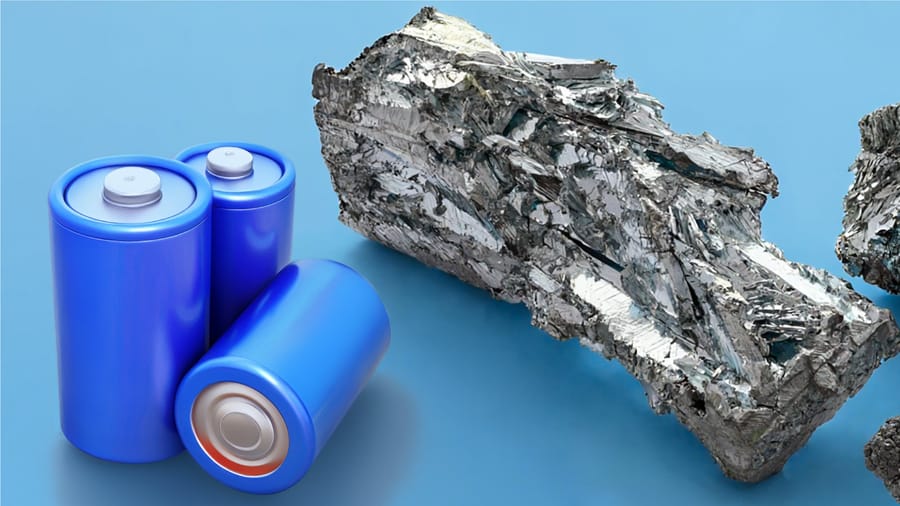
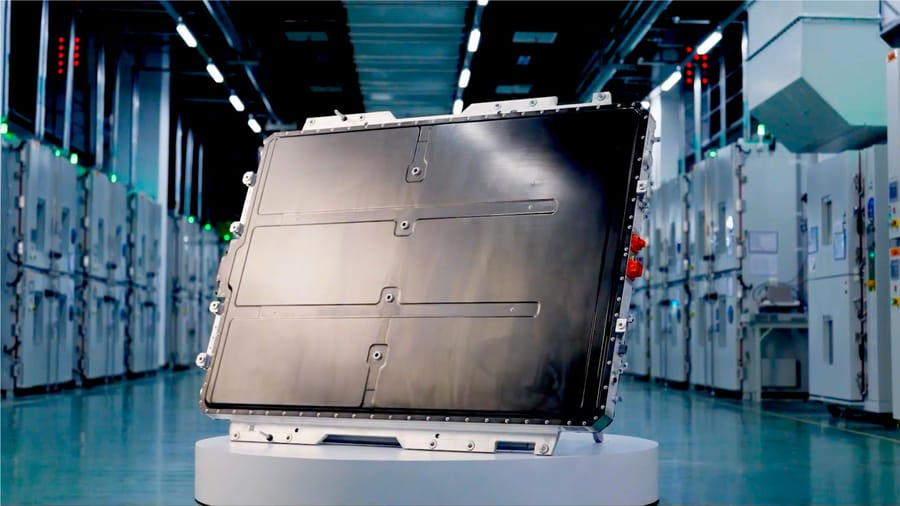
CATL, the world's biggest battery maker, just named what it thinks comes after solid-state batteries. It's called lithium air, and the headlines say it stores as much energy as gasoline. I've watched enough battery 'breakthroughs' fizzle to be careful with a claim like that. So, we dug in. And the real story is more interesting than the hype.
This is a battery that breathes. It stores energy using oxygen pulled right out of the air. And that lets it pack in more energy by weight than typical batteries that rely on heavy, hard-to-get metals.
In just the last few years, prototypes have gone from choking on humid air and side reactions to cycling 1,000 times and reaching more than twice the energy density of upcoming solid-state batteries.
Scientists at Argonne National Laboratory and the Illinois Institute of Technology say this battery could let EVs drive 1,000 miles, or 1,600 km on a single charge. And start-up Air Energy is inching towards commercializing it for long-range drones or even regional aircraft.
So, how does a lithium–air battery work? How did it go from a 1970s long shot to a technology CATL is betting on today? And just how much of the hype is science, and how much is a headline that got ahead of the lab?
I've been making videos about solid-state batteries for years. I'm still charging my phone with the same lithium-ion tech I had back then. So when the world’s largest battery maker, China’s CATL, announced what comes after solid-state, and the headlines shouted gasoline-level energy, my first instinct was to look for the catch. And there is one.
The company’s chief scientist, Wu Kai, says the company is banking next on lithium–air. It’s a lithium battery technology that ditches heavy cathode metals and instead uses oxygen from air to store lithium ions.1 Less weight means a higher energy density battery.2
Scientists at Argonne National Laboratory and Illinois Institute of Technology say lithium–air could give EVs a larger driving range than ever, and help electrify long-haul trucks, trains, or even some aircraft.34 They’re the team behind the biggest lithium–air breakthrough yet. It’s the first-ever rechargeable solid-state lithium–air battery with both a high energy density and a long cycle life.4
Their prototype reached nearly 700 Wh/kg at the cell level and lasted 1,000 cycles in 2023.5 The technology has since reached 1,000 Wh/kg, and is expected to get even better.2
It’s no wonder this lithium–air tech received a second round of DOE funding and an oversubscribed private funding round.2 Yes, a US-based start-up is working to move this technology from the lab bench to pilot production. I’ll get to that in a bit.
But first, how can oxygen stand in as a cathode material in a lithium battery? And could ditching that heavy cathode ever get lithium–air up to gasoline-level energy densities like the headlines claim?
The Battery That Breathes
Like a standard lithium-ion cell, this battery has a cathode and an anode, separated by an electrolyte. But lithium–air batteries trim weight by ditching the typical graphite anode for a pure lithium metal anode.6 They also scrap the heavy and expensive cathode metals, like nickel and cobalt, that weigh down the cathodes of today’s top-performing batteries.1
Instead, lithium–air’s cathode is a porous material, open to the surrounding air. When the battery discharges, lithium strips off the metal anode, passes through the electrolyte, and reacts with oxygen in those cathode pores. When the battery is recharged, lithium and oxygen part ways, with lithium returning through the electrolyte to plate on the anode.7
Simple enough on paper. So why did it take fifty years to build one that works, and why is CATL only betting on it now?
The idea dates back to the 1970s, though the first one didn’t arrive until 1996 and it was lithium-oxygen, not lithium–air.8 The problem? A battery that breathes is picky about air. Water vapor and carbon dioxide react with the lithium and the electrolyte. The gunk they leave behind plugs the pores in the cathode. The battery slowly suffocates.19
Every one of those early cells needed a tank of pure oxygen bolted to it. Fine in a lab. Try strapping that to a car. Then, in 2018, that same team in Illinois made the first true lithium–air battery. It survived nearly 700 cycles.1011
Fifty years of oxygen tanks, and one team finally got a cell to breathe real air.
But the high energy density CATL is banking on came even more recently. It depends on a neat trick that lets each molecule of oxygen pull double duty. Oxygen is the ingredient in short supply in a breathing battery. Lithium can react with each oxygen molecule (O₂) to store 1, 2, or 4 electrons.5 Earlier lithium–air batteries locked in the 2-electron reaction, forming lithium peroxide (Li₂O₂), which has a stellar theoretical energy density of 3,500 Wh/kg.1213
But in 2023, the team in Illinois designed a battery stack that favored the 4-electron reaction, producing lithium oxide (Li₂O), even at room temperature.145
Professor Asadi from the Illinois Institute of Technology told Aviation Week,2
“When you have four-electron transfer, you can store more energy in the same volume and the energy density goes much higher.”
This is the killer reaction that raises the theoretical limit of lithium–air to 5,200 Wh/kg.
But the number that’s been ping-ponging from one news outlet to another is even higher: 12,000 Wh/kg, on par with gasoline.
It’s time for a hype check.
I haven’t found any hard evidence that CATL or its chief scientist Wu Kai claimed a particular energy density for lithium–air. 12,000 Wh/kg is just the number bouncing around news sites. The press got ahold of a number it liked, and ran with it.
That number covers the active material alone. It leaves out the current collectors, the electrolyte, the cathode structure, and the battery management system. These numbers only count the energy stored in lithium and oxygen. And 12,000 Wh/kg counts the lithium by itself. As far as that math goes, the oxygen rides along for free.
Selling the energy density of a whole battery based on the energy density of just its active material is like selling an apple pie based on the nutritional content of just the apple. Hype the battery all you want. Lie to me about pie, and we've got a problem.
The number to care about is the battery’s pack-level energy density. As we’ll see in a moment, it’s already higher than what solid-state lithium-ion batteries are promising. That’s thanks to two tricks that steer the chemistry towards the 4-electron lithium oxide reaction.
The first trick is a cheap, but super effective, catalyst. Kind of like how a broker coordinates the logistics to help buy or sell a property, catalysts can help coordinate chemical reactions in either direction, too. The molybdenum phosphide (Mo₃P) catalyst on this lithium–air cathode speeds up the formation of lithium oxide as the battery discharges. The catalyst also helps it split back into lithium and oxygen as the battery charges back up, helping the battery cycle efficiently.514
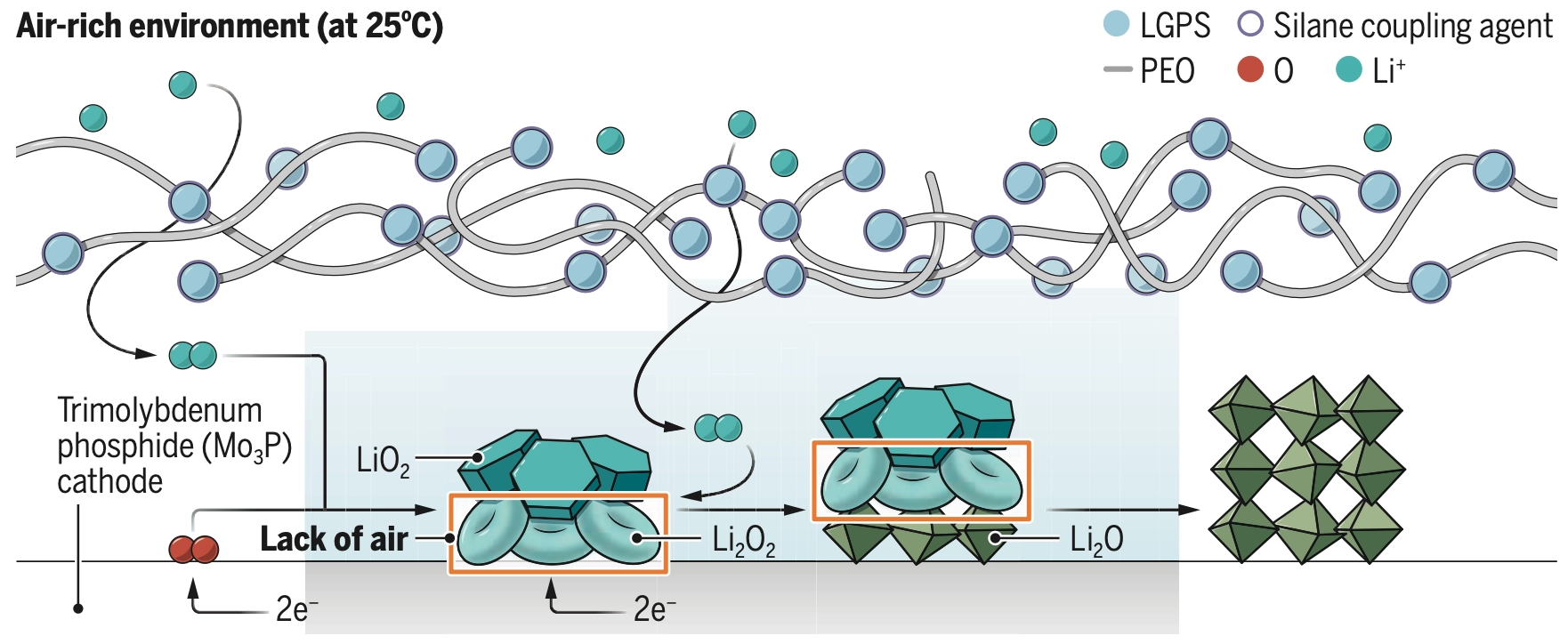
The second trick is a composite ceramic and polymer solid-state electrolyte. Ceramic electrolytes are better at conducting lithium ions, but flexible polymers help maintain good contact between the layers of a solid-state battery. This composite electrolyte is the best of both worlds, with lithium-rich nanoparticles sprinkled in. At room temperature, it conducted lithium ions about 15x better than other solid materials.15 The researchers think its high conductivity, and help from the catalyst, made lithium oxide (Li₂O) the favored reaction product.
That’s not easy to do. The oxygen in air is oh-two (O₂). But to make lithium oxide (Li₂O) with its single oxygen atom, you’ve got to break that oxygen bond.5 Lithium peroxide (Li₂O₂), with its two oxygen atoms, is just easier to make.5 But in this system, even when lithium peroxide is made, it turns to lithium oxide. The researchers aren’t sure why, but one theory is that when lithium peroxide forms on the cathode, it blocks the entry of more oxygen, forcing its own conversion to lithium oxide as more lithium ions arrive.5
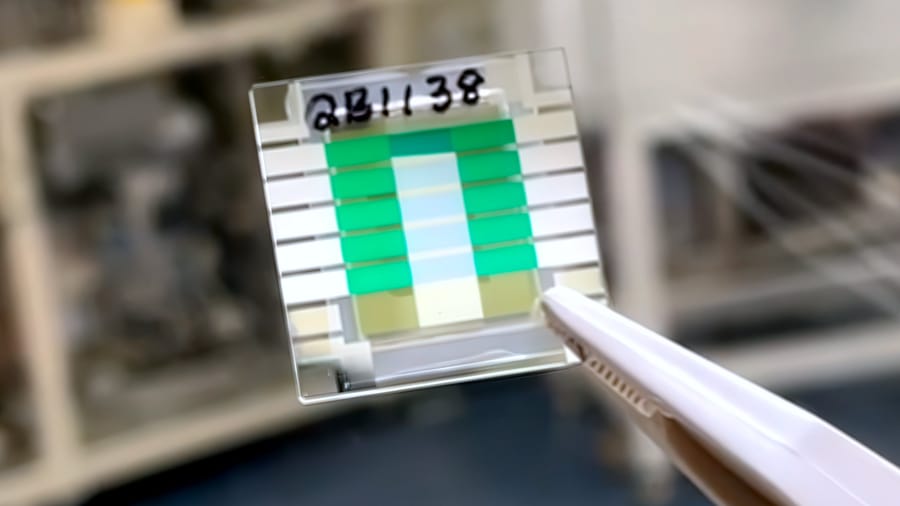
These tricks helped the team at Argonne National Laboratory and the Illinois Institute of Technology build a 685 Wh/kg lithium–air battery in 2023 that lasted through 1,000 charge cycles.514 That earned the team a $1.5 million grant from the Department of Energy (DOE) in 2024.16 Since then, the technology has reportedly reached 1,000 Wh/kg at the cell level and 700 Wh/kg at the pack level.2
That’s the full battery, with airflow and control electronics … the whole apple pie at an energy density higher than the best solid-state lithium-ion has promised.17
The scientists developing this battery expect a mature, commercial battery to eventually achieve at least 1,000 Wh/kg.18 That’s 4x more energy by weight than today’s mainstream EV batteries, and 2x more energy than upcoming solid-state batteries.17 It doesn’t matter that it’s nowhere near 12,000 Wh/kg
… because batteries don’t actually have to compete with gasoline. Combustion vehicles only turn about 20% of gasoline’s energy into motion, according to MotorTrend. The rest is lost as heat. EVs are nearly 90% efficient.19 By my back of the envelope calculation, an EV battery at 2,700 Wh/kg beats gasoline. And that’s before you even consider the lower fuel costs, maintenance, and emissions.
This is for you, Patreons: The solid electrolytes developed for lithium–air may prove useful for more than just batteries. They might help us mine lithium straight out of the ocean. A team led by Haoshen Zhou and Ping He from Nanjing University in China has used a lithium–air ceramic called LAGP [Li₁.₅Al₀.₅Ge₁.₅(PO₄)₃] to directly extract lithium from saltwater.20
Lithium prices have come down from their 2022 high,21 but efforts to reduce the environmental and human health toll of lithium extraction haven’t made nearly the same gains.
There is 5,000x more lithium in the oceans than in the world’s combined reserves of hard-rock lithium ores and lithium brines.22 And while most lithium reserves are concentrated in just a few countries, the ocean is far more accessible.
But lithium concentrations in seawater are so low, at around 0.17 ppm,22 I can’t even show them to you on a pie chart of seawater salts. Lithium's slice is too thin, so any method to pull lithium out of seawater has two jobs: concentrate the lithium, and leave every other salt behind. So far, that hasn’t happened at a price point that competes with traditional lithium extraction. Cue this new lithium–air-inspired electrodialysis technique.
Normally, I think of electrodialysis as a desalination method that uses electricity to drive salts across a membrane, leaving behind fresher water. But when you drive just one particular salt across the membrane, you selectively concentrate it.
That’s exactly what the researchers at Nanjing University in China did, using a lithium-selective ceramic as a membrane for electrodialysis, with saltwater on one side, and a liquid electrolyte on the other. When lithium passes through the ceramic membrane, it combines with oxygen (O₂) and carbon dioxide (CO₂) from air bubbled into the electrolyte. Together, they form lithium carbonate (Li₂CO₃), a powder that can then be filtered out of the electrolyte. The technique produces 93.8% pure lithium carbonate, which is a direct feedstock for lithium batteries.232022
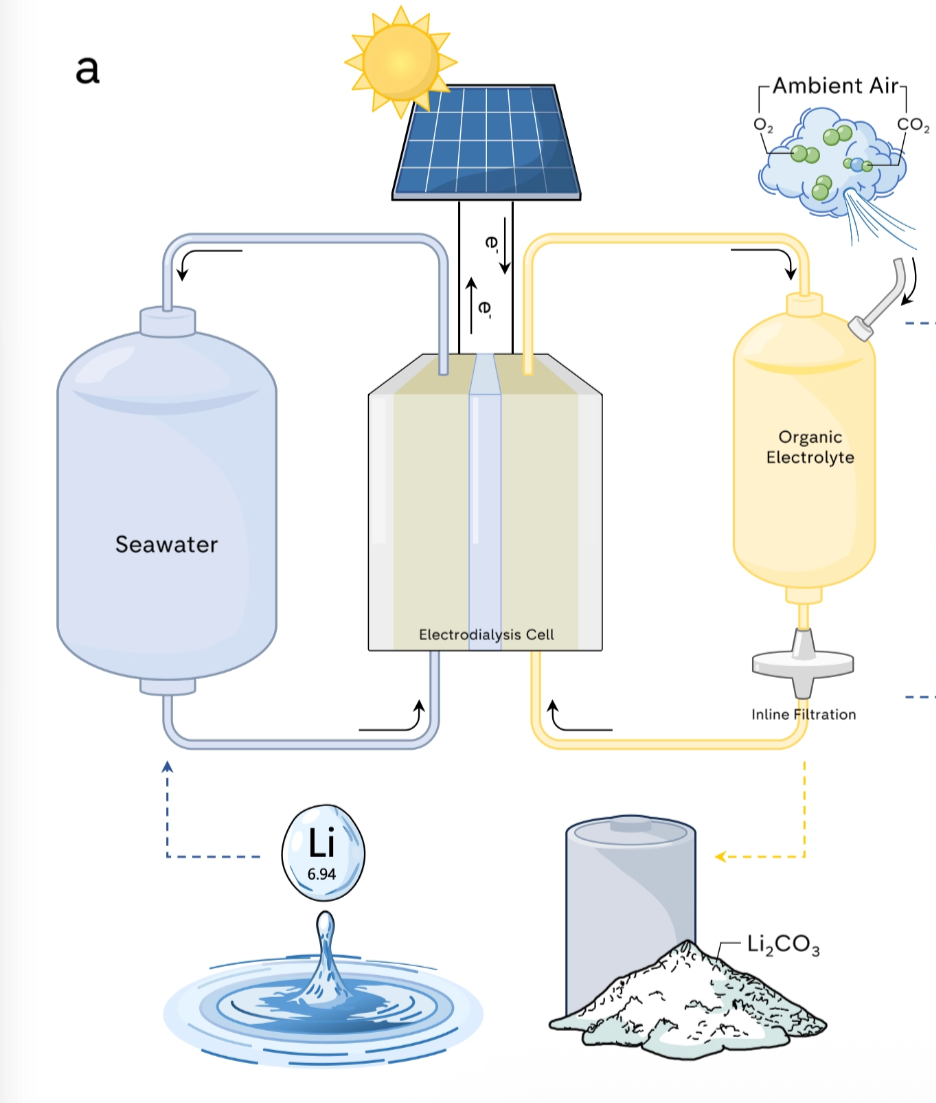
Nobody has built a plant for this. It's a lab bench technique with an expensive ceramic at the heart of it. But electrodialysis uses less energy and far fewer chemicals than traditional extraction methods. The researchers calculate that their direct extraction method could end up cheaper than conventional methods, depending on how long each ceramic membrane holds up.22
Like lithium–air batteries, this direct lithium extraction method is promising, but still in R&D.
The Illinois team’s new goal, backed by another $3.2 million in DOE funding,24 is to design and test lithium–air pouch cells for drones.2 That’s the dream: to create a battery so energy dense it can power flight further and longer than ever.
The DOE has set a target of 1,000 Wh/kg at the pack level.224 Professor Asadi told Aviation Week,2
“We have a pathway to go beyond that, hitting a target of 2,000 Wh/kg down the road.”
He and Larry Curtiss from Argonne National Laboratory founded Chicago-based Air Energy to commercialize their solid-state lithium–air technology. The goal is to adapt the battery for conventional roll-to-roll manufacturing methods.2 They’re aiming for pilot-scale manufacturing beginning in 2027,2 although production dates … and the path from lab prototype to fully commercialized battery … rarely go as planned.
This isn’t the first rechargeable lithium–air battery the DOE has funded.25 They awarded $5 million to PolyPlus Battery Company in California in 2010. And they’re … still working on it.26
Here’s my take: solid-state lithium–air is arguably one of the most promising battery chemistries to move forward in the past decade. It has real potential to extend the range of EVs and small aircraft like drones. But it’s going to have to clear the same hurdles facing all solid-state batteries in addition to new challenges the air cathode brings.
The cathode of that original 2023 prototype was super thin.5 A commercial cell is going to need a much thicker cathode to store a meaningful amount of energy without choking off the airflow the chemistry depends on. And that’s before tackling any remaining issues preventing the chemistry from scaling up.
Air Energy’s CEO Benjamin Drake put it plainly, saying,27
“We still have significant engineering and manufacturing work ahead.”
Lithium–air is a long-term ambition for CATL, too, according to Taiwanese outlet CNYes.28 The company expects development to continue past 2030.
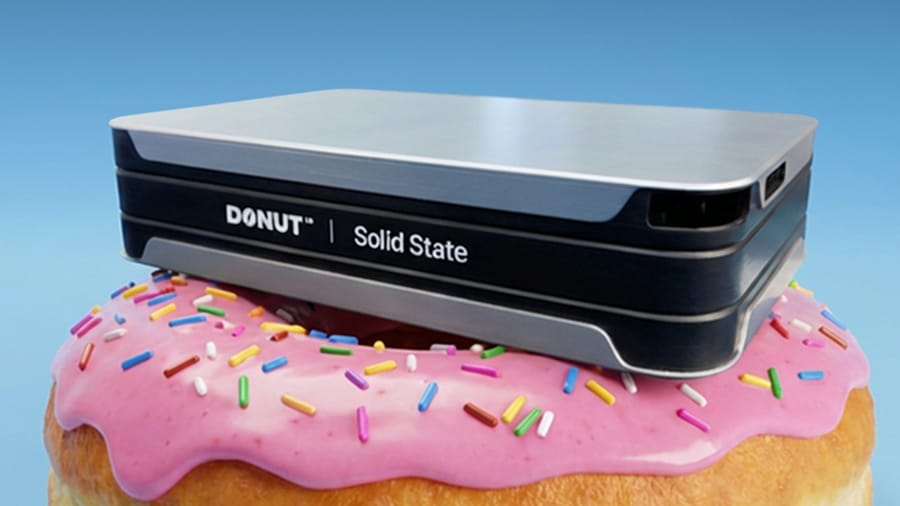
The lithium–air headlines got ahead of the lab. Credit where it's due, CATL and Air Energy kept their own claims grounded. That’s more restraint than Donut Lab showed when it hyped its own solid-state lithium-ion battery for release in the first quarter of this year. That deadline has come and gone.
And I won’t be holding my breath for lithium–air, either. But it’s good to see its developers building batteries in the lab, not castles in the air.
- Car News China – CATL sets sights on lithium-air technology with theoretical gasoline-level 12,000 Wh/kg energy density ↩
- Aviation Week – Air Energy’s Lithium-Air Battery Could Enable Bigger Electric Aircraft ↩
- Argonne National Laboratory – New design for lithium-air battery could offer much longer driving range compared with the lithium-ion battery ↩
- Illinois Tech – Illinois Tech Assistant Professor Publishes Paper in Science on Novel Chemistry behind Ultra-High Power Density Batteries ↩
- Science - A room temperature rechargeable Li2O-based lithium-air battery enabled by a solid electrolyte ↩
- Next Research – Exploring the anode materials for lithium-ion batteries: A review ↩
- Interesting Engineering – CATL eyes 12,000 Wh/kg theoretical limit lithium-air EV battery to end range anxiety ↩
- 36Kr European Central Station - We haven't fully understood solid-state batteries yet, and now lithium-air batteries are here ↩
- Nano Micro Small – Critical Advances in Ambient Air Operation of Nonaqueous Rechargeable Li–Air Batteries ↩
- Nature – A lithium–oxygen battery with a long cycle life in an air-like atmosphere ↩
- Science Daily – New design produces true lithium-air battery ↩
- Journal of Alloys and Compounds – Metal-air batteries: From fundamental mechanisms to practical applications ↩
- Metal–Air Batteries: Fundamentals and Applications ↩
- Interesting Engineering – Solid lithium-air battery hits 4x energy, breaks room-temperature performance barrier ↩
- Clean Technica – Researchers Report Progress On A Solid-State Lithium-Air Battery With High Energy Density ↩
- ARPA-E – All Solid-State Li-Air Technology for Green High-Performance Transport ↩
- ArenaEV – CATL claims its lithium-air battery has energy density similar to gasoline ↩
- Air Energy – HOW DO LITHIUM-AIR BATTERIES WORK? ↩
- Motortrend – Electric Vehicles Are Way, Way More Energy-Efficient Than Internal Combustion Vehicles ↩
- AZO Materials – Seawater Lithium Becomes Battery Material Through Li-Air Chemistry ↩
- Trading Economics – Lithium ↩
- Nature Communications – Li–air chemistry inspired electrodialysis for direct lithium carbonate production from seawater ↩
- Wikipedia – Lithium ↩
- ARPA-E – JOULES-1K Phase Two Project Descriptions ↩
- ARPA-E – PolyPlus Battery Company ↩
- PolyPlus – Product Pipeline ↩
- LinkedIn – Benjamin Drake ↩
- CNYes – CATL Reveals Future Energy Strategy Focusing on Lithium-Air Batteries ↩