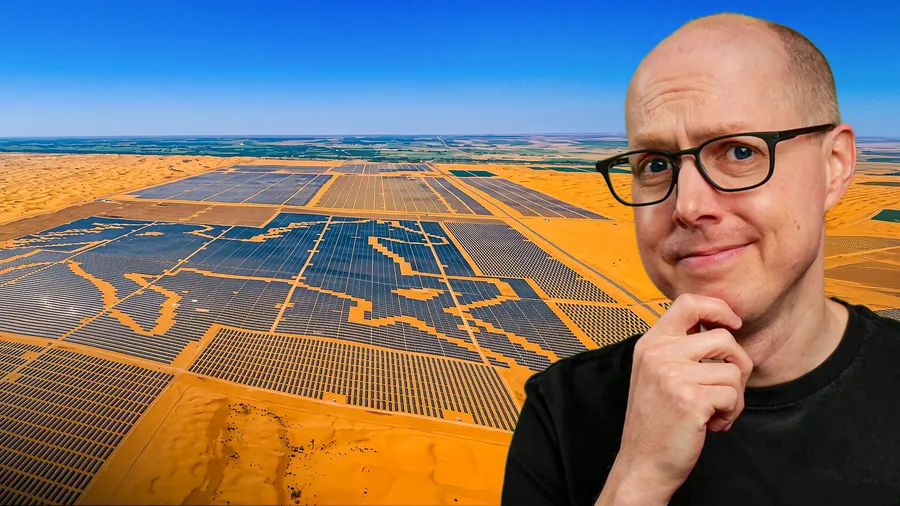
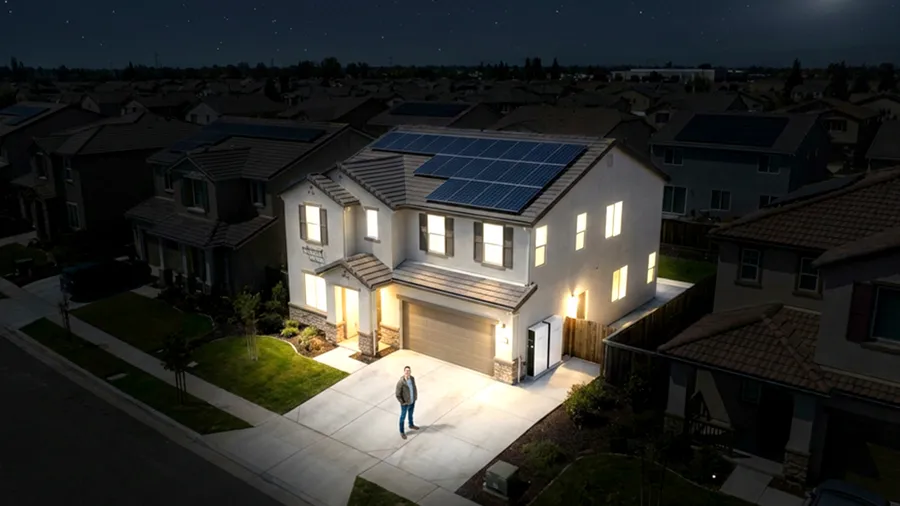
About one in three Australian homes have rooftop solar.1 Here in America, it’s less than one in ten.2 Same sun. Half of the US sits at the same latitude as Australia, and Denver is sunnier than Melbourne.3
The difference is the bill. A 7kW system here runs a median of $28,000. That’s $18,000 to $24,000 more than the exact same system costs in Australia, up to seven times the price.4 Australia is a rich Western country like the US, and it went solar for one reason above all others: money. The revolution in the lucky country is a product of cost, which has been going down…under.
I know exactly how we got here, because I’ve lived it. When I put solar on my own house, the panels sat there for months waiting on paperwork. Australia treats a solar install like buying a refrigerator. We treat it like a zoning hearing.
And their head start is compounding. Australians are adding home batteries at a rate of 2,000 a day, and that flood of storage helped drop the cost of generating power 12% in a single quarter.5 Cheaper electricity for everyone, including the people with nothing on their roof.
So what does Australia know that we don’t? What is the gap costing you, and what would it actually take to catch up?
An anti-renewables White House
Here’s the part that stings. America literally INVENTED photovoltaic technology. Germany provided the market for it, and China industrialized it. So how is it that the lucky country is eating our lunch after slathering it in electron vegemite?
There’s a big obvious reason why solar is taking off faster in Australia than the US. It’s the first of several. Right now American energy policy is actively ANTI-renewables.
The Trump administration’s energy policy is slowing down solar. This year he got rid of tax credits that existed for solar at the end of 2025. Although far from perfect, they made residential solar 30 percent cheaper.6
And that’s not all. Trump spent $2.6 billion taxpayer dollars to stop wind projects in development, funneling that money into fossil fuel extraction instead.7 And he’s fired renewable energy lab researchers,8 cancelled renewable money for farmers and ranchers,9 and slashed billions in energy grants to states that didn’t vote for him.10
This is setting America back. Canary Media expects peak annual solar installs to be held back for an entire decade.112
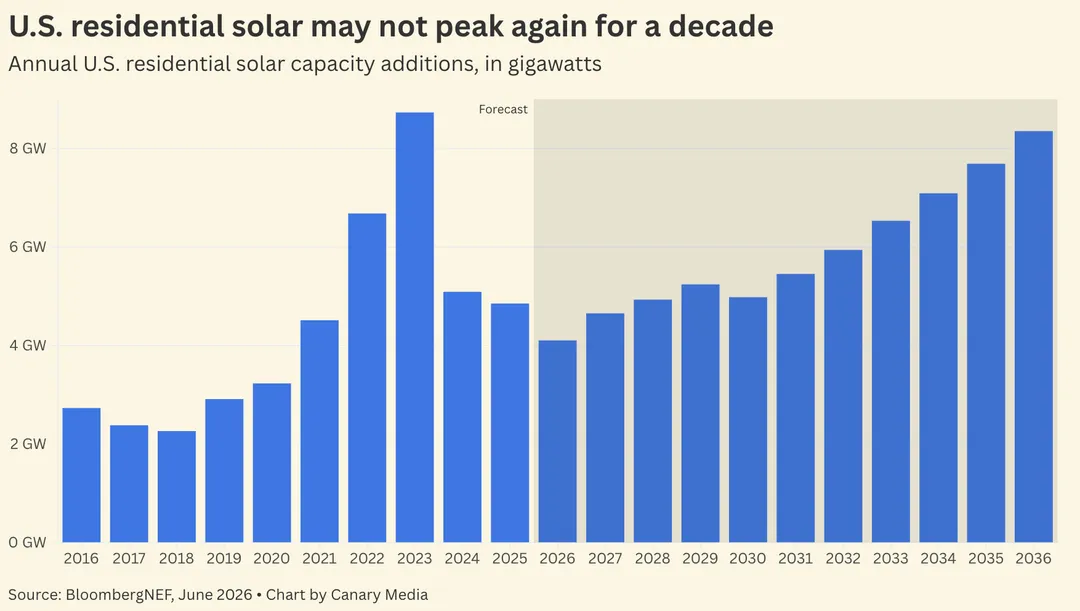
These policies make solar more expensive, and they convince people to be less enthusiastic about renewables.12
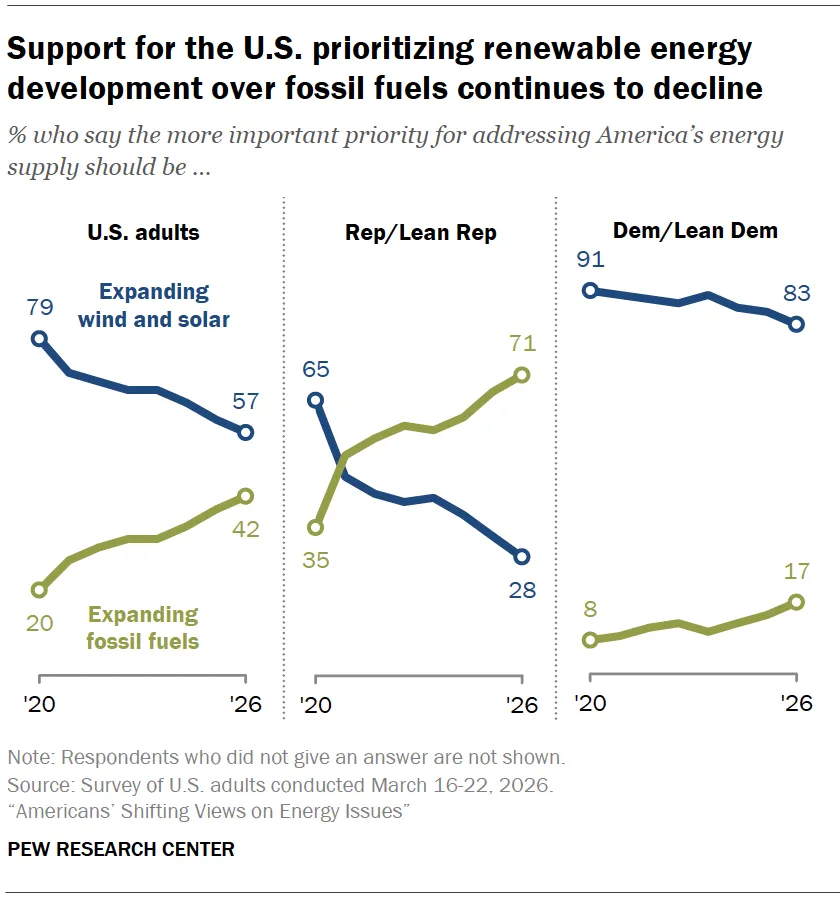
But while this explains what sets America behind Australia right now, it doesn’t explain how we got here. We can’t just pin this all on Trump. America started falling behind two administrations ago, back when Washington was actually trying to help.
How Australia made solar boring
Australia’s solar dominance took decades to build, and almost none of it was about the technology. It was about money, and one very weird quirk of their electricity market.
There are some, let’s say, structural factors that made solar a more enticing option in Australia than America. First off, the price of energy is just higher there, and that continues today. 28c/kWh in Australia is 40% higher than 20c/kWh in the US. The higher the price, the greater incentive to go with renewable sources.13 I feel their pain, the cost per kWh delivered in Massachusetts is over $0.30, which is part of why I wanted to go solar myself.
The price is also less predictable. Retail energy costs skyrocketed in Australia earlier this century. Their utilities poured money into infrastructure the grid didn’t need. The more they built, the more profit they were guaranteed. It’s a bonkers quirk of the Australian utility structure known as “gold plating,” and it cranked up retail prices. If your energy price goes up 195% in 15 years, as it did in the state of Victoria, you’re going to say crikey, hop in your land rover, and head into the bush in search of a cheaper alternative. Or something like that.14
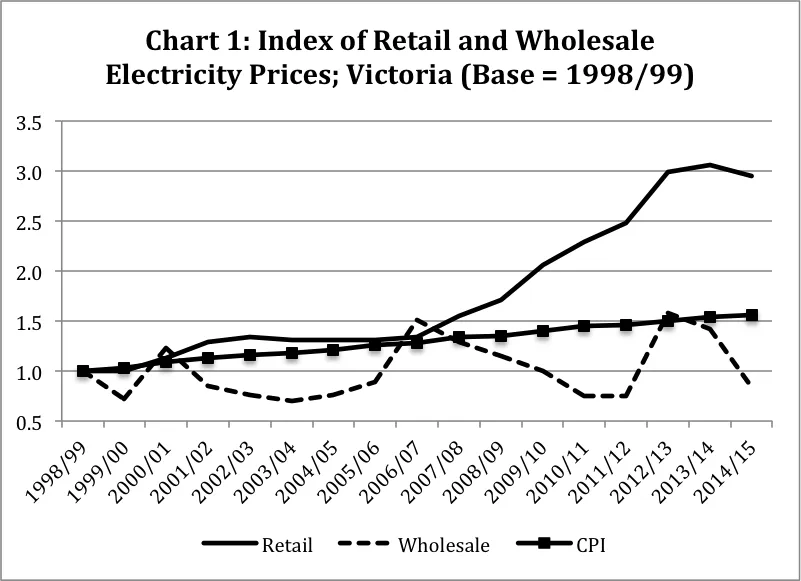
In response to this really wild energy market, Australia pursued policies aimed squarely at building the consumer market. It still does. They made it easier to buy and sell solar panels and batteries.
This began in the early 2000s, and as solar prices plummeted during the great recession,15 solar installations took off.
Germany wrote the playbook, with the first subsidy scheme. Then, Australia copied the German model and ran it in a sunnier climate. Australian energy strategist Dr. Gabrielle Kuiper puts it plainly: “none of us would be here without them.” Australia’s version included rebates that sometimes covered the entire cost of solar panels, plus feed-in tariffs that paid households for the energy they fed back into the grid.16
The national rebate started at A$8,000 for a small 1kW array. In parts of the country, that was more than the sticker price of the panels themselves.16
Critics attacked these schemes as an expensive way to cut emissions, but according to the Guardian “it kickstarted an industry of installers, sales people, trainers and inspectors, and quickly made solar a viable option for people beyond the country’s wealthiest suburbs.”
It was messy. It was improvised. And it worked. In the second half of 2025, rooftop solar contributed over 14% of Australia’s electricity, a doubling of its contribution from just 2020!17 By comparison, small-scale solar contributed less than 2% of US electricity in 2023.1819
How America made solar expensive
So I know what you’re thinking, didn’t America also have a significant tax credit for solar? We did, but we also pursued a policy to promote and protect American solar producers during the 2010s, when solar began to take off.
Policy makers had good reason to do this! This was industrial strategy, a world away from the renewable denialism that dominates the federal government today.
In 2011 the US solar industry was dying. China’s manufacturing success led to plummeting prices and industry wide bankruptcy. American manufacturers sued, and regulators agreed that Chinese companies had sold panels here for a fraction of their fair market value.20
A company called SolarWorld Industries America, out of Hillsboro, Oregon, filed the petition that started all of this. They got their tariffs, but it didn’t save them. The German parent company filed for insolvency in 2017, and what was left of the American operation was sold off to a rival the next year.21 We built the wall, and the thing it was protecting died behind it anyway.
There were a variety of policies the government could have turned to, but they chose protectionism. The solar industry lawsuits kicked off four rounds of tariffs targeting solar exports from China and elsewhere between 2012 and 2019.
The tariffs helped a handful of manufacturers. They slowed down everybody else. Researchers at the National Bureau of Economic Research found that subsidizing production instead “could increase domestic production, employment, and welfare.”22
What would it actually take to catch up?
What would it take for the US to actually catch up on solar? Even if the US could wave a magic wand, and replace tariffs with producer subsidies, and revive the tax credits it had just last year, it would not be on track to catch up to Australia. That’s because the structure of American incentives and regulations is a mess.
Let’s start with the incentives. American solar tax credits were annoying to sign up for! You had to apply for them on your taxes after paying the full price up front, which stops a lot of people from buying them.623
By contrast Australia makes it easy. Very easy. Your solar installer automatically deducts your solar credit from your invoice, you don’t even have to do anything. Less work for the buyer means more people will buy.2425
Australia beats us on incentive design, and then beats us again on the design of the entire system. Or in America’s case, the MANY systems.
In Australia, and much of the rest of the world, buying solar is like buying any appliance. You call up someone and just get it installed. Bill McKibben laid this out on the Ezra Klein Show. America has around 15,000 separate jurisdictions, and every town and every county has “its own zoning code, its own team of inspectors.”3 We are tying up solar in so much red tape the sun can’t get to the panels.
These rules have neither rhyme nor reason. Illinois requires paper submissions, approved by different departments in a specific order. Colorado requires paper AND online submission, and can spike your application if you don’t name your files according to their special rules.2 Remember those panels sitting on my roof waiting on paperwork? This is the machine that kept them there. Look I love literature, but there’s no reason getting panels connected to the grid should be a Kafka-esque nightmare.
Combined these rules slow down solar adoption or stop it entirely. And every one of them carries a price tag. Permit Power puts the non-hardware costs of solar in the US, the “design, project management, sales, permitting, inspections, and interconnection,” at a whopping 78 PERCENT of the total installed cost.2 This is something I’ve talked about for years!26 That tangle of extra rules is costing us big time.
Australia’s hangover
Before we start printing Australia t-shirts, I owe you the other half of this story. All that success came with a hangover.
When millions of homes push power into the grid at the same moment, midday demand collapses. The Australian Energy Market Operator has been sounding the alarm about minimum operational demand for years, and Australia’s energy ministers now require “backstop mechanisms” to be in place for emergency response.27 Three different things get blurred together here, so let me pull them apart.
First, the backstop. It’s an emergency lever, and it only comes out on mild sunny days when there’s so much solar that demand on the grid drops dangerously low. The operator can remotely dial back your exports for a few hours, and it only applies to newer systems.28 Your panels keep powering your house the whole time. Rare, boring, and it keeps the lights on.
Then there’s the second thing, what your exports are worth. Victoria used to guarantee a minimum feed-in tariff. As of July 2025, it doesn’t, and retailers set their own rate. The only rule is that it can’t go below zero.29 For context, the last minimum the state ever set was four hundredths of a cent per kilowatt hour, with a daytime time-varying rate of exactly zero.30 Nobody is billing you here. The check just got a lot smaller.
Third, South Australia went further. It charges for exporting in the middle of the day, about a dollar fifty a month, to help pay for an $80 million grid upgrade.31 That’s a fee for pushing power into a grid that already has too much of it at noon. Whatever you use inside your own house is still free.
So, the deal that built Australian solar, fat rebates and real money for your exports, mostly doesn’t exist anymore. Australia solved cost, and ran straight into the next problem … a problem I’d love to have. What's left is a country with so much cheap daytime power that the hard problem is soaking it up. Solar does knock off at sundown, after all. Home batteries are the sponge. Australia knocked 30 percent off the upfront cost in July 2025, and installs hit 2,000 a day.5 Same 30 percent we just threw away.
What the delay is costing you
It doesn’t have to be this way. The success of solar in Australia comes down to paperwork. The CHARGED Initiative sent a delegation down there in 2026, and they found Australia’s low costs are the “product of streamlined permitting, lightweight installation rules, and strong, audit-based installer accountability.”32 Boring stuff, guys. Boring, achievable stuff.
Emissions aside, Americans could be saving so much more with a different approach to solar. And I can show you exactly what that gap looks like, because I paid for it.
Let me put my own invoice on the table. 43 panels. 17.2 kilowatts on my roof. Sticker price, $55,384 before rebates. That works out to $3.22 a watt.33
Now price that exact system in Australia. Before any rebate, about $15,300 US. Eighty nine cents a watt.34
Then run the incentives on both sides. My federal tax credit and my state credit brought me down to $37,784, and I had to wait until tax season to see a dime of it. The Australian rebate comes off at the register, and brings them to about $11,200.
Fifty five thousand against fifteen thousand before help. Thirty eight thousand against eleven thousand after help. Either way, I paid about three and a half times what an Australian pays for the same panels on the same roof. That's lower than the seven times you see in the headlines,4 but three and a half times is still absurd.
Here's the part that should bother you. The subsidies cancel out. Take them away from both countries and the gap is the same. Whatever made my system cost three and a half times more, a tax credit was never going to fix it.
I know where a big chunk of my extra forty thousand went. My installers got most of the panels up, then had to take a bunch of them back down, because my town wanted a rough-in inspection nobody knew about. This is something specific to my town, but not unusual. My panels went live in October, but my battery didn't turn on until May.33 In Australia you fill out a form online and get approval the next day.
Forty thousand dollars. Most of it paperwork and soft costs.
Permit Power ran the numbers. Reform permitting alone, and by 2040 an extra 18.2 million families could install solar, a 155 percent increase, saving $245 BILLION dollars.2
Add in a reduction in tariffs. Stop the directly anti-renewable policies of the Trump administration. America could easily save many billions more.
America is so far, and so unnecessarily behind on solar, that improvement can seem impossible. But the basic fact is that even explicit anti-renewable policy cannot stop the energy transition here. 90 percent of power added to the grid last year was from renewables.35 US solar generation has grown every single year since 2006, and there are now six million solar installations in this country.3637
There are two real reasons to be optimistic. First, the AI build out is putting brutal pressure on energy bills.3839 Cost pressure was essential to Australian success.
Second, look at Texas. It’s the number one solar state in the country, and it got there on cost and easy permitting.40 Deep red state, cheapest electrons in America. Nobody had to win a culture war. They just made it easy to build.
America and Australia both have the sun and the size, and both have a fossil fuel industry pushing the other way. America falling behind is a choice … and choices can be unmade.
Here’s my take. This is a paperwork problem, and that’s what makes it so maddening. Give us one national standard for residential solar instead of 15,000 versions of the same rulebook, put the permit online, and automate the approval. Texas and Australia both show what happens next. Do I think we’ll actually do it? Not quickly. Fifteen thousand jurisdictions don’t hand over control just because it would be cheaper for everyone. But this is the rare problem where we already know the answer. We just have to be bothered enough to do the paperwork about the paperwork.
- Australian Government – Australia hits rooftop solar milestone ↩
- Permit Power – How cutting red tape can lower the cost of rooftop solar and offset rising utility bills ↩
- New York Times – The Very Good and Very Bad News on Climate ↩
- HEATMAP – Simpler Solar Regulations Would Save Americans $1.2 Trillion ↩
- Financial Times – Australians ‘going gangbusters’ on Chinese batteries in renewable energy shift ↩
- Internal Revenue Service – Residential Clean Energy Credit ↩
- AP – Trump administration to buy back another energy company’s offshore wind leases for 4 more projects ↩
- The Hill – Former federal renewables lab lays off 134 people ↩
- NRDC – White House Watch: Tracking Attacks on Our Environment & Health ↩
- New York Times – Trump Administration Admits Canceling Grants to States That Did Not Vote for Him ↩
- Canary Media – Rooftop solar is in for a tough few years in the US ↩
- PEW – Americans’ Shifting Views on Energy Issues ↩
- Statista – Household electricity prices worldwide as of September 2025 ↩
- Institute for Energy Economics and Financial Analysis – How ‘Gold-Plating’ the Australian Electricity Grid Is Killing Off Coal-Fired Generation ↩
- Bloomberg – How the US Lost the Solar Power Race to China ↩
- Guardian – ‘Go hard and go big’: How Australia got solar panels onto one in every three houses ↩
- Clean Energy Council – Rooftop solar and storage report ↩
- Energy Information Administration – What is U.S. electricity generation by energy source? ↩
- Google – what percentage of 4,178 billion is 73 billion? ↩
- Tuck at Dartmouth – The Real Impact of U.S. Solar Tariffs on Prices, Jobs, and Solar Adoption ↩
- Utility Dive – SunPower to acquire SolarWorld in a deal driven by Trump's solar tariffs ↩
- National Bureau of Economic Research – Strategic Avoidance and the Welfare Impacts of U.S. Solar Panel Tariffs ↩
- Turbotax – Federal Tax Credit for Residential Solar Energy ↩
- ECO Flow – Solar Panel Incentives in 2026: Federal & State Savings Guide ↩
- Aussie Solar Tech – Federal STC Rebate ↩
- Undecided – Top 5 Reasons We’re Getting Ripped Off With Solar … or Are We? ↩
- Australian Energy Market Operator – Minimum operational demand ↩
- Energex – Emergency backstop mechanism ↩
- Essential Services Commission – Minimum feed-in tariff review 2025–26 ↩
- Essential Services Commission – Solar minimum feed-in tariffs for 2025–26 ↩
- ABC News – Falling feed-ins and new export tariff frustrate SA solar customers ↩
- CHARGED Initiative – Lessons from the 2026 CHARGED Initiative Australia Study Tour ↩
- Undecided – Solar Panels On My Net Zero Home … Still Worth It? ↩
- Solar Choice – Solar Panel Costs: Solar Choice Price Index ↩
- Bloomberg – US Solar Is Thriving in the Face of Trump’s Tariffs ↩
- Statista – Solar power net generation in the United States from 2000 to 2025 (in gigawatt hours) ↩
- Solar Energy Industries Association – 6 Million Solar Installations ↩
- Environmental and Energy Study Institute – Data Center Power Demands Are Contributing to Higher Energy Bills ↩
- Reuters – Big Tech data centers are driving up power bills at America's Rust Belt factories ↩
- Texas 2036 – The Spectacular Growth of Utility-Scale Solar in Texas, 2000-2025 ↩