Every summer, your building dumps a mountain of heat into the air just to stay cool. Every winter, it burns fuel to make all that heat right back. Now, what if you could catch the heat you’re throwing away in July, park it underground until January, and do the same thing with winter’s cold to get you through next August?
That’s a real thing you can build. It’s a kind of thermal battery buried under our feet, and it’s been quietly heating and cooling buildings in the Netherlands for more than 30 years. The wild part? The US Department of Energy proved it could work here decades ago, and then we basically forgot about it.
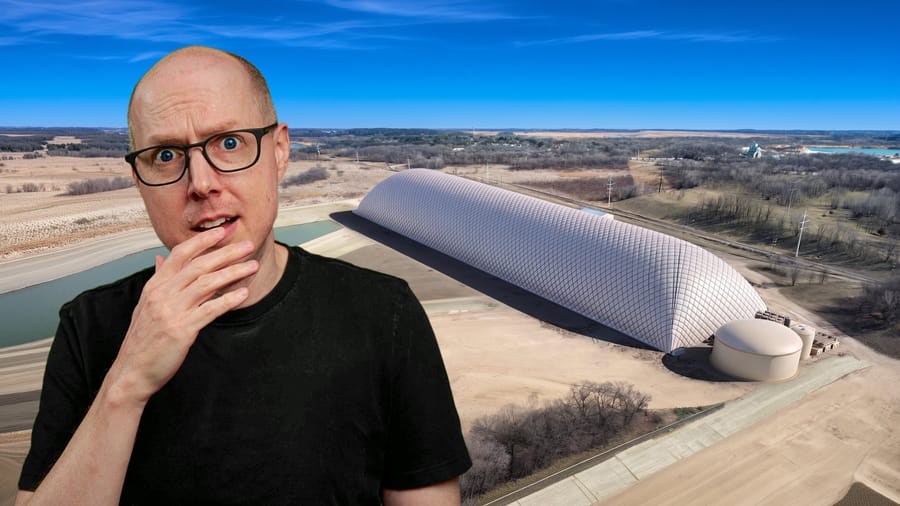
Take the campus at Eindhoven Science University, home to one of the most impressive geothermal projects of its kind…anywhere.
The Dutch call it “Warmte-Koude Opslag.” This system is not some indecipherable secret, like the Dutch language. In the rest of the world it’s called Aquifer Thermal Energy Storage, or ATES.
So let’s dig into how you turn the ground beneath your feet into a battery for heat, why a country better known for tulips and canals is running away with it, and whether it could ever catch on here in America.
When my team and I dug into this, I was expecting a typical story about an advanced tech that is so expensive it can’t earn its money back, or that only works under conditions so specific that barely exist anywhere. What I found instead was something more complex, but potentially, more manageable. So, let’s set the table by getting into the water table.
To explain ATES, let’s start with the A: Aquifers. These are porous underground formations of sand, gravel, and rock that hold water. Despite the name, an aquifer isn’t a big underground cave or lake. Picture a giant sponge of sand and gravel, with water filling the gaps. I don’t want to alarm you, but you might be standing over one right now. But don’t worry, they’re stable, huge, and crucially for ATES, they stay close to the average surface temperature. The earth, it turns out, is a fantastic insulator. That’s exactly why the sponge can work like a battery: if you pumped hot water into an open cavern, the heat would quickly bleed away, but surrounded by all that sand and rock, it stays put. It helps that water has an unusually high heat capacity too, so it holds onto a lot of heat without much escaping. 1
Now we need to address the T, the E, and the S: thermal energy storage. In the summer, when an ATES system is in cooling mode, groundwater is pumped up through a heat exchanger, where it takes heat and shoves it back underground into one side of the aquifer that stores warm water. In winter, that warm water is pumped back up for heating through a heat exchanger, and then heads back down to the cooler water side of the aquifer. 1
Now that Dutch animation will make a little more sense.
ATES works similarly to air source heat pumps, which use outdoor air to warm and cool buildings. But when it’s extremely hot or cold outside air-source heat pumps lose efficiency. ATES is powerful at these exact moments, since it’s able to take stored thermal energy from an entirely different season. When it’s winter outside, it can still be summer down in the aquifer. 2
ATES is great for small apartment blocks, hospitals, and clusters of urban buildings. At Eindhoven the system covers 19 different buildings. 3
The benefits of this are potentially huge because the energy used by heating and cooling buildings is huge. About a quarter of primary energy goes to heating and cooling buildings. 4
So how good is it? The number that jumps out at me is cooling: a well designed ATES system can be roughly five times more efficient at cooling than a conventional geothermal system. 5 The reason is a trick called free cooling. Most systems, including a normal geothermal heat pump, run a compressor every time they cool. ATES mostly doesn’t. It spends all winter banking genuinely cold water underground, then in summer just pumps that stored chill through a heat exchanger, for little more than the cost of running a pump. 1 Against an ordinary air-source heat pump the gap is even wider, up to ten times more efficient for cooling. 5
This one got me. I have a ground source heat pump loop in my own house, and I figured that was about as good as it gets. Turns out mine still runs a compressor every time it cools, while ATES just coasts on the cold it banked all winter. Fair caveat: mine is a closed loop for one house, and ATES is an open, aquifer fed system for whole districts, so it is not a swap I could make at home. Still, a little humbling.
And cooling is only part of it. Heating runs up to four times more efficient than a gas furnace, and the emissions savings can reach 75 percent. 6 Best of all, it is cheap enough to run that the whole system usually pays for itself in two to ten years, faster where energy is expensive. 6
I know I’m making ATES sound perfect and flawless, like it’s the Dutch language or something. But of course there are drawbacks we need to mention.
The aquifer wells for ATES systems can corrode, decreasing their efficiency. And as you might imagine, you need to be very careful with groundwater. Mud and silt can get in the way over time, and even worse, ATES systems can stimulate bacterial growth by injecting warm water back into an aquifer. These multiplying bacteria can make a slimy biofilm that can obstruct pores in the ground 7 8. I’m not a hydrology expert, but slimy biofilms are the kind of thing you do not want to be making more of underground.
But these problems are manageable, and even the Department of Energy declared ATES ready for commercialization, more than seven years ago. 9
So if ATES is the greatest, where is the ATES? Because it has certainly not taken off in America. To understand why that is, or why not, we need to see if there are any places it has been successful, and what might be learned from those places, which we’ll get to in a bit. But before any of that, let’s see just which places this tech might be feasible…at all.
Where Could it Work?
To make ATES work you need two things: an aquifer, and an above ground temperature that gets hot in summer and cold in winter. If the average temperature of a place is super low or super high, you’re not going to get the benefits 10.
This is bad news for viewers in Anchorage or Death Valley. But while it’s true that not EVERY place has the right geological and climatic conditions, there’s no shortage of places that do. A 2019 study found 27% of all land is in a good or very good zone for ATES. 9
Ok, but are those zones in places people actually live? Also yes. Broad swaths of North America, Asia, and Western Europe are perfect for ATES. And moreover, land has been identified in the urban zones which have most of the buildings and complexes that can make use of the technology.
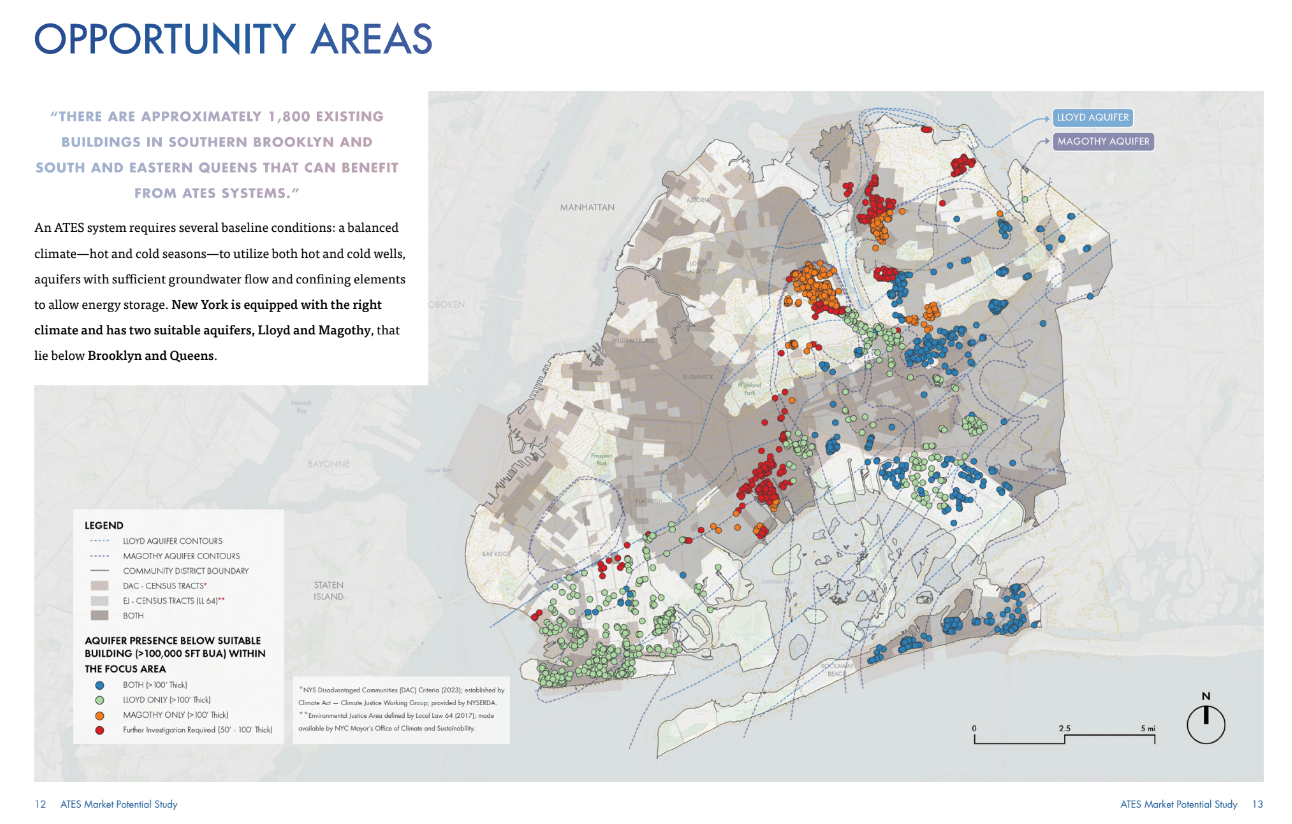
A potential market study commissioned by the New York State Energy Research and Development Authority found around 1,800 potential buildings that could benefit from ATES in the Queens and Brooklyn boroughs of New York City. 11
A separate study found that ATES for heating and cooling could reduce consumption of natural gas and electricity in the US by 40 percent. 12
So, if this technology works, and there’s the land to do it in America (cuz we’ve got a lot of it), why don’t we have it? And could we? Do we just lack models to copy? Is this a case where the first mover has not moved or what?
The Dutch Example
Well, there’s a land where the stroopwaffles are fresh and the aquifers are porous. It’s a country that built over 3,000 ATES projects in the last 30 something years. We’re talking about the Netherlands, the heart of global ATES know-how, that contains something like 85% of all global projects. 13
But why the Netherlands? It’s a combination of price and policy. Energy is much more expensive in the Netherlands than the US, which makes the case for efficiency gains more appealing. But on top of that, the Dutch government has put in place serious regulations to reduce greenhouse gas emissions. 11 It also probably helps that the water table is just 4 meters underground across 90% of the country. 14
The Dutch created an energy performance standard requiring building owners to make their buildings efficient. Performance guidelines became stricter starting all the way back in the early ‘90s. By 2022 the standard required buildings to be energy neutral, or even energy positive 4.
This requirement for building efficiency, ratcheted up over decades, spiked demand for ATES systems. But that demand didn’t immediately make the Dutch masters of the aquifer battery. There were speed bumps, or their Dutch equivalent, verkeersdrempels, along the way.
In the ‘90s and early 2000s, anyone who applied for a permit to build an ATES system was let into the market. The result? A bunch of sloppy, poorly performing systems. In response, the Dutch created quality standards for every part of ATES, from their design through their installation and operation. In order to make sure the wells would work for a long time, they even made installing contractors responsible for their maintenance. 4
This went well beyond the tech. It made Dutch ATES cheaper and better than any that has ever existed. The country is much further along than any other, and it's not close.
I’m talking about Dutch ATES success as if it’s just the product of thoughtful fostering of technology, regulations, and markets over decades. And it is those things! But it’s also worth mentioning that the Dutch are really, insanely, good at water management. To some extent it can’t be surprising that the country that has been pioneering control of water for centuries would figure out how to make aquifers into batteries first.
So, the Dutch have a head start, and they earned it. It took more than one sample project. They built a market and a regulatory framework geared towards ATES excellence, over the long term. Given all that we know, let’s think about how ATES might or might not work in the US.
Could it Work in the US?
Let’s be honest here. I’m not sure the Dutch example is going to be so easy to repeat in the states, where the current national energy policy is to send every newborn home from the hospital with a dripping sack of light sweet crude … metaphorically.
And it’s not like no one here is thinking about making ATES work. The case for it, after all, is pretty good! Last year there was an ATES system planned for a large development in Minneapolis, near the site of the US government tests on the technology 40 years ago 2. But further into the planning stages, it turns out that the ATES system didn’t pencil out, so they’re going with a different approach for their heating and cooling 15.
Right now, ATES is expensive in the US, and people are unfamiliar with the technology. The Dutch built 32 wells to power the ATES system at Eindhoven Science University, and we can’t even get two. 16
These are significant barriers. A study modeling how ATES could work in a Chicago neighborhood found that although ATES could reduce petroleum use by 40%, it would cost 15 to 20% more than existing energy storage technologies. 12
However, over time, the price of ATES would drop. That same study’s first author A.T.D Perera says “after just a few years of developing ATES, we could easily break even. That’s why it’s quite important that we start to invest in this research and start building real-world prototype systems.” 12
There are other reasons to believe those investments might happen. First off, there are still significant government funds left for new geothermal projects leftover from the Biden administration. 17
Skyrocketing demand for cooling and water from data centers also provides a serious near term incentive to develop the technology. 18 And many of the cities and metro areas where ATES could work, like New York, will continue to push greater efficiency standards.
On top of this, as climate change brings ever greater swings in seasonal temperatures, the case for having a clean technology to manage those swings by storing thermal energy in the ground only gets stronger. Internationally, demand for heating and cooling is heading up in the developing world, making the economic case for getting good at ATES stronger still. 19
When it comes to ATES, we’re in a bit of a geothermal chicken and the geothermal egg situation. This technology can work in the states. We have ten kinds of proof. But someone needs to lead. One project won’t do it, and it’s going to take time. The Dutch started all the way back in the early ‘90s, around the same time that a Department of Energy report concluded seasonal storage promised to “significantly reduce the need to generate primary energy in the United States,” with aquifers seen as “the most cost-effective approach.” 2 This technology does work, and it could work here too. All that remains is for people to do the hard, grinding work of building it out.
- National Groundwater Association (Westerville, Ohio) Journal Groundwater – Aquifer Thermal Energy Storage: Groundwater for Efficient Data Center Cooling in the United States ↩
- Inside Climate News (U.S.) – Decades After the U.S. Government Conducted Research Beneath This City, a Promising Clean Energy Technology Returns to Its Roots ↩
- Eindhoven University of Technology (Eindhoven, Netherlands) – Energy web page ↩
- Symposium on Energy Geotechnics 2023 (TU Delft, Delft, Netherlands) – Drivers to allow widespread adoption of ATES systems: a reflection on 40 years experience in The Netherlands ↩
- NYSERDA (Albany, New York) – Market Potential for Aquifer Thermal Energy Storage (ATES) ↩
- Clean Technologies and Environmental Policy – Policies for aquifer thermal energy storage: international comparison, barriers and recommendati ↩
- Journal of Hydrology: On the Impact of Clogging in Aquifer Thermal Energy Storage (ATES) under Constant-Rate and Constant-Head Injection-Extraction Scenarios ↩
- Water Research: Rapid growth of thermophilic bacteria during a high-temperature aquifer thermal energy storage (HT-ATES) field experiment ↩
- Renewable and Sustainable Energy Reviews 2019 – Evaluating the global potential of aquifer thermal energy storage and determining the potential worldwide hotspots driven by socio-economic, geo-hydrologic and climatic conditions ↩
- Renewable and Sustainable Energy Reviews 2021 – Environmental impacts of aquifer thermal energy storage (ATES) ↩
- NYSERDA ATES Brochure (Albany, New York) – Aquifer Thermal Energy Storage (ATES) ↩
- Lawrence Berkeley Lab (Berkeley, California) – Underground Water Could be the Solution to Green Heating and Cooling ↩
- Geothermal Energy – Potential of low-temperature aquifer thermal energy storage (LT-ATES) in Germany ↩
- The European Environment Agency (Copenhagen, Denmark) – Netherlands…Characteristics of Groundwater ↩
- Michael Ahern interview with Sam Roudman – 05/26 ↩
- Eindhoven University of Technology (Eindhoven, Netherlands) – Forward-thinking offers a perspective in times of gas crisis ↩
- QUARTZ (New York) – There's one renewable that Trump won't cut ↩
- Interesting Engineering – Underground aquifer ‘thermal batteries’ to cool smart data centers and save water ↩
- Renewable and Sustainable Energy Reviews 2026 – Capital costs of aquifer thermal energy storage (ATES): a review ↩