Everyone agrees on one thing about lithium batteries: they're brilliant for about 4 hours of energy storage or less. What? That wasn’t what you were going to agree on? Anyway, past that, the price stops making sense, so China went and built an alternative … out of thin air.
In March 2026, they switched on the largest compressed air battery ever built.12 It sits in a salt cavern under the city of Huai'an, in Jiangsu province, Eastern China. When power is cheap, giant compressors stuff air down into that cavern and save the heat they make on the way in. When the grid wants it back, the heat and the air go through a turbine together.34 No lithium. No fuel burned to get the power back out. And 71% of the electricity you put in comes back out, which for this kind of system is kind of a big deal.12
The real question is does it fix the thing it's supposed to fix? I did the math. Think of it like a water tank. Megawatt hours are how much is in the tank. Megawatts are how fast it pours. This one holds 2.4 gigawatt hours and pours at 600 megawatts. Divide, and you get how long the tap runs.
4 hours. That's it. The whole pitch for compressed air is that it beats lithium when you need extra long duration energy storage, like 8 hours or all night. And the biggest one ever built runs for 4, which is exactly where lithium already wins.
Before the comments beat me to it, "largest" here means power rating, how hard it can pour. On how much it holds, the McIntosh plant in Alabama has beaten it since 1991.5
So what's going on here? Did China just build the equivalent of a very expensive gas peaker plant that runs on air? And if the economics are as good as the industry claims, why hasn't anyone in the West finished one?
I told you 2 years ago that compressed air was finally here. But is it really?
Why cheap hours matter
When do you think your house actually uses the most power? It's after the sun goes down. Everybody's home, the oven's on, the TV's going, and the car is plugged in for the night. Solar handles none of that at night. So every bit of solar power you use in the evening has to come out of storage first.
Those 4 hours of storage covers dinner. They don't cover a cloudy week in January, and they don't cover the night a winter storm drops snow all over your panels. That's the gap long-duration storage is supposed to fill, and it's the reason anyone bothers with a 71% efficient system when a lithium battery gives you 85 or 90% round-trip efficiency.
So what are you actually buying here?
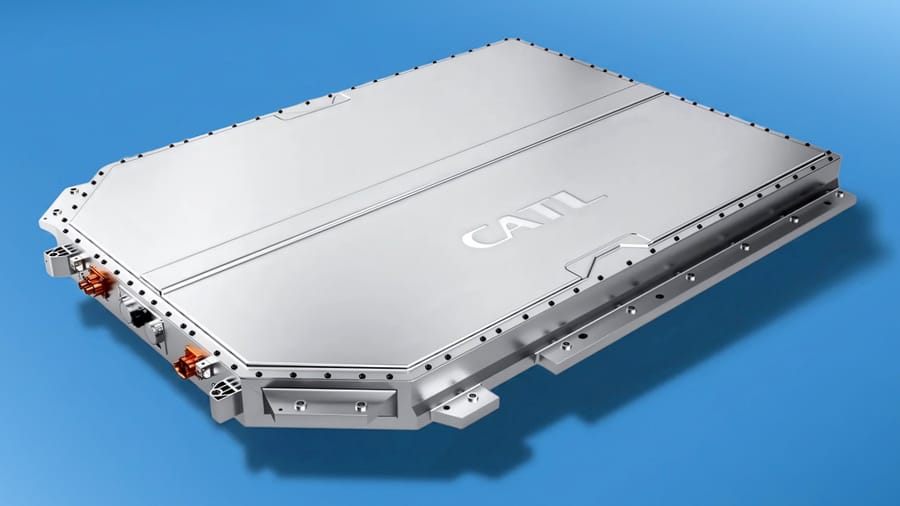
Want another hour? Buy another rack of cells. Want a third hour? Buy another rack. Every hour costs about what the first one did, somewhere around $300 to $350 per kilowatt hour, and that line keeps climbing forever.67 It's like being told the only way to get a bigger gas tank is to buy a second car.
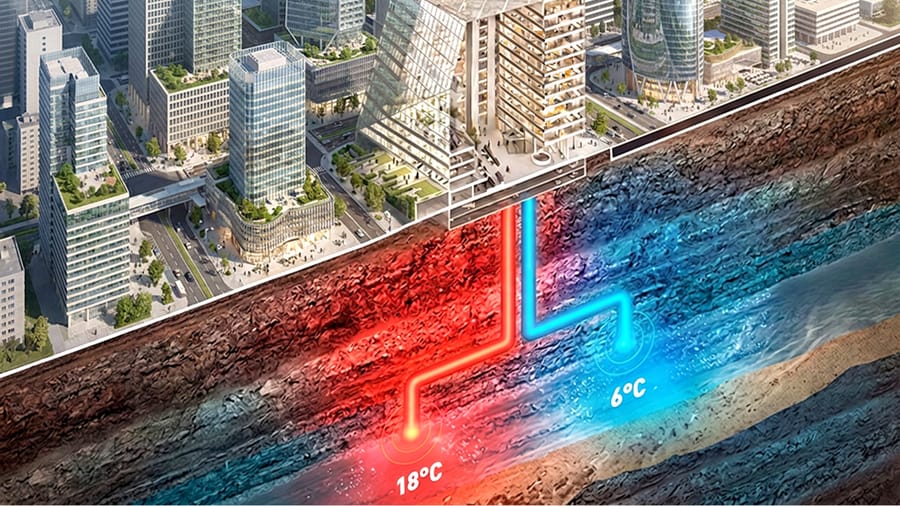
Compressed air splits that bill in two. You buy the pump separately from the tank. There's the machinery: the compressors and turbines, which runs about $1,000 per kilowatt. And then there's the hole in the ground, which is the cavern the air actually sits in. Once you've paid for the machinery, making that hole bigger costs about $20 per kilowatt hour.6
$20, against the $300 of lithium battery storage. That's about 7 cents on the dollar.
Hold onto that, because it's the entire argument behind every project in this video. It also came from Curtis VanWalleghem, CEO of the Canadian company Hydrostor, who sells compressed air storage for a living.6 The math is mathing, though it’s good to validate someone’s claims, especially if they’re selling you a product.
What 71% efficiency actually buys you
Quick refresher, because that number only means something when looking at the big picture.
Compressed air storage is an old idea. The first plant opened at Huntorf, in northern Germany, in 1978, and the McIntosh plant in Alabama followed in 1991. Both still run.5 The concept is simple. When power is cheap, you run a compressor and cram air into an underground cavern. When power is expensive, you let the air back out through a turbine to generate electricity.
The problem is heat. Squeeze air and it gets hot. Let it expand and it gets cold, which is why a can of compressed air gets cold and frosts over when you spray it.
Huntorf and McIntosh both vented that compression heat straight into the sky, then had to burn natural gas to warm the air back up on the way out. It's a bit like running a hot bath, pulling the plug, and then boiling a kettle to fill it again.
Huntorf gets about 42% round-trip efficiency doing that.5 More than half the energy you put in never comes back. And you're burning gas in a machine that's supposed to be replacing gas. McIntosh is rated for 26 hours, longer than anything else in this video, and burning gas is how it gets there. Which is the whole reason the next number matters.
Adiabatic systems fix that heat leak by keeping the heat instead of throwing it away. China's Huai'an plant catches it in molten salt and pressurized hot water, parks it there, then shoves it back into the airstream before the turbine.14 Think thermos instead of open mug. No kettle, no gas, and round-trip efficiency goes from 42 to 71%.
That jump is the actual news here. It took about 50 years to make it, and China made it at a scale nobody else has attempted. And it's bigger than it looks, because Huntorf's 42% only counts electricity in against electricity out. It ignores the gas.
One caveat before we go further. That 71% comes from the vendors. Harbin Electric and Shanghai Electric both put out releases claiming credit for the equipment, and both quote roughly 71%.12 There's no independent operating data yet. I'd love to see a year of real numbers from somebody who isn't selling turbines.
The domes are getting real
Compressed air isn't the only weird way to hold a day's worth of electricity. Let's talk about the CO2 battery, because the Milan-based company Energy Dome has had a very good few years since I last talked about them.
Their system works on the same basic idea, with a twist. Instead of air, it uses carbon dioxide in a sealed loop. Compress the CO2 until it turns liquid, store the heat separately, then reverse it. The gas lives in a big fabric dome that inflates and deflates, so nothing vents and nothing gets used up.8910
Picture a bouncy castle the size of a city block, breathing in and out once a day. That dome is the tank, sitting right there on the surface where you can watch it work. When I covered this in 2022 it was a 4 megawatt-hour pilot project in Ottana, Sardinia, with a long way still to go.115
Now Google's buying it. They’re signing a 10-year deal with a balloon.
Now back to the war of the batteries. In June 2026, Google signed on as the sole customer for a CO2 battery in County Offaly, Ireland. 23 megawatts, 200 megawatt hours, with land, planning permission, a grid connection to the Dublin network, and a 10-year capacity contract from the Irish grid operator EirGrid already locked down. It should be running in 2028, and Energy Dome plans to put a second one next to it.1210
There's another dome going up in Wisconsin with the utility Alliant Energy, 20 megawatts and 200 megawatt hours.9 And a third with Salt River Project in Arizona.13
Run the same division on those. Ireland comes out at 8.7 hours on paper, though Energy Dome's own COO calls it an 8-hour system in practice.10 Wisconsin is a clean 10.
Those are long-duration machines. They sit exactly where the cheap energy storage hours argument says they should. And Energy Dome CEO Claudio Spadacini's public claim is careful in a way I appreciate. He says that past 8 hours, the CO2 battery is cost competitive with lithium.14 Past 8 hours. That qualifier is the whole ballgame, and I respect him for leaving it in.
Energy Dome won't publish a levelized cost of its own. The number floating around in a lot of coverage, about 11 cents per kilowatt hour, comes from an academic paper modeling a compressed CO2 system, not from an Energy Dome plant.15
So, hold the domes up against our question. On duration, they're the best answer anyone has. On everything else, they're tiny. Ireland is 23 megawatts. China's plant is 26 times bigger, and not one of these has produced a kilowatt hour yet.
The bet somebody is actually making
If you want to see what a serious long-duration wager looks like in the West, it's in the Mojave.
Hydrostor's Willow Rock project in Kern County, California cleared its final permit from the California Energy Commission in December 2025. 500 megawatts, 4,000 megawatt hours. 8 hours, right in the sweet spot.1617 California Community Power has already signed for a 50 megawatt slice.18
The design is clever. Instead of letting cavern pressure swing as air moves in and out, Hydrostor pushes water out of the cavern into a pond up top, and that column of water holds the pressure dead steady. Turbines hate surprises.195 Water as a piston. I love it.
Now the timeline. Willow Rock needs $1.5 billion, 5 years of construction, and more than 6,000 workers.19 Groundbreaking is this year, and Hydrostor is targeting 2030 for its first test run.20
Hydrostor's VanWalleghem would rather you look at the other end of that timeline. He says his plants "last 50 years with no cost degradation." A lithium installation needs replacing after 10 to 15 years.9
So the best long-duration answer in the West is correctly sized, but half a decade away from delivering a single kilowatt hour. China's plant is running right now.
So why is China's only 4 hours?
Back to the thing that bugged me.
If the entire advantage of compressed air is cheap hours of energy storage, why would you build the world's biggest one and stop at 4 hours?
The honest answer is that duration is only one of many reasons to build these. China's grid has a specific, enormous problem. Just like trying to shift solar power to when it’s needed, China’s wind power produces cheap power in the middle of the day, when nobody wants it. Then, everybody gets home at dinnertime and wants it all at once. That's a how-fast-it-pours problem, and it has to be solved at gigawatt scale, night after night.3 For that job, what matters is megawatts and a machine that'll still be running decades from now. Huai'an gives them that, and the salt geology under Jiangsu makes it cheap to do.
So, Huai'an is best understood as a very large, very durable gas peaker plant replacement that happens to run on compressed air. Which is a perfectly good thing to build. It's also thinner evidence for the long-duration argument than the headlines make it sound.
And here's where I have to mark my own homework. In 2024 I looked at the big nameplate megawatt number and heard "long duration." Back to the tank: I was looking at how fast it pours and calling it how much it holds. I should have done the division.
China's not slowing down. Phase 2 of the Jintan project, also in Jiangsu, is under construction with two 350 megawatt units and 2.8 gigawatt hours.21 That's 700 megawatts into 2.8 gigawatt hours. That’s 4 hours again.
Under pressure
This is where the story starts losing pressure.
Geology comes first. You need a salt formation, a depleted gas field, or hard rock that can hold pressure for decades without leaking. Salt is the favorite, because you can wash a cavern out of it with water and end up with walls that seal themselves. Huai'an's caverns sit between 1,150 and 1,500 meters down and hold around 980,000 cubic meters of compressed air.2 You either have the right rock or you don't, and no amount of funding changes the answer. Lithium goes anywhere, on a concrete pad, in 18 months. So, any promise about where these get built, take it with a grain of salt.
Also, the supply chain runs the other way from what you'd expect. Compressed air skips lithium, cobalt, and graphite, the minerals most batteries are built on, though it still takes plenty of steel and copper. What's actually scarce is experience. Hardly anyone has ever bolted a 300 megawatt adiabatic train onto a molten salt heat store and made it work, which is why Huai'an ran on Chinese-built equipment start to finish.22 Lithium's problem is the materials. Air's problem is the machine shop.
Two trends going opposite ways
Here's where two trends ran into each other, and it's the part that changed my mind about whether long-duration air storage actually happens.
Air is getting cheaper, and we can measure it. A peer-reviewed paper in iScience last year tracked every adiabatic compressed air project the researchers could find and fit a learning curve to them. Costs fell at a 15% rate for every doubling of installed capacity between 2013 and 2024. The biggest projects, 100 megawatts and over, are down to roughly $120 per kilowatt hour of capacity. Follow that curve and the market average drops below $157 once the world hits 10 gigawatt hours of capacity, then down to $92 past 100 gigawatt hours.23 That's measured from real projects, and the line points down.
Now, hold that up against lithium. The two cost figures don't line up cleanly enough to race head to head, so the honest comparison is lithium against itself. 4-hour utility-scale lithium in the United States runs $210 to $292 per megawatt hour without the investment tax credit, or $148 to $209 with it.2425
That's the number that surprised me most, because it went the wrong way. Everyone expected it to keep falling. American battery storage costs are up roughly 27% since 2020.24 Most of that climb, 2021 through 2024, was pandemic supply chains and materials prices, and costs actually fell in 2025. The reversal is this year with rising costs again, and Lazard, the bank whose annual study is the industry's yardstick, puts that one on tariffs and the new foreign entity rules, which have pushed the supply chain through Southeast Asia at a price.25
For a decade, the assumption was that lithium gets cheaper every year and everything else has to chase it. In the US market, that stopped being true.
I want to be careful here. One of those two numbers is a build cost, dollars per kilowatt hour up front. The other is a levelized cost, what it works out to per megawatt hour over the plant's whole life. So, I'm watching which way each line moves. Air's falling curve is global and built almost entirely on Chinese projects. Lithium's rise is American and driven by trade policy, so if the trade picture changes, it reverses. And neither project in this video sits on that curve. Huai'an cost $520 million for 2.4 gigawatt hours.22 That's about $217 per kilowatt hour. Willow Rock works out closer to $375. Both well above the $120 the curve promises, which tells you something about the distance between a learning curve and a construction site.
China built 4 hours because 4 hours is what China's grid pays for. America may end up building 8 or 12 for a reason China never had: the cheap lithium option got taken off the table.
This is for you, Patrons: there's a design split running underneath every project in this video, and it explains why China's plants and Hydrostor's look so different.
Huai'an is a constant volume system. The cavern is a fixed box. Pump air in and the pressure climbs. Let air out and it falls. That swing is hard on the machinery, because compressors and turbines are happiest at one pressure, so engineers have to keep the swing inside a narrow band and accept efficiency losses at both ends of the cycle. Salt caverns handle the stress fine. The turbines are the fussy part.5
Hydrostor went the other way with a constant pressure design. The cavern starts out full of water, and incoming air displaces that water up a shaft into a pond on the surface, so the cavern is always full of something. The weight of the water column sets the pressure and holds it there no matter how much air is in the cavern. The turbine sees the same conditions on hour 1 and hour 8.19
So, why doesn't everyone do that? Cost. You're digging a cavern, plus a shaft, plus a surface reservoir, and moving a lot of water around for the life of the plant. Constant volume is cheaper to build and lets you use salt caverns that already exist from solution mining, which is exactly why nearly every Chinese project picked it.
That's the tradeoff in a sentence. China optimized for cheap and big. Hydrostor optimized for steady and long. Both are defensible, and which one wins probably depends on whether your grid needs 4 hours or 12.
My take
2 years ago I said compressed air was finally here. I'd revise that.
The machine works. 71% is real progress from 42%. The cost curve is pointed down, even if no project in this video has actually landed on it yet. And Google and California are signing contracts, which tells me more than any press release does. Calling it a solved problem is still premature, because almost nothing running today actually runs long enough to earn the long-duration name. The plants with the impressive nameplates empty out in 4 hours. The projects with the right duration are small, or unbuilt, or both. Willow Rock is a 2030 story at best. Ireland is a 2028 story.
So, here's where I land. Air and CO2 are going to take long-duration storage, and the case is now strong enough that I'd put money on it. Paying for the pump and the tank separately is a real structural advantage, whoever happens to be saying it. Past 8 hours of energy storage, the economics aren't close, the hardware runs 50 years instead of 15, and it doesn't touch the battery mineral chain … at all. Lithium keeps everything up to about 4 hours, and it should. It's better at that job and you can build it anywhere.
What I'm less sure about is who gets there first. China has proven the machine works at gigawatt scale and hasn't needed to build it long. The US knows exactly how long to build it and can't get one out of the permitting office. If that's still true in 2030, the failure is ours.
And that record China just set? A 4.2 gigawatt hour project at Sanmenxia, in central China, breaks ground this year.26 The world's largest air battery has about a 2-year shelf life. Which feels about right for a technology that spent 50 years going nowhere and then started moving all at once.
- ESS News – World's largest compressed air storage plant switched on in China ↩
- The Korea Herald – Shanghai Electric Provides Core Equipment for World's Largest Compressed Air Energy Storage Station Now Fully Operational in Jiangsu, China ↩
- Enerdata – China switches on 600 MW/2.4 GWh compressed-air storage in Jiangsu ↩
- pv magazine – China's 600 MW/2.4 GWh storage plant becomes world's largest CAES site ↩
- Wikipedia – Compressed-air energy storage ↩
- BloombergNEF – Compressed Air Can Compete and Thrive in Lithium Age: Q&A ↩
- Undecided – How Compressed Air Batteries are FINALLY Here ↩
- Energy Dome – CO2 Battery ↩
- POWER Magazine – Finding a Longer-Duration Alternative to Battery Storage ↩
- Energy-Storage.News – Energy Dome's second CO2 Battery project with Google will secure carbon-free energy for tech giant while easing grid congestion in Ireland ↩
- Undecided – How the CO2 Battery Could Be the Future of Energy Storage? ↩
- Energy Dome – Google and Energy Dome Advance Multi-Continent Energy Storage Buildout with First Bilateral Project in Ireland ↩
- Energy Dome – Energy Dome and SRP to Add Long-Duration Energy Storage Project to the Grid, Expand Google Collaboration ↩
- Energy Dome – Cost-competitive, operating, and readily available: the reality of the CO2 Battery ↩
- Fuel – Performance of compressed CO2 energy storage systems with different liquefaction and storage scenarios ↩
- Hydrostor – Willow Rock Energy Storage Center Obtains Final Approval for Power Plant License ↩
- Utility Dive – Hydrostor secures key permit for 500 MW, 8-hour California energy storage facility ↩
- Solar Power World – California power aggregators sign on for 50-MW slice of compressed-air long-duration energy storage ↩
- Hydrostor – A peek inside the cavern: Building the Willow Rock Energy Storage Center ↩
- The Globe and Mail – Hydrostor prepares to break ground on first utility-scale project in California ↩
- ESS News – World's largest compressed air energy storage project breaks ground in China ↩
- ESS News – World's largest compressed air energy storage station now fully operational in China ↩
- iScience – Cost-reducing adiabatic compressed air energy storage for long duration energy-storage applications ↩
- ESS News – Battery storage costs up 27% since 2020, says Lazard ↩
- Energy-Storage.News – Lazard: US utility-scale energy storage LCOS has increased since restrictions on Chinese cells came into force ↩
- ESS News – China scales up long-duration storage with 4.2 GWh compressed air project ↩