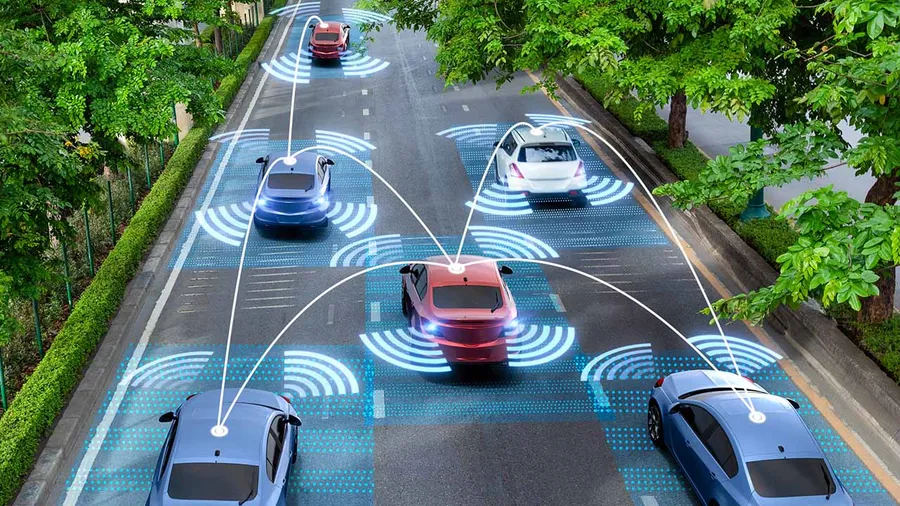
You know that stretch where you hit every green light perfectly? Feels like magic. Like the traffic gods are smiling on you. Well, depending on where you live, that might not be luck anymore. There's an AI system that watches every car, bike, and pedestrian approaching an intersection in real time… and lines up the lights so you cruise right through. And the numbers on how much faster people are getting home? They're kind of ridiculous.
Speeding up your commute is just the beginning. There's a city in Tennessee where AI flagged so many near-crashes on one block that planners made a single change… and the result still blows my mind. When I saw how much safer AI made bike lanes in Vancouver, Canada, I thought maybe I was the one hallucinating.
The catch? For any of this to work, the city has to see you. Cameras, radar, the phone in your pocket, the car in your driveway. It kinda creeps me out. So what do we actually get back? And is there a way to get all of this without cameras watching our every move?
Cameras already surround us. They might be on your neighbor’s front porch, recording you wishing them good morning from the sidewalk. They’re watching while you shop, and as you pull out of the parking lot. It’s gotten so bad, it’s been in the news.1 How is all that data used? And by who?
Some of the first cameras that got us used to being watched were at intersections. You probably noticed them while you were sitting at a red light, no cross-traffic in sight, waiting forever for a green. Stephen Smith, a robotics professor at Carnegie Mellon University, noticed them, too.2 But where many of us see surveillance, he saw an opportunity… to build a traffic system so smart, it could see everyone arriving in real time and line up the lights to let you cruise right through.
It worked. Smith’s AI traffic system, called Surtrac, sped cars through Pittsburgh 25% faster. Not because they were speeding, but because they weren’t stopped at red lights. He cut idling by 40%. That’s about half as much time waiting for the light to change. And by cutting down wait times, Smith’s system cut tailpipe emissions around 21%.3 That’s wild. It’s more than just better air quality. Faster commutes mean more time over breakfast, and less money at the pump.
Still, it’s not a reason to stop worrying about the cameras watching us. But I think I might have found a technology that gives us all the upsides of intelligent traffic systems without the heebie-jeebies.
In systems like Surtrac, each intersection uses computer vision to track what’s happening and adjust in real time. Computer vision algorithms detect patterns in images the way chatbots recognize patterns in words.4
To do that, they train on massive video datasets where all the cars, bicycles, and people are labeled by hand.5 One system I found trained on over 4 million labeled objects from 800 different locations.6
That lets computer vision “see” how many cars are coming and how fast, whether cars are waiting, and if there are bikes and pedestrians in the mix.3
All this data gets crunched street-side on advanced chips from companies like NVIDIA. It’s called Edge AI, and it means many calculations… the ones where time-delays matter… happen right in place instead of in the cloud or a central server.76 A bad connection doesn’t crash the lights.
When deciding who gets the green, each intersection doesn’t just look at its own data. Intersections are connected locally, and give each other a heads up on the traffic coming their way. That’s what lets them line up those perfectly-timed green waves.38910
Compare that to older traffic control, like Los Angeles’ Automated Traffic Surveillance and Control system, or ATSAC.1112 The cameras at LA intersections don’t identify cars and people, they’re just there for when city staff want to see why traffic jammed up. Instead, ATSAC relies on inductive loops: wire coils buried beneath the asphalt that detect when a hunk of metal is sitting on top. That means they can detect cars or trucks, but not motorcycles or bicycles like the camera-based AI systems can.1314
It can’t see what’s coming next, either. That means it can adjust the lights to relieve a traffic jam, but it can’t predict the jam and adapt the lights to prevent it.11 It’s the difference between calling in extra cashiers as soon as a crowd walks in… and waiting until the checkout line stretches to the deli. It’s no wonder Surtrac dropped travel times 25%, where ATSAC averaged just 10%.15
That’s a massive win… if you’re okay with cameras watching every intersection in your town. Cameras don’t just see traffic. They see everything.
The cameras in the original Surtrac system didn’t have high enough resolution to recognize faces or even read license plates.16 But that was back in 2012. Traffic sensors on today’s market combine radar with 1080p HD cameras.17
They’re not marketed for facial recognition. But the hardware could. And there's no guarantee a future software update (or a new mayor in town) couldn't change that. The question is… would we even be told?
In the United States today, thousands of AI–powered cameras capture video clips and license plates of vehicles moving through town. They’re paid for by both local law enforcement agencies and private businesses. It sounds like a smart choice for local safety … but … data from many of those cameras, operated by a single company called Flock, is now searchable nationwide. Your car could be tracked across city and even state lines.1819
It’s not just cameras. Miovision, the company that bought up the original Surtrac technology, they collect MAC addresses from phones passing through intersections for traffic studies. A MAC address is the unique identifier your phone broadcasts when it’s scanning for WIFI.
It’s useful information. Miovision can use it to figure out where cars or bicycles are entering the main drag, and how long it took them to pass through downtown.20 In Bad Breisig, Germany, MAC addresses helped determine which traffic light was slowing things down, leading to changes that nearly guaranteed a green wave on the town thoroughfare.21 For measuring throughput, or how long it would take any single person to pass through this town, this is relevant data.
In order to do to this, they need to track specific devices. Adding one car to the traffic as it enters downtown and subtracting one as it leaves tells you nothing about how long it will take any speciic car to get through town. Tracking MAC addresses makes this possible. At first glance, this seems like it might not a problem. MAC addresses are just strings of random numbers and letters. A city collecting data with this or another system won’t know it’s you. However, it could know a device leaves 5th and Vine at 8am and arrives at Montgomery Boulevard twenty minutes later. Every weekday. It kills me how little data you need to build up a pretty clear picture of someone’s habits.
The data smart traffic systems use to hurry up your commute could also be given freely by those who opt in. Like, by letting the traffic lights know your route on Google Maps or Waze.9
Surtrac’s Stephen Smith said,
“if a vehicle is willing to share this route… then we can move them faster through the intersections.”9
“It sounds magical at first, but really you're just giving us more information and reducing uncertainty so we can we do a better job at optimizing the signal timings."9
The more data AI systems have, the better decisions they can make. Smith envisioned interconnected cities, where people, vehicles, and infrastructure all talk to one another.9
That idea was tested in Amsterdam, where a number of traffic lights gave priority to freight and cyclists through a mobile app. But in January 2025, the city halted the program after regulators found users weren’t totally aware that they were being tracked across the entire city.22 But similar programs are still up and running in 3 other Dutch locations despite the exact same privacy concerns.22
But what if you didn’t have to choose between green waves and giving out your data? There’s a newer type of AI traffic system that doesn’t track people and cars with cameras or cell phones at all. It can’t identify a person, or even read a license plate.
That’s because it uses LiDAR, or Light Detection And Ranging.
Think of how bats navigate in the dark, sending out sounds and then listening for the echoes bouncing off nearby objects, like lakes, trees, and even flying insects. The longer it takes for the sound to return, the farther away the object. With echolocation, the bat maps the world around it, even honing in on insects for dinner.
LiDAR does kinda the same thing, but with laser light instead of sound. LiDAR sensors strapped to street poles reflect infrared light off objects to build a 360-degree, three-dimensional map of the intersection.1323 But instead of tracking flying insects, LiDAR tracks speeding cars, bicycles, the odd jaywalker. And it does it rain or shine, night or day.13
That LiDAR data looks like… clouds… points in space where light was reflected: the shape of a car… or a cyclist moving northwest at 8 mph.1324
Not faces. Not license plates. And unlike camera systems that promise not to identify you, LiDAR just can’t. That limit is built right into the hardware.25 A neighborhood full of LiDAR sensors could track an individual trip, but it couldn’t tie it to a person, day after day, the way MAC addresses could.
These more anonymous LiDAR–AI traffic systems are already happening. Now.
Seyond is based in California, but is rolling out its LiDAR–AI systems to intersections in Sweden and Finland.262728 That makes sense, given how simple LiDAR makes it to comply with GDPR, Europe’s General Data Protection Regulation. This regulation makes capturing and storing personal data, like someone’s face or license plate, a real compliance and data security headache.2930 Which… it should be. Everywhere. This is sensitive stuff.
LiDAR is coming to America, too. Ouster is another LiDAR–AI traffic system out of California, and it’s deploying to 100 intersections in Utah and another 120 in Chattanooga, Tennessee.77
Chattanooga. That place with the crosswalk stat I can’t get out of my head. Because AI traffic systems are about so much more than speeding up your commute. Getting home fast is great. But getting home alive is even better.
According to the National Highway Traffic Safety Administration, about 40,000 people die in traffic accidents in the US every single year.31 That’s the entire crowd of a baseball stadium.32 Not just people dying in cars, but over 7,000 pedestrians and 1,000 bicyclists struck and killed. That doesn’t even include the other 50,000 bicyclists that are injured each year.33
For me, the most exciting part of AI traffic monitoring is that it detects not just trucks and cars, but bicycles and pedestrians, too. That means it can help make the roads safer for everyone.
AI can tell there are still people in the crosswalk and just… hold the light.34 That’s every kindergarten teacher’s dream. And honestly, pretty useful on Fremont Street, too. Las Vegas has announced it’ll install 16 smart lights there this year to automatically detect pedestrians.35 No button, just the walk sign when you need one.
But how about a whole crosswalk when you want it? In cities like San Francisco, pedestrian fatalities are often due to jaywalking.36 Jaywalking makes me think of desire paths: those trails through the grass that show where people actually walk.37 With AI, traffic planners can now see exactly where those paths are, even when they cut across asphalt on a busy city street.
So, when Ouster’s AI–LiDAR system flagged a bunch of close-calls on a city block in Chattanooga, city planners were able to install a crosswalk that reduced near misses 100%.38 How many things in this world are 100%? This is the power of using AI data to design city streets for the way people actually use them.
The reason those near-misses are gold for improving the safety of our streets is that current systems only record the crashes… the fatalities in police reports. Accident studies have shown that for ever major injury or fatality, 29 minor injuries and about 300 near-misses also occur.39 With computer vision watching the roads, we don’t have to wait for someone to get hurt or die.
After studying near-misses in bike lanes in Vancouver, Canada, Miovision says they were able to suggest cheap safety improvements that reduced risks by nearly 55%, and also boosted bicycle ridership 68%.40 That’s close to doubling the number of cyclists using the path, because they were able to make it more than twice as safe.
And now that intersections can see everyone, we can program in our values, giving the green light to greener transportation methods.
And it’s not just intersections that are getting smarter.
Massachusetts-based Cambridge Mobile Telematics launched a system called StreetVision that uses AI and data from drivers’ cellphones to identify the places people are braking hard, or even driving distracted.4142 Which in Massachusetts is pretty much everyone.
They give the example of aggressive breaking leading them to find a stop sign hidden by an overgrown bush. As the company put it:
"What we're looking at is the accumulation of events. That brought me to an infrastructure problem, and the solution to the infrastructure problem was a pair of garden shears." – Ryan McMahon, Cambridge Mobile Telematics Senior Vice President of Strategy & Corporate Development41
Garden shears. It’s a simple fix to a problem found thanks to AI… and millions of drivers across the US that have opted-in to having their data used.43
The catch is that “opting in” can be a bit squidgy.
Sometimes, your insurer says they’ll only give you a discount if you install an app that tracks your driving.4445 Or your workplace requires it as part of your driver score.46 Or, as the New York Times reported for General Motors and its telematics service OnStar, data-sharing can be baked into your new car’s cell phone app… the kind where you quickly scroll through the fine print looking for the accept button.4547 It’s not always clear what you’ve signed up for, who’s going to get the data, or all the ways it’ll be used.45
Regulators have started to respond. Just this past January, the Federal Trade Commission banned General Motors and OnStar from sharing consumer data for five years.48 But they didn’t even fine them.
From where I stand, privacy creep… isn’t creeping anymore. It’s going double the speed limit through school zone. And I don’t see US laws catching up anytime soon.
Surtrac’s Stephen Smith pointed out that the more data AI systems have, the better decisions they can make.9 On one hand, I want them to have that data. On the other hand, I want it to be anonymous whenever possible, like LiDAR allows. I don’t want any of it to be used any other way than was originally intended.
How far to take AI, when the laws lag so far behind? It’s a tough call.
But when I learned that Smith developed a similar AI algorithm to optimize delivery routes for over 100,000 meals to Pittsburgh families during the pandemic… kids that lost their free school lunches and elderly people stuck at home…4950 It’s not a question of whether AI can help. It can. And it is. The questions is how to capture all the upside, without losing control of our data and our privacy.
- Tech Crunch – Amazon’s Ring cancels partnership with Flock, a network of AI cameras used by ICE, feds, and police ↩
- Pittsburgh Magazine – He's Helping Pittsburgher Drivers Get The Green Light ↩
- Smart City Trends – AI for Traffic Management: Paving the Way to Smarter, Safer Streets ↩
- Wikipedia – Computer Vision ↩
- TechXplore – New AI language-vision models transform traffic video analysis to improve road safety ↩
- Ouster – Ouster BlueCity Brings Physical AI to Smart Cities with NVIDIA for Reduced Traffic Congestion and Improved Roadway Safety ↩
- Ouster – Ouster BlueCity to Power the Largest Lidar-Enabled Smart Traffic Solution in the United States ↩
- Advanced Fleet Management Consulting – Smart tech revolutionizing the traffic light ↩
- Carnegie Mellon University – Surtrac Allows Traffic To Move at the Speed of Technology ↩
- Interactive AI Mag – Innovative Applications of AI: The SURTRAC Application ↩
- LA DOT – Advanced Transportation System and Coordination (ATSAC) ↩
- LA DOT – ATSAC: 21st Century Automated Signal Control ↩
- Ouster – From inductive loops to lidar: How lidar-powered traffic systems are redesigning urban traffic management and safety ↩
- Wikipedia – Induction Loop ↩
- ITS Deployment Evaluation – Los Angeles' Automated Traffic Surveillance and Control System Reduced Travel Time by Ten Percent Using 40,000 Loop Detectors Across 4,500 Connected Intersections with Automated Signal Control ↩
- Wikipedia – Scaleable Urban Traffic Control ↩
- Omnisight – FusionSensor ↩
- American Civil Liberties Union – Flock’s Aggressive Expansions Go Far Beyond Simple Driver Surveillance ↩
- Senator Ron Wyden – Letter to the Federal Trade Commission ↩
- Miovision – Scout Connect - FAQ ↩
- Miovision – Keeping small towns connected through major commuter routes ↩
- Innovation Origins – Amsterdam stops smart traffic lights over privacy concerns ↩
- Vik’s Newsletter – A Short Introduction to Automotive Lidar Technology ↩
- TechXplore – Traffic lights controlled using artificial intelligence ↩
- Seyond – Traffic Cameras vs LiDAR Technology for Detection and Actuation ↩
- Seyond – SIMPL-Intersection by Seyond ↩
- Seyond – Seyond Announces $2.6M Collaboration with Aventi Sweden to Enhance Market Presence ↩
- Seyond – Several SIMPL Deployments Across Finland: Seyond and Normi Accelerate LiDAR Rollout for Smarter Intersections ↩
- Optex – LiDAR and GDPR: a privacy-first approach to securing critical infrastructure ↩
- Bluecity – Is Your Traffic Data Solution in Compliance with GDPR? ↩
- National Highway Traffic Safety Administration – NHTSA Estimates 39,345 Traffic Fatalities in 2024 ↩
- USDOT – The Roadway Safety Problem ↩
- Reuters – US traffic deaths fell 3.8% in 2024, lowest number since 2020 ↩
- Mobility Lab - In Pittsburgh, machine learning improves traffic for all road users – not just cars ↩
- National Today – Las Vegas Pilots AI-Powered Pedestrian Safety on Fremont Street ↩
- Ouster – Enhancing pedestrian road safety: Outside of crosswalks ↩
- Wikipedia – Desire Paths ↩
- Business Wire – Ouster BlueCity to Power the Largest Lidar-Enabled Smart Traffic Solution in the United States ↩
- Ouster – Beyond the close call: Solving near miss detection with 3D digital lidar ↩
- Miovision – The Road to Zero: Insights From 50 Traffic Safety Studies ↩
- TechXplore – Cities and states are turning to AI to improve road safety ↩
- Cambridge Mobile Telematics – The most advanced telematics platform ↩
- Cambridge Mobile Telematics – Streetvision: AI Behavioral Analytics for Proactive Road Safety ↩
- Cambridge Mobile Telematics – Safe Driving Technology ↩
- New York Times - Automakers Are Sharing Consumers’ Driving Behavior With Insurance Companies ↩
- Uber – Cambridge Mobile Telematics ↩
- Autoweek – Automakers Are Selling Your Car’s Every Richer AI-Enhanced Data Stream ↩
- TechCrunch – The FTC’s data-sharing order against GM is finally settled ↩
- Area Development: In Focus: Redefining the “Smart” in Smart Cities ↩
- Carnegie Mellon University – Using Machine Learning to Feed Families in Need ↩