This Battery Has Blood In It (Kinda). What if the secret to next-generation batteries is circulating in your blood, and the blueprint for powering AR contact lenses is swimming in the Amazon?
Humans have been building batteries for a couple hundred years, but nature has been perfecting energy systems for billions of years.12 Take electric eels ... they've turned muscle cells into biological tasers that can deliver 860 volts. That's more powerful than a Porsche Taycan.3 Scientists are now reverse-engineering these living batteries into squishy, see-through power sources that could someday be implanted in your body.
But here's the kicker: the wildest breakthrough is happening right now...in your bloodstream. A Japanese company has cracked the code on using hemoglobin, yes, the stuff that makes your blood red, to create a catalyst that could replace expensive platinum in next-generation batteries. And when the team combined this blood-inspired tech with an electrolyte exploit, they shattered voltage records.
So can biology solve our battery problems? Will transparent eel-powered devices actually make it into our bodies? And could blood-inspired catalysts finally give us cheap, powerful batteries for everything from cars to the power grid?
First, a power upgrade coursing through your veins: researchers have figured out how to re-engineer the very protein that makes blood red, turning it into a catalyst that could replace platinum in industrial batteries and hydrogen tech. This blood-inspired tech isn't just clever: it's essential.
The clean energy rollout has been hitting serious speed bumps, and they’re typically made of lithium, nickel, and cobalt. There just isn't enough of these minerals to electrify everything.4 That's why grid-scale batteries made with superabundant materials like iron, aluminum, and zinc are so exciting. It's also why hydrogen fuel cells are still in play.
But these alternative technologies have an expensive catch: they still need a tiny dusting of platinum. Without it? No charge.
Platinum isn't just for catalytic converters. It's the secret sauce in catalysts across green tech, from zinc-air batteries to hydrogen production.5
Think of catalysts as molecular matchmakers: they help reactions spark faster without getting used up. Without enough platinum, today's tech stalls and tomorrow's may never launch.
That's bad news, because platinum is 30 times rarer than gold. According to the International Energy Forum, there simply isn't enough to hit climate targets.6
It feels like clean energy whack-a-mole: solve the lithium problem, and platinum scarcity pops up next. But scientists may have found a new hammer ... one inspired by blood.
Hemoglobin, the protein in red blood cells that ferries oxygen through the body, contains nature's original catalyst blueprint.7 Each hemoglobin unit is like a tiny oxygen taxi with four passenger seats, each holding an iron atom precisely positioned to grab and release oxygen molecules.8 It's this iron-based system that AZUL Energy is mimicking to replace platinum.9
That's because hemoglobin's ability to bind oxygen just tightly enough, to hold it, then let it go, mimics how platinum handles oxygen in batteries and fuel cells. In these systems, platinum drives the oxygen reduction reaction (ORR) by pulling in oxygen and helping it accept electrons. This weakens the O₂ bond, allowing hydroxide or water to form ... a key step in generating power.10
So, could hemoglobin sub directly for platinum? Apparently, yes…at least for 20 to 30 days. That’s according to researchers at the University of Cordoba in Spain, who used real hemoglobin to catalyze the ORR in a zinc-air battery.11 They even claim the battery is biocompatible, operating at a pH of 7.4, pretty close to that of blood.
Why use real hemoglobin? Well, I think it’s pretty obvious. “In order to change a human being into this.” I was going to say pacemakers.
The team is now looking for a biological molecule that can pull off the reverse reaction, the OER, or oxygen evolution reaction, so the battery can be made rechargeable. But for zinc-air batteries meant to power a grid, we’re going to need something tougher than blood. And that’s where AZUL Energy’s synthetic hemoglobin homage comes in.
To make this blood-inspired catalyst tough enough for industrial use, AZUL Energy beefed up the basic design with extra chemical armor.9 The result is iron azaphthalocyanine unimolecular layer, mercifully shortened to AZUL. It's a fitting nickname, because it really is blue in solution.
This color-coordinated catalyst is platinum-free, synthesized using common, inexpensive processes. The payoff: lower costs, wider availability, plus reduced emissions and environmental impact.9
And if access to a superabundant catalyst removes one of the biggest bottlenecks in green tech production, the ripple effect could be huge: more fuel cells, more metal–air batteries, more stable energy supply, and a much bigger dent in emissions. It would truly be a catalyst for change!
Metal–air batteries are promising contenders for grid-scale storage, with theoretical energy densities up to 3x higher than lithium-ion batteries.1213 Their party trick? Their cathode, often the heaviest part of a battery, is made of air.
Here's where AZUL pulled off something incredible...
A zinc-air battery hitting 2.25 V, a massive 60% jump over the typical 1.4V ceiling. How'd they do it? Well, battery voltage comes from the electrochemical potential difference between anode and cathode. That potential doesn't just depend on materials like zinc and air, or lithium and manganese ... it also shifts with pH.
Traditional alkaline-only zinc-air batteries, like the button cells in hearing aids, top out at about 1.9 V between the anode and the cathode. Under fully acidic conditions, you can squeeze out 2 V. But you never see acidic zinc batteries ... because zinc dissolves rapidly in acid, belching hydrogen gas like it's got a nasty case of heartburn. So zinc-air batteries typically use alkaline throughout, limiting voltage.
AZUL's synthetic blood catalyst, though? Its superpower is surviving in acid ... something platinum can't do. Platinum breaks down in acid, losing its catalytic edge. But the blood catalyst opens the door to a split-menu battery: acidic on one end, alkaline on the other, connected by a special membrane ... like a divider at the buffet table keeping the ghost pepper chicken from contaminating the potato salad.
When you keep alkaline conditions near the anode and let the cathode go full acid, the electrochemical potential between them stretches out to nearly 2.7 V, blowing past the voltage barrier in zinc-air batteries. That’s exactly the tandem acid-alkaline setup AZUL Energy engineered. And the results were spectacular.
Not only did they hit a record 2.25 V, but they achieved 318 mW/cm² power density ... the first zinc–air battery reaching both voltage and power milestones in real-world setup, not just theory. That performance is enough to give lithium a shock, bringing zinc-air technology closer to someday powering EVs.14
But that day isn't tomorrow. There are still kinks to work out, like stopping chlorine gas from bubbling up where cathode meets acid, plus finding catalysts for the reverse reaction (OER) needed for recharging.12
AZUL Energy has teamed up with Canadian company ABOUND to optimize its catalyst for zinc-air batteries.15 I actually covered ABOUND a while back, when the team was still calling themselves Zinc8.1617
This isn't just about zinc-air batteries, though. A stable, scalable ORR catalyst could ripple across clean energy tech, including metal–air systems, fuel cells, and water-splitting for green hydrogen.
Now, these blood-inspired batteries are impressive, but they still need electrodes and metal components. What if you could build a battery with no solid electrodes at all? What about one that’s completely transparent and flexible enough to wrap around your wrist? That's exactly what one shocking species figured out millions of years ago.
In 1799, when European scientists were still debating what electricity was, naturalist Alexander von Humboldt witnessed electric eels launching up from muddy riverbanks with jolts powerful enough to down a horse.18 Alessandro Volta took inspiration from these fish to build the Voltaic pile: the world's first man-made battery, made from stacked metal discs and salt-soaked cardboard.1920
Now, over 200 years later, we're coming full circle. Scientists are borrowing from biology to build better batteries. That same electric eel is inspiring soft, flexible power sources designed for the human body.
These freshwater fish cruise murky river basins, stunning prey with their electric organs.1921 A big electric eel can zap with up to 860 V at 1A peak current, 860 W, the power draw of a toaster, though only for a millisecond or two. That’s just long enough to immobilize prey... or teach you to never fish toast out with a fork.2119
Electric eels pull this off by turning 80% of their body into a living battery made from modified muscle cells. Like stacking regular batteries for more power, lining up these electric cells lets the eel pack a serious punch. No lithium, no metal, just rows of tissue built to generate electricity.21
But how do you go from muscle cells built to twitch... to cells built to charge?
Tiny pumps in the membranes of these muscle cells move sodium ions out, like water being pumped into the reservoir of a dam. Then, when the eel wants to zap something, it opens the floodgates and sodium rushes back in all at once, generating about 150 mV of electricity per cell.
Stack thousands end to end, and those tiny pulses become hundreds of volts ... turning the eel's head into a living taser. All without electrodes, heavy metals, or corrosive liquids.19
That’s why researchers at the University of Ann Arbor, Michigan, and the University of Fribourg in Switzerland are looking to electric eels to design body-friendly batteries.22
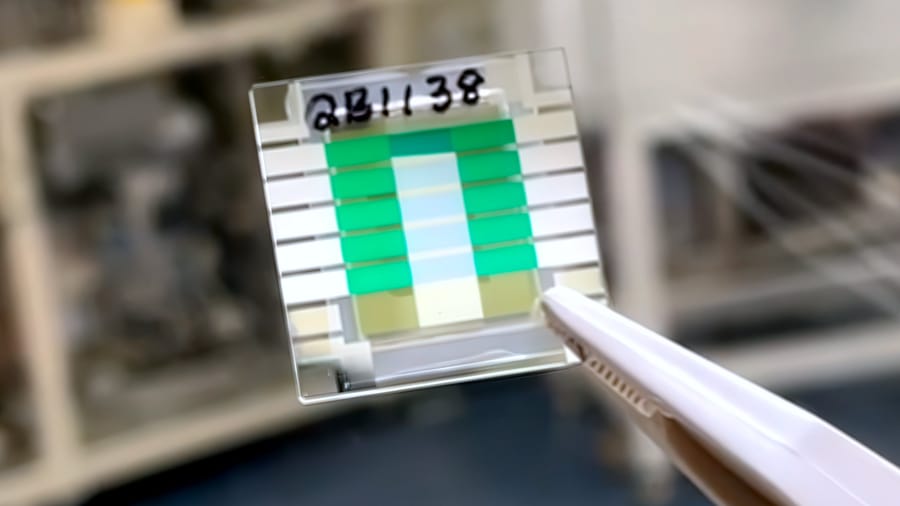
The team built a metal-free battery from colorful hydrogel droplets ... essentially electric JELL-O. They printed thousands of drops in patterns mimicking the eel's setup: red and blue blobs with high/low sodium levels, separated by green and yellow membrane-like blobs.
Stacking nearly 2,500 droplets created a squishy, flexible battery producing 110V. Without the colorful dyes, it would've been completely see-through.
But like the eel's brief jolt, this battery only produced 27 mW/m² before dying. The researchers recharged it by applying current, recovering 90% capacity across 10+ cycles.22 The real trick will be recharging inside the human body. But if electric eels can do it... maybe someday we can too.23
The hope? These biocompatible batteries could power next-gen implants and wearables. Not just better pacemakers, but health monitors, medication dispensers, bionic prosthetics, biohybrid robots ... even transparent batteries for AR contact lenses. The future's looking bright...and possibly labeled in AR.
While promising, even the 2017 pioneers admitted they needed 10-100x performance boost for mainstream use.22
By 2023, Oxford researchers made a massive leap. Using next-gen microfluidic and 3D printers, they printed blobs 100,000x smaller, extended storage to 24+ hours, and increased power density 680x to 1,300 W/m³.2425 Their droplet chains even triggered nerve cells in petri dishes ... showing real integration potential with living tissue.
Then, in 2024, researchers from Xi'an Jiaotong University said "hold my beer." They built a powerful 208 V super-stretchy hydrogel battery using the same eel-inspired approach, wrapping it around a wrist to power a watch ... proving how incredibly flexible yet strong these squishy batteries can be.26
We're finally building body-friendly batteries using patents nature's been sitting on for millions of years. Making catalysts on the bleeding edge of science based on molecules that evolved before dinosaurs. Researchers are raiding biology's playbook to solve high-tech problems ... and it's working.
- Wikipedia – Battery ↩︎
- Wikipedia – Abiogenesis ↩︎
- Wikipedia – Porsche Taycan ↩︎
- Vox – The clean energy transition can’t happen without these minerals ↩︎
- CME Group – Platinum Group Metals in the Hydrogen Economy Midstream ↩︎
- International Energy Forum – Energy transition to trigger huge growth in platinum for hydrogen ↩︎
- Wikipedia – Heme ↩︎
- Wikipedia – Hemoglobin ↩︎
- Ask Nature – Clean Catalysts for Energy Storage Inspired by Hemoglobin ↩︎
- Wikipedia – Oxygen Reduction Reaction ↩︎
- Tech Briefs – Behold: The First Battery Prototype Using Hemoglobin ↩︎
- APL Energy – Rare-metal-free Zn–air batteries with ultrahigh voltage and high power density achieved by iron azaphthalocyanine unimolecular layer (AZUL) electrocatalysts and acid/alkaline tandem aqueous electrolyte cells ↩︎
- Popular Science – Rusty metal could be the battery the energy grid needs ↩︎
- Wikipedia – Metal-air Electrochemical Cell ↩︎
- ABOUND – ABOUND Energy and AZUL Energy Announce Strategic and Financial Agreement to Advance Air Cathode Technologies ↩︎
- Undecided with Matt Ferrell – Why Rust Batteries May Be the Future of Energy – Iron Air Battery Technology ↩︎
- ABOUND – Zinc8 Energy Solutions Announces Rebranding to ABOUND: Culminating a Strategic Shift in Management and Future Growth Plans ↩︎
- Proceedings of the National Academy of Sciences – Leaping eels electrify threats, supporting Humboldt’s account of a battle with horses ↩︎
- Wikipedia – Electric Eel ↩︎
- Wikipedia – Voltaic pile ↩︎
- Small Methods – Electric Eel Biomimetics for Energy Storage and Conversion ↩︎
- Nature – An electric-eel-inspired soft power source from stacked hydrogels ↩︎
- Futurity – Electric Eel-Based Device Could Power Future Medical Implants ↩︎
- Nature – A microscale soft ionic power source modulates neuronal network activity ↩︎
- University of Oxford – New ‘droplet battery’ could pave the way for miniature bio-integrated devices ↩︎
- Nature Communications – Consecutive multimaterial printing of biomimetic ionic hydrogel power sources with high flexibility and stretchability ↩︎