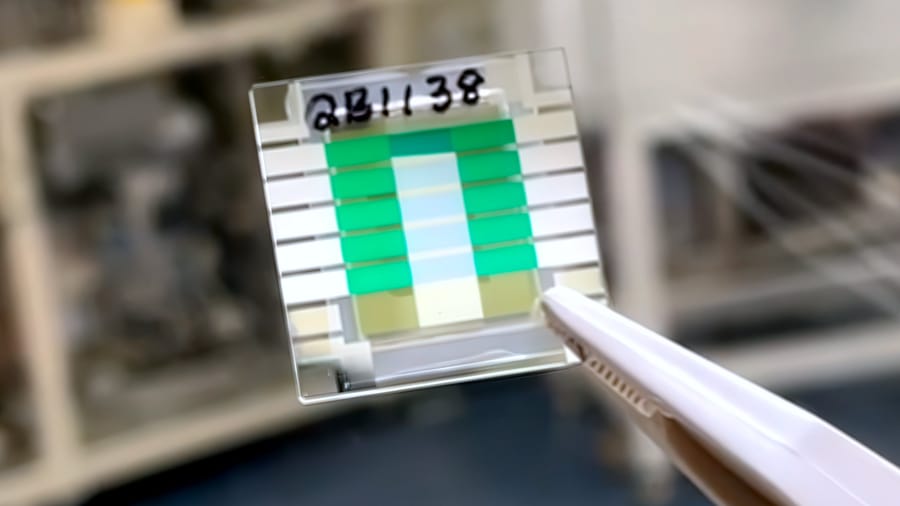
Perovskite solar cells are smashing efficiency records and starting to hit the market, but what if the real future of solar is a material you’ve probably never heard of? It’s called kesterite, and new research suggests it could match perovskites’ efficiency without any toxic lead in the stack. That could mean even cheaper, cleaner, and more efficient solar panels for your home down the road. Scientists just simulated a version of kesterite that could reach a 33.56% efficiency, brushing up against the theoretical limit for solar cells. The kicker? Kesterite is durable, where perovskite struggles to survive the great outdoors. With new kesterite efficiency records set this past year… could this underdog race ahead of perovskite and reshape the future of solar?
Why should you care about kesterite? Three reasons. First, it's made from copper, zinc, tin, and sulfur or selenium, which are all abundant metals.1 No rare earth elements, no supply chain drama. Second, it can be manufactured without toxic lead or cadmium, which matters both for your home and the environment. And third, it actually survives outdoors (peroskites have some challenges there). In field tests in southern Spain, kesterite cells barely degraded over three and a half months of direct sunlight.2
Now, solar is booming. 7% of the world's electricity now comes from sunlight,3 with 540 GW of solar capacity added each year.4 But that growth depends on materials that are either expensive, toxic, or fragile.
For example: those gridlines on silicon solar panels? They’re made with silver, and they jack up the price of each panel by a hefty 12%.5 Cadmium telluride (CdTe) is gaining marketshare in American utility-scale solar farms,67 but cadmium is toxic8 and tellurium costs as much as platinum.9 That’s made researchers pin their hopes on perovskite for powerful solar cells made from cheap, abundant materials.10
Which is why it’s really too bad perovskites degrade in air, heat, humidity and even UV rays. Kind of awkward for a material meant to stare at the sun.10 Oxford PV in the UK claims its new commercial panels have overcome these durability issues,1110 but perovskite solar cells usually contain toxic lead, which complicates manufacturing and recycling.12
And that’s why a whole new solar material called kesterite is finally getting it’s time in the spotlight … or rather the sunlight.
Kesterite is grown right in the lab from the four or five abundant metals I mentioned earlier.1 Depending on the mix, researchers give it different nicknames, but whatever the recipe, kesterite has a high absorption coefficient. That puts it in a similar class as other thin film solar technologies like perovskite and cadmium telluride, which use light-absorbing layers far slimmer than the silicon wafers in traditional panels.13 A solar panel made with a thin layer of cheap materials (and no silver gridlines) has the potential to be a lot cheaper.14 Because kesterite panels can be made without toxic metals like lead and cadmium, the environmental cost could be lower, too.
The real question: is kesterite any good at staring down the sun? Yes. In field tests run by IMRA Europe in southern Spain, encapsulated CZTSSe kesterite solar cells barely degraded over three and a half months outdoors. When bare kesterite cells were kept under continuous indoor lighting for seven months straight, their efficiency stayed stable after an initial dip.2 Accelerated aging tests are still on the to-do list, but kesterite already has a reputation for stability.8
There’s one last box to check. It’s the make or break for any solar cell … that’s efficiency. It’s not just homes and businesses that are space-constrained; utilities are, too. Every last watt that’s squeezed out of a square foot or meter of a solar panel helps.
We just talked about how well kesterite absorbs light in general, but it’s also the way it absorbs light that has scientists paying attention. Like all light-harvesting materials, kesterite has a “band gap,” which is the amount of energy a photon of light needs to kick an electron loose and make electricity. Kesterite’s band gap is “wide.” It’s up to 1.5 eV in comparison to silicon’s 1.1 eV, which is closer to the sweet spot for a single-layer solar cell. That means it can absorb higher-energy photons with less energy wasted as heat.1516
Just how efficient could kesterite solar cells become? Researchers at Kafr El Sheikh University in Egypt used a computer model to optimize a kesterite device. They tuned the band gap, swapped out stack materials, and dialed in the thickness of each layer.17 Their results were published in Nature in 2025, and they showed that a kesterite solar cell could become 33.56% efficient at turning sunlight into electricity.1718
That’s shockingly close to the Shockley-Queisser theoretical limit of around 33.7% for a single-layer solar panel.19 It also beats earlier modeling studies that relied on toxic cadmium-sulfide buffer layers to reach high theoretical efficiencies.
What makes it different? It’s modeled with abundant, non-toxic materials.18 The lone splurge was a gold back contact, which the team plans to replace with molybdenum in future studies.17
If theoretical kesterite models promise near-max efficiencies, then actual kesterite cells in the lab must be doing pretty hot, right? In reality … they’re still pre-heating.
The highest certified efficiency ever reported for a kesterite solar cell is 14.3%, achieved by researchers at the Chinese Academy of Sciences in September 2025.20 That’s almost twenty years after the first kesterite solar cell was ever made.
What’s holding kesterite back? Recombination. When sunlight knocks an electron loose in the kesterite crystal, it leaves behind a positively charged hole. If those charges travel to opposite ends of the solar stack, you get electrical current. However, if they meet again, they cancel out as heat instead of electricity. That’s recombination, or at least, a very simplified version of it.
Recombination happens because copper and zinc are so similar that they swap places in the lattice, undermining the crystal structure. That creates “deep traps” where electrons and holes get stuck long enough recombine, instead of making electricity. Kesterite can also have vacancies at atomic sites in the crystal lattice, which is the semiconductor equivalent of a pothole.21622
The trouble isn’t just inside the crystal. At the interface between kesterite and the other layers in the stack, surface defects and poor contact between layers can trap electrons, block electricity generation, and sink the solar cell’s efficiency. You can see this in the modeling study: the solar cell’s efficiency drops off dramatically with higher levels of defects at the kesterite–titanium dioxide interface.
The good news is that the kesterite crystal can be healed even after it’s already formed. In January 2025, a team at the University of New South Wales in Sydney, Australia broke the efficiency record for a cadmium-free kesterite solar cell by heat-treating a fully-formed device with hydrogen gas.232124 Just a couple months later, researchers at Shenzhen University in China showed that oxygen could also heal defects by entering the crystal lattice and filling vacancies where sulfur should have been.2526 Think of hydrogen and oxygen like a polish for scratched glasses, filling in imperfections to let the light (or the electrons) through.
There is also a way to form a more efficient kesterite crystal right from the start. In June 2024, a group at the Chinese Academy of Sciences in Beijing added a tiny amount of silver and cadmium to the crystal mix, plus a little germanium at the back interface. These metals helped the zinc, copper, and tin atoms settle into the right places in the lattice, creating a more perfect (and more efficient) crystal. The resulting kesterite stack reached a certified efficiency of 14.2%, a new record for a kesterite cell using a cadmium sulfide buffer layer.27
If the aim is a solar panel made with just earth-abundant and non-toxic materials, then adding expensive silver, rare germanium, and toxic cadmium isn’t ideal. Still, these tweaks show that kesterite can be coaxed into a more perfect crystal. If the amounts added are tiny, alloying could be an ally in the search for a cheap, efficient solar cell.
There's more: the technique that secured the current kesterite world record skipped the germanium. In September 2025, the same team at the Chinese Academy of Sciences added cheap, non-toxic chemicals between the layers of the kesterite stack that smoothed out the interfaces and filled in defects. Because one of the additives was slightly magnetic, it helped align nearby atoms and improve electron flow.20
The solar cell hit 14.3% certified efficiency, less than 6 points away from the 20% goal that would make kesterite commercially viable. And yes, it still used a cadmium sulfide buffer layer. This discovery shows that “cheap and cheerful” materials can deliver meaningful performance gains.
Do we even need to worry about toxic metals like cadmium in solar panels? Industry groups like the Solar Energy Industry Association point out that the cadmium in solar panels doesn’t readily dissolve in rain or water and is encapsulated in tough polymers between layers of glass.28 Even the National Renewable Energy Laboratory’s own risk assessment agrees that the cancer and non-cancer risks to human and environmental health are de minimus.29 It’s worth remembering that clean energy technologies save lives every year by cutting fossil fuel use and therefore air pollution.30
First Solar, a US-based manufacturer of cadmium telluride panels that we’ve covered before,31 says it can recycle 90% of the semiconductor material in its panels.32 Academic sources point out that cadmium emissions could still occur during manufacturing, and that cadmium from improperly dumped or incinerated solar panels could enter the water or air.3334 So while I’m for any advance that gives us cheaper clean energy… championing tech that doesn’t contain toxic metals? It can’t hurt. And that’s exactly the point.
Perhaps a better reason not to worry about Cadmium Sulfide is that it isn’t a great fit for kesterite. Its conduction band, the highway electrons use, lines up so poorly with kesterite’s that electrons fall down an energetic “cliff” at the interface. Instead of a smooth handoff, electrons step off a curb they didn’t see and stumble. It also steals some of the best sunlight before it ever reaches kesterite, the way a tinted window can block the bright part of the view. That drives up recombination with nearby holes and drags down the voltage.13 35 That’s why researchers, including the team at Kafrelsheikh University, are modeling different buffer options like titanium dioxide, hoping to push kesterite to higher efficiencies.18
What makes this latest kesterite record even more exciting is that it was achieved using a faster, cheaper production method. Because as much as efficiency matters, manufacturing costs are often the deciding factor for whether a solar cell ever reaches mass market.
In previous years, the best kesterite films were made by “sputtering,” which sounds messy but uses plasma-hot gas to precisely deposit thin layers in a vacuum.36820 Energetic particles strike a target, causing single atoms to be removed at a time. Those atoms eventually deposit on the surface to be coated. That’s not cheap or easy to do.
Solution-based methods are 10 times cheaper and 5 times faster than sputtering.20 However, high defect levels in kesterites made with solution-based techniques made the method, well, hardly the solution.22 Until now. The current kesterite record-holder (that solar cell boosted to 14.3% efficiency with a couple of simple additives) was built layer by layer using a solution technique called doctor blading.20 Sounds like the name of a new TV drama, but it also sounds pricey. It’s actually the same as slathering too much icing on a cake, then wiping off the excess to a fixed thickness.837 Simple, quick, and low-energy. It's a really common technique in manufacturing, including for thin film semiconductors. In other words, it’s the kind of approach that could help bring kesterite to commercialization.
So, when will kesterite make it out of the lab? Qingbo Meng, who led the team behind the current record, told Chemistry World in late 2025 that he sees kesterite crossing the 20% threshold within five years.8
The problem is … I’m impatient now. So, I try to remember that the first solar panels were installed on a New York City rooftop in 1884, made of selenium with a thin coating of gold. They worked, but with an efficiency of just 1-2%. It wasn’t until 1954 that Bell Laboratories rolled out the silicon solar cell, achieving 6% efficiency.38 And it took another 30 years until the University of New South Wales made a solar cell with 20% efficiency in 1985.39
Kesterite is still in its early days. Most of the work happening now sits around a NASA technological readiness level (TRL) of 3 or 4, which is the stage where a technology proves itself in the lab and early prototypes start to look like real devices. Perovskites were in that same spot about sixteen years ago.40 We’ve watched them grow up in real time, climbing from those first lab experiments to something around a TRL 8 with companies like Oxford PV shipping panels to customers.10 The timeframe for solar innovations is compressing. If kesterite follows a similar path, it could move from lab curiosity to commercial tech much faster than earlier generations of solar did.
- Wikipedia – Kesterite ↩︎
- Journal of Physics: Energy – Stability, reliability, upscaling and possible technological applications of kesterite solar cells ↩︎
- Ember Energy – Global Electricity Review 2025 ↩︎
- PV Magazine – IEA warns global solar growth may plateau at 540 GW annually to 2035 ↩︎
- PV Magazine – Silver price surge drives PV makers to cut silver usage further ↩︎
- Applied Materials Today – Sustainability-Driven Advances in Kesterite Solar Cells: Strategies, Challenges, Future Directions ↩︎
- Department of Energy – Cadmium Telluride Photovoltaics Perspective Paper ↩︎
- Chemistry World – Can kesterite provide dirt cheap solar power? ↩︎
- Wikipedia – Thin-Film Solar Cell ↩︎
- Undecided with Matt Ferrell – How Record Breaking Perovskites Are Here NOW ↩︎
- Oxford PV – 20% more powerful tandem solar panels enter commercial use for the first time in the US ↩︎
- Advanced Energy Materials – Toxicity, Leakage, and Recycling of Lead in Perovskite Photovoltaics ↩︎
- Advanced Energy Materials – A Critical Review on the Progress of Kesterite Solar Cells: Current Strategies and Insights ↩︎
- ACS Energy Letters – The Steady Rise of Kesterite Solar Cells ↩︎
- Maysun Solar – What is Energy Band Gap of Solar Cells ↩︎
- Modern Concepts in Materials Science – Kesterite Solar Cells ↩︎
- PV Magazine – Scientists see 33.56% efficiency potential for kesterite solar cells ↩︎
- Nature Scientific Reports – Numerical simulation and optimization of FTO/TiO2/CZTS/CuO/Au solar cell using SCAPS-1D ↩︎
- Wikipedia – Shockley-Queisser Limit ↩︎
- Joule – Multi-interface engineering for all-solution-processed kesterite solar cells ↩︎
- Nature Energy – Hydrogen-enhanced carrier collection enabling wide-bandgap Cd-free Cu2ZnSnS4 solar cells with 11.4% certified efficiency ↩︎
- Nano-structures and Nano-objects – The prospective contribution of kesterites to next-generation technologies ↩︎
- University of New South Wales, Sydney – World-record photovoltaic efficiency achieved for kesterite solar cell ↩︎
- PV Magazine – Australian researchers set world record with kesterite solar cell ↩︎
- The Cool Down – Scientists make game-changing discovery in quest to create next-gen solar panels — here's what's happening ↩︎
- Nature Energy – Heat treatment in an oxygen-rich environment to suppress deep-level traps in Cu2ZnSnS4 solar cell with 11.51% certified efficiency ↩︎
- PV Magazine – Chinese researchers build kesterite solar cell with certified efficiency of 14.2% ↩︎
- Solar Energies Industry Association – Solar Panels Are Designed for Decades of Safe Use & Decommissioning ↩︎
- National Renewable Energy Laboratory – Human health risk assessment for improper landfill disposal of end-of-life CdTe modules ↩︎
- The BMJ – Phasing out fossil fuels would save millions of lives worldwide ↩︎
- Undecided with Matt Ferrell – How the Next Big Solar Panel Tech is Already Here ↩︎
- c&en – How First Solar recycles its CdTe panels ↩︎
- Journal of Hazardous Materials – Leaching of cadmium and tellurium from cadmium telluride (CdTe) thin-film solar panels under simulated landfill conditions ↩︎
- Journal of the Arkansas Academy of Sciences – Cadmium Sulfide-buffered PV Systems: Assessing the Environmental, Health, and Economic Impacts ↩︎
- Sustainable Materials and Technologies – Cd-free kesterite solar cells: State-of-the-art and perspectives ↩︎
- Wikipedia – Sputtering ↩︎
- Ossila – Doctor Blade Coating: Method, Coating Thickness and Design ↩︎
- Smithsonian Magazine – A Brief History of Solar Panels ↩︎
- University of South Wales, Sydney – Solar genius celebrates 40 years at UNSW ↩︎
- Journal of the American Chemical Society – Organometal Halide Perovskites as Visible-Light Sensitizers for Photovoltaic Cells ↩︎