If you believe half of what you hear about heat pumps, you'd think they're a $20,000 scam that stops working the second it gets cold outside. But here's what the skeptics don't mention: modern heat pumps work in temperatures down to -26°C (that's -15°F), and those "reliability" complaints? They usually trace back to installation problems, which are shockingly common.
The truth is, heat pumps are some of the most efficient climate control tools money can buy. Their financial and environmental benefits make them worth considering. But in the past few years, I've heard so much conflicting information about what they can and can't do that it's hard for anyone to know what's actually true.
Today I want to pull apart the biggest myths around heat pumps, so you can tell if they actually make sense for your home, in your climate, with your budget. But how do you separate the myths from what actually matters for your situation?
One of the biggest misunderstandings about integrating renewables into your home is that there’s a universal experience. I recently shared my experience living with a geothermal heat pump for the past few years, but one person's setup only tells part of the story. So let's talk about how heat pumps actually work and what you can reasonably expect from the different types.
For those unfamiliar, heat pumps use the same vapor compression cycle as your refrigerator or AC. They pressurize and depressurize a refrigerant, moving it through phase changes between gas and liquid. This lets them transfer heat from one place to another. They don't generate heat … they move it around.
And here's where it gets interesting: heat pumps can be more than 100% efficient. They can deliver more thermal energy than the electrical energy they consume. That's not magic, it's how we measure electrical efficiency, and it's just because they're moving heat, not creating it. Some heat pumps put out three or four times as much heat energy for every unit of electricity they use.1
And here's where it gets interesting: heat pumps can be more than 100% efficient. They can deliver more thermal energy than the electrical energy they consume. That's not magic, it's how we measure electrical efficiency, and it's just because they're moving heat, not creating it. Some heat pumps put out three or four times as much heat energy for every unit of electricity they use.1
There are two main types that you’ll see the most often. Air-source heat pumps (ASHPs) transfer heat between your home and the outdoor air.2 Ground-source heat pumps (GHP), also called geothermal, tap into the stable temperature of the earth deep underground.2 Each has different strengths depending on your climate, budget, and setup.
Which brings us back to all that conflicting information I mentioned.
The Cost

Myth #1: Heat pumps are too expensive to be practical.
Let’s just get the big one out of the way: the cost. The most important thing to know about the cost of any heat pump is that it’s extremely variable. The quotes you’ll receive for an installation depend on what kind of heat pump you’re shopping for, your location, the size of your home, what kind of ductwork you have, and of course, the local climate.34
Air-source heat pumps tend to be much cheaper than geothermal ones. According to 2025 data from EnergySage’s installer marketplace, the U.S. national average hovers around $16,500 after applying incentives.3 Then there’s geothermal, which has a considerably higher upfront cost. EnergySage pins that price tag at anywhere from $15,000 to $40,000 and up.5
I can personally speak to the gravity of investing in a geothermal heat pump, or GHP, because that’s exactly what I did over two years ago. On my video about whether my brand-new setup was worth it, a lot of you were experiencing some secondhand sticker shock. And that’s not surprising: $54,000 after incentives is, well, earth-shaking. But I can’t emphasize enough that 1) that was a new house build will all new duct work, and 2) My situation will not look like yours. Not unless you’re moving next door. (…Please don’t.)
Anyway, it’s important to note that even though geothermal heat pumps can be an intimidating purchase, their value shines through their long-term benefits. The U.S. average payback period varies, with some GHPs paying for themselves in as few as three years, and others hitting that point after a decade.46 For context, this isn’t too far off from the range of average payback periods for solar panels.7
You can also count on GHPs’ longevity, which is considerably better than what you’d get from air-source heat pumps.6 With the tubing that delivers the heat safely stowed underground, that portion of the system can last decades. We’re talking as long as 50 years or more. For the other components, you can expect a similar lifespan to solar: about 20 to 25 years.85
In the short-term, however, every region has its own government-based rebates and incentives that can dramatically reduce the price of your initial investment.
Incentives
Going back to my own experience, the cost of geothermal systems can be steep…but that’s because the drilling required for an all-new install is steep. In my case, a full $18,000, which was nearly a quarter of the cost of my system without incentives. The price got me a 122 meter (or 400 feet) deep borehole that now carries steady heat to my home. But, as I mentioned, I was able to save thousands by taking advantage of federal and regional incentives to hit that $54,000 cost. My installation was entirely new, but if it were a retrofit, state rebates would drop the costs even further to about $39,000.
Separately, there’s also income-based initiatives like the U.S. Department of Energy’s Weatherization Assistance Program, the Low Income Home Energy Assistance Program, and the services offered by Community Action Agencies.9
Now, of course, your circumstances are going to be different from mine. What’s available will vary by where you live (and how accessible it is). Sometimes, incentives don’t have as much of an impact on the final price tag as you’d hope. And sometimes, you can’t always cash in on the opportunities before they’re gone. In the States, our president’s “Big Beautiful Bill” put an end to several federal tax credits in 2025. This is definitely putting a strain on consumers’ abilities to cut down on our own big, beautiful bills.
That's why it's even more important now to check what bonuses your local utility offers. My utility, Eversource, recently launched a special electricity rate for heat pump owners. Eversource has a winter rate program that cuts distribution and transmission costs by about 23% from November through April. For an average household using 1,670 kWh per month in winter, that's around $124 in monthly savings during heating season. If you got a Mass Save rebate (a Massachusetts program) for your heat pump, you're automatically enrolled.10
Resources like the Database of State Incentives for Renewables & Efficiency are a great place to start looking for both rebates and special rate programs in your area.
The Cold


Myth #2: Heat pumps don’t work in the cold.
We can come back to my geothermal heat pump setup to explain just how mythical this idea really is. Ground-source heat pumps are founded upon the dependability of what’s known as the geothermal gradient. The further you travel below the surface of the earth, the hotter it gets.11 GHPs leverage the relatively fixed range of temperatures located in the sweet spot of the shallows. This heat source doesn’t fluctuate much even as the seasons change, supplying a form of thermal energy storage.12 So, GHPs pretty much skirt the chilling effect completely.6
As for air-source heat pumps, the tech has long past evolved its initial limitations. Low temperatures used to be a problem, but newer iterations of ASHPs implement multiple strategies to keep themselves running even during extreme weather. I could try to get you pumped about improvements like vapor injection and variable speed compressors, but those are complicated enough for their own video.13
Many heat pump systems also have a backup heating system, like resistive heating strips, for those extra cold days where the heat pump struggles a bit. That means instead of getting 3:1 or 2:1 heat from electric ratios, you’d be getting that 1:1 (or 100%) efficiency from the resistive strips. Before you say the need for backup heat makes a heat pump not worth it, consider how often it’s actually going to be used. When sizing your system, you work with your installer to match your area's typical temperatures to an appropriate heat pump. That's what I did with my mechanical engineer. You might find that out of 365 days a year, there’s four to seven days of temperatures that force the backup heating system to kick on. That still means you’re getting over 358 days of energy efficient heat pump heating and cooling.
Either way, the “cold climate” variety of ASHPs do exactly what they say on the tin: continue to perform even when degrees starts to dip.14 Some models are powerful enough to continue to work in temperatures as harsh as -26 to -29 C (or -15 to -20 F).1315
That said, in the States, there’s no standard for what constitutes a cold climate heat pump. As a result, an ASHP’s ability to perform during a blizzard or cold snap is dependent on its manufacturer…and its correct installation.1615
However, the ENERGY STAR certification program does have its own requirements. Any heat pump with a “cold climate” mark has to be able to maintain a coefficient of performance (or COP) of 1.75 or above at a temperature of 5 F (or -15 C).1317 A coefficient of performance is just one of many measures of a heat pump’s efficiency. That leads us directly to our next myth.
The Competition

Myth #3: Heat pumps cost more to run than fossil-fuel based devices.
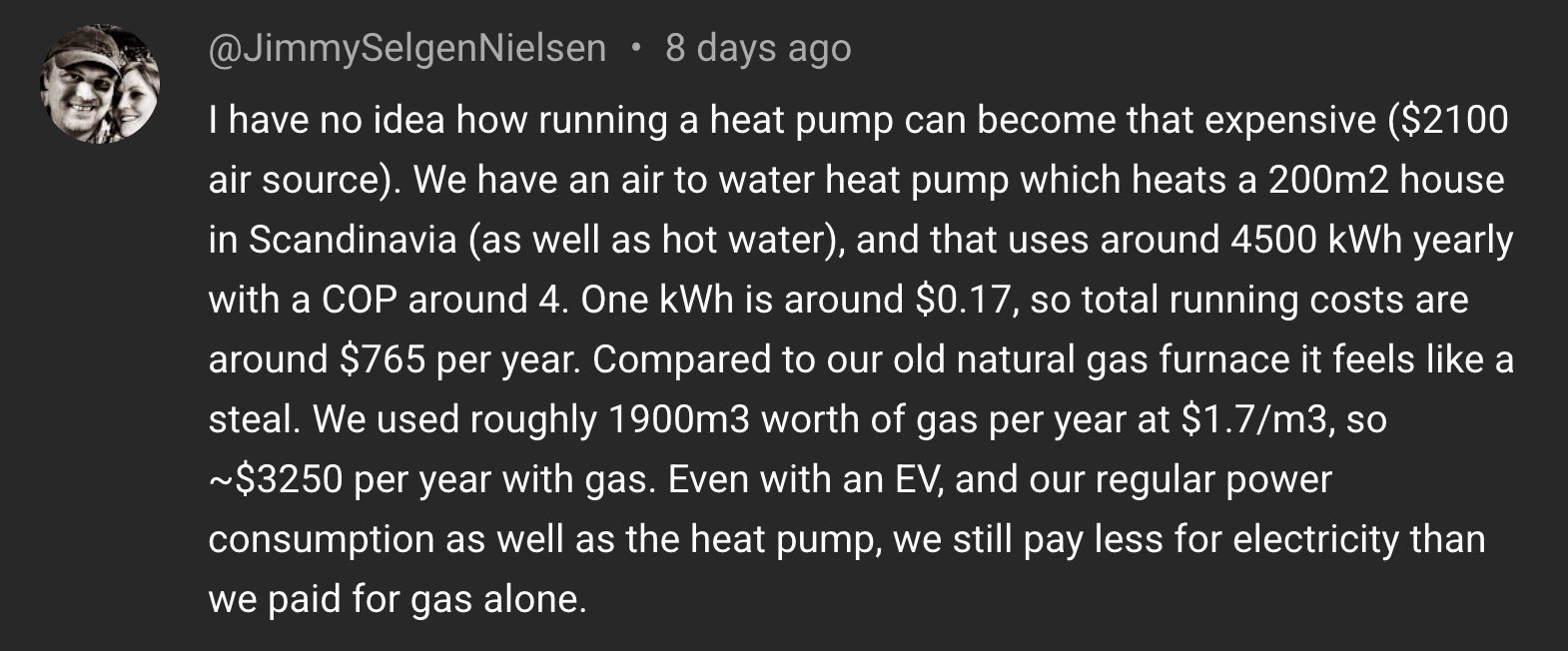
A heating system operating at 100% efficiency has a COP of 1. In other words, for every unit of electric energy put in, you get exactly one unit of heat energy out. But as I said before, heat pumps can be more than 100% efficient. Under ideal conditions, some heat pumps can operate at efficiencies as high as 400%, meaning that you’re getting quadruple the amount of heat from each watt.18
By comparison, oil furnaces and gas boilers typically run at about 85% efficiency. So even when heat pumps have to work harder in colder environments, you’re still getting better performance than you would with fossil fuels.1918
However, analyzing costs always involves that tangled mess of variables. It's not enough to compare efficiencies. Regional differences like the price fluctuations for gas and electricity, the quality of your home's insulation, and the ability to leverage smart technology and local tariffs all factor into whether a heat pump is your best option.19
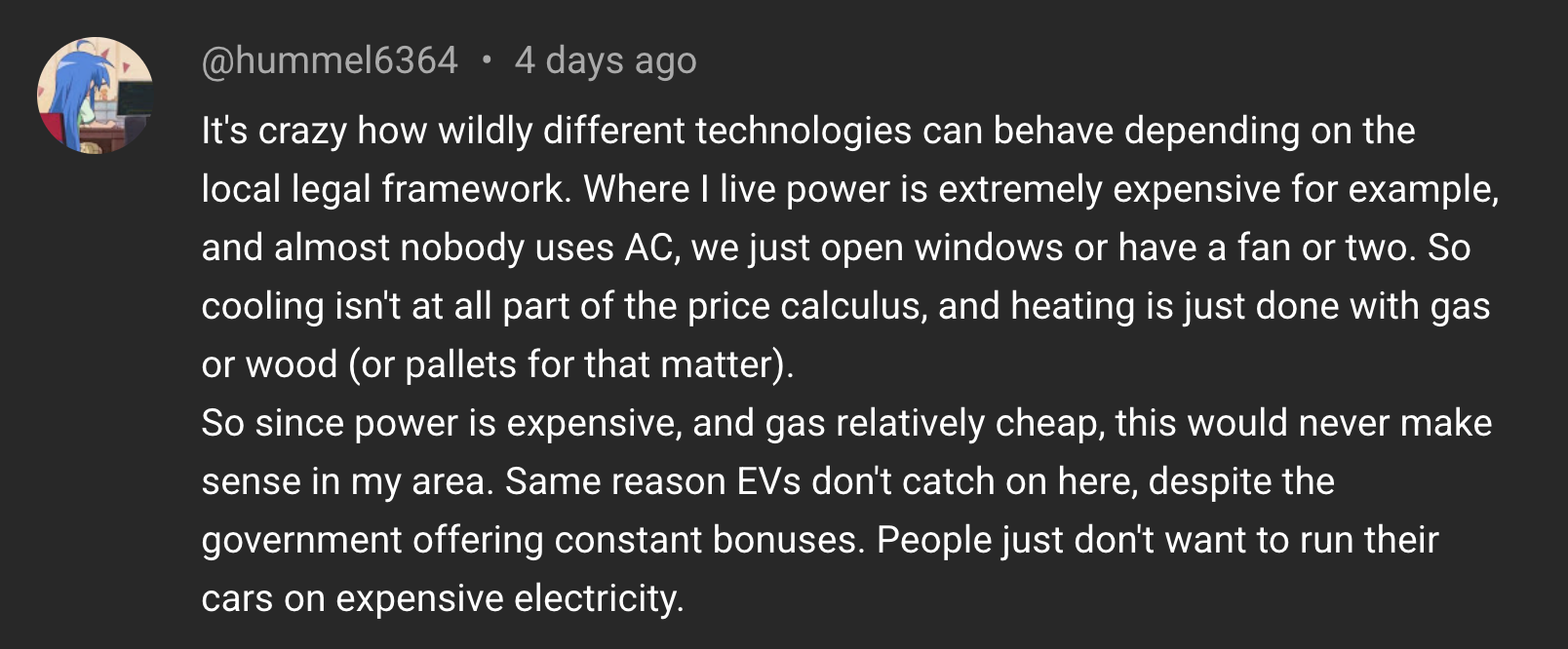
But there is one legitimate cost concern worth understanding: the “spark gap.” That's the price difference between electricity and fossil fuels. When electricity costs significantly more per unit of energy than natural gas or heating oil, even highly efficient heat pumps can cost more to operate than a gas furnace. In my area, we have some of the highest electricity rates in the country at around $0.31 per kWh. That makes electric heat hard to compete with ultra-cheap natural gas.
Policymakers and utilities talk about "closing the spark gap" because fixing that price imbalance will make the decision to go electric easier. That can be done with rate design, shifting fees and taxes, or targeted incentives. Exactly like Eversource's special heat pump electricity rate I mentioned earlier.
The bottom line is that sweeping claims don’t apply.
The Conditions (that they need to work)


Myth #4: Heat pumps need special types of insulation and ductwork.
If you remember what I said about my geothermal setup in my earlier video, a significant portion of my system’s cost came for the need for all-new ductwork. The context of this is important, though: I was building a new home. It’s much cheaper (and easier) to retrofit an air source heat pump. In most places across the States, you can swap your central AC or furnace with an ASHP, no ducts required.14 It’s a pretty simple swap.
But what about when retrofitting isn’t an option? Well, if you can’t duct ‘em…then you can just use a ductless heat pump instead. Also known as “minisplit” heat pumps, these air-source models offer flexibility in multiple ways. They’re a solution for when a home doesn’t have existing ductwork, and they’re also useful when you only need coverage for a small area (even as small as individual rooms).20 If you have radiant heat, air to water heat pumps are out there … they’re a little niche in the US, but they are an option.
And as for apartments? Renters rejoice: heat pumps aren’t as inaccessible as you might think. Back in mid-2024, I covered the introduction of window heat pumps into New Yorkers’ apartments as part of the state’s “Clean Heat for All” challenge.21 Since then, the market for heat pumps you can install right onto your windowsills has broadened, too. Recently, General Electric released a line of window units that look the same as any other AC box. Their price point, however, is in the hundreds, not the thousands.
The Consistency (of their performance)


Myth #5: Heat pumps are unreliable.
Another myth I’ve bumped into a lot is that heat pumps are prone to leaks and failures. The truth is, a heat pump is only as reliable as its installer. And it turns out it’s unfortunately pretty difficult to find an installer with the training, interest, and meticulousness needed to get the job done right.22
A 2018 Department of Energy study found that as many as 90% of HVAC systems have at least one performance issue that either began with installation or arose from poor maintenance. That data includes both heat pumps and air conditioners, so it’s not hard to imagine how this issue is exacerbated by unfamiliarity with a newer technology. It doesn’t help that this new technology comes with old baggage. The specter of the frozen heat pump continues to haunt us all.22
In any case, the larger problems with how the HVAC industry approaches heat pumps are way beyond the scope of this video, but that doesn’t mean proper installation is a lost cause. With careful vetting and research, you can find a professional that can meet your home’s needs.
I can only speak to my experience, but everything’s coming up Ferrell with my GHP (despite my own system not being perfect). You don’t have to take my word for it, though. The Department of Energy actually keeps up a list of geothermal case studies that span the entire country, from Albany…Georgia…to Alaska. Some of these projects are absolutely massive, like the Norton Commons neighborhood of Kentucky or the Colorado Mesa University campus. Yet years after their installation, they’re not only still kicking, but still expanding.23242526
Bottom line: the unreliability isn’t usually a technology issue.
If you take anything away from this video, let it be that there’s a lot more nuance in this conversation than people might want you to believe. There’s so many angles to take into account when deciding if a heat pump is feasible for you that it’s just not possible to generalize, much less dismiss the tech entirely.
The key is understanding your specific situation: your climate, your utility rates, your home's existing infrastructure, and what incentives or discounts are available in your area. Those factors matter way more than any blanket claim about heat pumps being too expensive, unreliable, or ineffective in the cold.
- Air-Source Heat Pumps ↩︎
- Heat Pump Systems ↩︎
- How much does a heat pump cost in 2025? ↩︎
- Geothermal heat pumps are crazy efficient. Should you get one? ↩︎
- Ground source heat pump cost: How much will you pay in 2025? ↩︎
- Pros and cons of geothermal heat pumps ↩︎
- Solar payback period: How soon will it pay off? ↩︎
- Geothermal Heat Pumps ↩︎
- Where Can I Find Assistance? ↩︎
- Massachusetts Heat Pump Rate ↩︎
- Geothermal Gradient ↩︎
- Geothermal Heat Pumps ↩︎
- Cold Climate Heat Pumps Work! ↩︎
- ENERGY STAR Certified Air Source Heat Pumps ↩︎
- Cold Climate Heat Pumps ↩︎
- Can Heat Pumps Actually Work in Cold Climates? ↩︎
- ENERGY STAR® Program Requirements Product Specification for Central Air Conditioner and Heat Pump Equipment ↩︎
- Heat pumps vs. oil furnace heating: What’s better in 2025? ↩︎
- Gas boiler vs heat pump: which is right for your home? ↩︎
- Ductless Minisplit Heat Pumps ↩︎
- Governor Hochul and Mayor Adams Announce $70 Million Initial Investment to Decarbonize NYCHA Buildings as Part of Clean Heat for All Challenge ↩︎
- Underqualified Installers Are Giving Heat Pumps a Bad Name. Here’s How to Find a Competent Pro. ↩︎
- Geothermal Heat Pump Case Studies ↩︎
- Geothermal Heat Pump Case Study: Colorado Mesa University ↩︎
- Geothermal Heat Pump Case Study: Norton Commons, Kentucky ↩︎
- Geothermal: Major Louisville projects are tapping into Earth's warmth for heating, cooling ↩︎