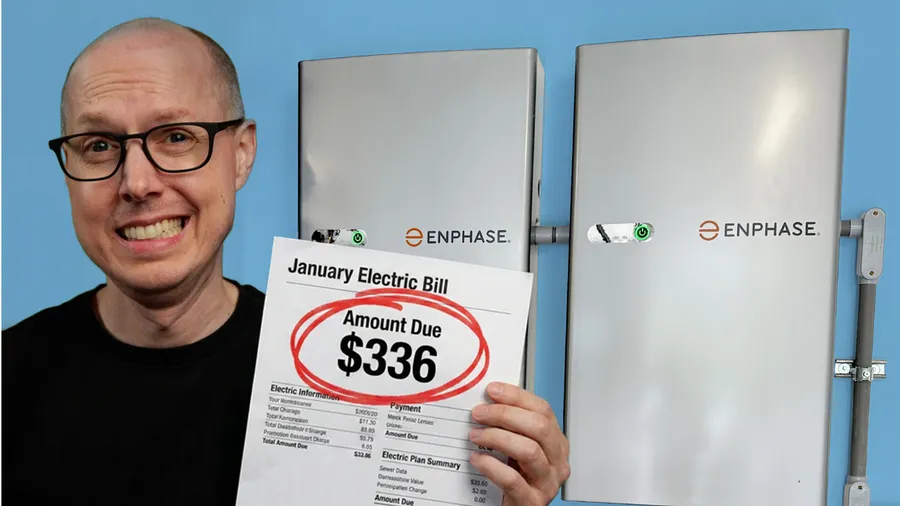
This 20 kWh battery on my garage wall cost over $33,000 before any tax incentives, and anyone buying one today won’t get the federal tax credit.1 In my last video, I mentioned how my system will never actually pay for itself, but I’d still buy a whole-home battery again. Just maybe … not this specific one.
So, a lot of you asked the obvious question: well Matt, what battery system would you buy today?
I can’t redo my own house, but my friend is about to put a battery in theirs. So, we’re installing one of the new modular whole-home systems, killing their power to see if it holds up, and finding out if it can actually save them any money.
Let’s take a look at what it’s like to get one, and grade every type of home battery you can get today. There are so many options it can make your head spin. Not every battery is the right fit for every situation. Let’s see if we can nail down what the right battery is for you.
I’ve been fascinated by modular home battery systems that a homeowner can add to over time. I first covered them in one of my CES videos a couple of years back. I wasn’t able to get one to test on my own house, so I partnered with EcoFlow to get some firsthand experience at a friend’s house. While EcoFlow is a sponsor for today's video, this shouldn’t be considered a “review,” and they have no say over the editorial of this video or my final conclusions. I should also mention that I’m an advisor to Pila, another battery company, which comes up later in this video.
So what are the different categories of batteries you can get today? Cuz … there are a lot of choices. I think it’s possible to boil it down to about 4 main categories of battery for your home:
- Installed whole-home, like Tesla and Enphase.
- DIY, like building a PC instead of buying a pre-built one.
- Plug-in modular, which is meant for inside the home to back up specific things instead of a whole home system.
- Whole-home modular, like EcoFlow’s TITAN battery that is getting installed here at my friend’s house.
Each one has its pros and cons. To keep it simple, I’m going to grade each one on the 4 jobs a home battery can do.
Job 1 is time of use shifting. If your utility charges more at dinnertime than overnight, the battery charges up when power is cheap and runs your house when it’s expensive, which should in theory save you money on your electricity bill.
Job 2 is solar self-use. If your utility pays you less for the solar you export than it charges you for grid power, a battery lets you keep those kWh and use them yourself.
Job 3 is grid programs, also called virtual power plants (VPPs). Your utility pays you to borrow your battery on the days the grid is maxed out. The Boston-based Brattle Group found VPPs cost utilities only about 40 to 60% as much as a gas peaker plant or grid-scale battery doing the same job.2 Here in Massachusetts, the grid program is ConnectedSolutions. It paid me $1,881 in 2024 and $1,634 in 2025.3
Job 4 is backup. When a nor’easter knocks the power out, the battery kicks in silently, ensuring my home still has electricity. I’ll be honest, mine hasn’t had much to do in this category. I’ve had 10 outages in 26 months, adding up to 51 minutes total.3 I still like knowing it’s there.
Right now at my friend’s house, the electrician is shutting off the main to start on the panel. My friend wants 3 things out of this battery: use more of their own solar, ride out the next nor’easter, and be ready if time of use rates come to Massachusetts. The state is already looking at time of use rates, but more on that later.
Installed whole-home
My system is the perfect example of a whole-home installation, or option 1 as I defined it. I went with one ecosystem for everything: Enphase. An installer does everything; they handle the permits, installation, support and the warranty. It’s the all-inclusive resort of home batteries. These kinds of systems can have a breakout panel for essential loads, or be configured to cover the entire panel and every single circuit in the house. All I had to do was pay for it and show them where to install it. That’s 20 kWh, and the $33,000 covered everything, including the labor and permits.
When choosing a whole-home battery, you need to know how much power your home needs at any given moment. For instance, a single Tesla Powerwall 3 can output about 11.5 kW,4 and my 4 Enphase IQ 5P batteries can output 15.4 kW.5 That’s more than enough to cover my entire house’s load.
So, how do installed whole-home systems score? They can do all 4 jobs, which makes them the most flexible option. They also have the longest warranties. Tesla backs the Powerwall 3 for 10 years,4 and Enphase backs my batteries for 15 years.5 And my Enphase batteries have grid-forming microinverters built in. Which means that during a blackout, they create a mini grid that keeps my solar panels running, so the sun can recharge my batteries even when the grid is down.5 Keep that one in mind, because we'll come back to it later.
But there’s a catch … you have to buy pretty much everything up front. On EnergySage, a typical Powerwall 3 quote comes out to about $13,055 for 13.5 kWh.6 But that’s including installation, which is highly variable and changes based on where you live, so let’s focus on just the hardware costs. One Tesla Powerwall 3 and its gateway runs about $10,000 to $11,000 for 13.5 kWh.7 My 4 Enphase batteries and their controller would cost about $15,000 to $20,000 for 20 kWh at today’s prices.8 And they’re both locked to your house. If you have to move, they’re not going with you because they’re hardwired and bolted to the wall. It’s not worth the expense to rip them out to take them with you. So there is a downside to a whole-home battery system.
DIY
So what about option 2: DIY? If you’re trying to maximize value for the money, this is honestly your best shot. For example, the Texas-based EG4 sells a 5.12 kWh server rack battery for about $1,477. That’s roughly $288 per kWh.9 Stack 3 of them with a 6 kW inverter, a rack, and cables, and you’re at about 15 kWh for around $6,600 in parts.9 When an installer puts in an EG4 system, quotes on EnergySage average about $1,149 per kWh.6 So most of the savings come from doing the work yourself. You still need a licensed electrician for some of it. And you get to pick every part, from the battery chemistry to the inverter. It’s THE most customizable way to do this. But it’s a double-edged sword.
Think of it like getting a new PC. Do you build one yourself, or pick one off the shelf at Best Buy? Unless you're Henry Cavill, most people don’t want to figure out which part failed, or chase down the company that made it for warranty support. Especially while the power is out.
On the scorecard, DIY can also do all 4 jobs. Virtual Power Plant (VPP) support just depends on the gear you pick. Here in Massachusetts, ConnectedSolutions only works with batteries controlled by an approved inverter maker. Texas-based Sol-Ark is on that list, so a DIY build with a Sol-Ark inverter can qualify. EG4 isn’t on the list.10 This means customers have limitations when it comes to which systems they can choose from.
Speaking of doing it yourself … back at my friend’s house, the electrician just finished wiring in the panel. That’s the last task that requires a licensed electrician. The rest is on us.
Plug-in modular
Not too long ago, I made a video about Pila's plug-in modular batteries. Pila’s not alone in this market, as it is a growing category of home batteries. These are batteries purpose-built for a homeowner or renter to drop inside the house where needed. You plug whatever you want backed up directly into them. Sometimes you’ll see this type of battery sold as part of a balcony solar kit. You just buy one and start using it. No installer. No permits.
These are hands down the cheapest way to get started with home batteries. A single Pila is $1,499 for 1.6 kWh, and there’s nothing to install.11 Per kWh, that works out to about $937. That’s a bit more than a Tesla Powerwall’s hardware, but about what a Powerwall costs once it’s installed. The difference is you only buy what you need, one battery at a time. You can take them with you when you move … and even move them around your home as your needs change. This makes it more flexible.
On the scorecard, they’re best at 2 jobs: time of use shifting and backup. Solar only counts if you pair one with a balcony solar kit, and for my friend they can’t join ConnectedSolutions.10 And you can’t use them with 240 V loads like central HVAC, an EV charger, or a well pump.11
Whole-home modular
And that brings us back to my friend’s house, and the last category: whole-home modular systems like EcoFlow’s TITAN. As I mentioned, my friend’s house is also in Massachusetts and they have solar too, but solar’s optional. You can just get a battery for backup and things like time of use shifting to save money.
The install for the system does require a licensed electrician and a permit, but the actual components and complexity of the system are pretty straightforward. You need to install the Smart Home Panel 10, which is EcoFlow’s breakout box and interface into the home. Any circuits you want backed up will go in here. My friend used 8 of the 10 slots, leaving room for more things to be added down the line. They moved over their water heater, furnace, kitchen, laundry, a freezer, their bedroom and bathroom, and some of the lights.
That’s the most complicated part of the install. After that, you add the batteries yourself, no electrician needed. Each one is 5 kWh and takes a few minutes to plug in and set up. So you can start with one and add more as you need them, instead of paying for everything up front. It’s basically LEGO for your house. Just don’t step on one barefoot.
So what does all that get you?
The TITAN 5000 Plus with 2 TITAN 5 kWh batteries and the Smart Home Panel 10 gives my friend 15 kWh total. Think of kWh as the size of the tank, and kW as how fast you can pour from it. The TITAN can pour 7.2 kW at once, so everything running at the same moment has to add up to 7.2 kW or less. It can handle a quick burst of 16 kW when something with a motor kicks on, like an AC compressor or a well pump.12
So how long does the tank last? If your house is pulling 1 to 2 kW, a full charge would last somewhere around 7 to 13 hours. My friend’s house was pulling a lot more than that right after the install, so it really depends on what you’re running. Adding batteries makes the tank bigger, so it lasts longer, but the pour rate stays at 7.2 kW. It can grow to 30 kWh if they ever need more.
The batteries are LFP, or lithium iron phosphate, the same chemistry as my Enphase batteries.135 It’s known for being safe and long-lasting. The main unit weighs about 121 lbs, and each extra battery is about 83 lbs.13 So you can take it with you, but it’s a two-person lift.
If you wire solar panels straight into the TITAN, it acts as the inverter too, and it can push up to 10 kW of battery plus solar.13 My friend already has Enphase panels with their own microinverters, so they can’t connect that way. Instead, the EcoFlow system uses CT clamps, little sensors that clip around the main wires coming into the panel. They watch how much power the house is pulling from the grid. That way it knows when to soak up extra solar, and when to cover the house from the battery, even the circuits that aren’t backed up.
So day-to-day, this whole system will cover their appliance loads and demand changes through the day like a champ.
What about cost? The hardware for this setup is $12,696 at full price. During the launch, it’s $8,699 through at least the end of the year. That works out to about $846 per kWh at full price, or $580 at launch. Install is extra, and like I said, it varies a lot depending on where you live.
But there are a couple of drawbacks for this category. In an outage, that 7.2 kW only goes to the circuits in the Smart Home Panel, and it holds 10 at most.14 There’s also no export to the grid from this system, which means you can’t participate in VPP programs like ConnectedSolutions. The warranty is also 5 years,13 compared to 10 years for a Powerwall 3 and 15 for my Enphase batteries.
And remember my Enphase microinverters? This is where they matter. When the grid goes down, solar panels without a battery have to shut off, so they don’t send power into the lines while utility crews are working on them. My batteries keep my panels running in a blackout. My friend has Enphase solar too, but no Enphase batteries. Their panels have their own microinverters, so they shut off with the grid and can’t recharge the TITAN. New panels wired straight into the TITAN would keep charging it.
That puts the TITAN at 3 out of 4 on the scorecard. Time of use shifting, solar self-use, and backup are covered. Grid programs, like VPPs, aren’t covered, because it can’t send power back to the grid. Wiring solar into it doesn’t change that.
So … does it actually save money?
The money question
My friend’s bill savings will be close to zero … for now.
Here in Massachusetts we have 1:1 net metering, which means that we get 1 kWh wiped off our bill for every kWh that our solar pushes out onto the grid. It essentially makes the grid seem like a perfect virtual battery. No efficiency losses, no costs … just 1:1.15 That means any battery we use, no matter the category, isn’t going to benefit us financially to try and maximize our solar self-use. But that’s going to vary based on where you live.
Where a battery like this does pay is with time of use rates. So, let’s run a clearly labeled example. I’ll use the same setup EcoFlow uses for its own savings estimate. That’s a 15 kWh system, 8 kW of solar, and a home in San Diego using about 16.5 kWh a day.16
On SDG&E’s TOU-DR2 plan, power from 4 to 9 p.m. costs 58.9¢ per kWh. The rest of the day, it’s 31¢.17 And under NEM 3, SDG&E only pays new solar customers an average of 3.7¢ for every kWh they push back to the grid.18 That’s a huge gap. A kWh you store at noon is worth about 16 times more at dinnertime than a kWh you export. And if you’re in California on an older NEM 2.0 plan, adding a battery won’t knock you off that plan.19
Here are my assumptions. The short version: the battery stores extra solar and covers about 10 kWh of evening use each day. That saves about $1,500 a year, or closer to $1,000 if it only covered the peak hours. EcoFlow’s own estimate for this setup is up to $3,100 a year.13 My math comes out lower, because I’m only counting what the battery itself saves.
At full price, that’s a payback of roughly 8 to 13 years. At the $8,699 launch price, it’s closer to 6 to 9 years. Both are before paying the electrician. That’s a lot better than my friend's system in Massachusetts.
So two things make a battery pay off. One is when your utility pays you very little for the solar you send back, like California’s NEM 3. The other is time of use rates, where power costs more in the evening. San Diego has both. Here in Massachusetts, we have neither right now.
We might get the second one sometime soon. In April 2026, the state’s energy office asked utility regulators to look into time of use rates, so they’re ready once every home has a smart meter.20 Those are already going in and I just got mine a little while ago. Even with 1:1 net metering, time of use would give a battery a real job: store power when it’s cheap, and use it when it’s expensive.
Until then, if you have 1:1 net metering and flat rates like we do, the main reason to buy is emergency backup. Same as my system. And speaking of emergency backup … how well does it work for that? Well, we tried that.
The blackout test
EcoFlow says it switches over in under 20 milliseconds.13 If a system takes too long to respond, it can cause computers to shut down and the transitions are hard on internal power supplies.
When we killed the power, there was no noticeable change.
Verdict: which is right for you?
So what’s the right battery system for you? Well, it’s going to depend on your situation, location and motivations.
Here’s the scorecard. Installed systems do all 4 jobs. DIY does all 4 if you pick the right gear. Plug-ins do 2. The TITAN does 3.
For me, if I had to do this over again, I’d be looking very closely at the whole-home modular approach of EcoFlow. This kind of system wasn’t a thing when I was shopping around 4 or 5 years ago. I really like the simplicity and the ability to add more over time. But I also really like participating in VPP programs and helping out the broader grid, so I’d probably end up sticking with a fully installed system for that. But if a VPP wasn’t on the table, I’d get myself a TITAN. It’s a close call for me. I guess you could say I’m living up to the channel name.
Renters
Do you rent your apartment or house and have time of use rates? Or want to get yourself a balcony solar kit to try and get some solar power into your life? Then you’re going to want to focus in on plug-in modular batteries like the ones from Pila and others. Drop one on top of your refrigerator or next to your desk in your office. You can back up the key things in your home that are most important, and shift some of that energy use around to try and save some money at the same time. When you move out of the apartment, you take it with you.
Homeowners
If you’re the kind of person who’d build your own PC, I'd recommend going DIY. It’s the cheapest way to get all 4 jobs, and you’ll have fun doing it. You still need to consult a licensed electrician for the grid tie-in, but otherwise, the installation will be on you.
If grid programs matter to you, for the money or for helping the grid, an installed whole-home system like mine is the easiest path. ConnectedSolutions has paid me over $3,500 in 2 years.3
If you want a battery wired into your house that covers you in an outage, helps you use more of your own solar, and manage time of use rates, without building a DIY system from parts, look at whole-home modular systems like the TITAN. You can start small and add batteries yourself later, and one company backs the whole thing. Just know the warranty is 5 years, and it can’t join grid programs.
Per kWh, the hardware is about $846 at full price, or $580 at launch. A Tesla Powerwall 3 with its gateway is about $750 to $830. At the launch price, that’s roughly 25% less per kWh than a Powerwall 3’s hardware. At full price, it’s about even. Either way, you can start small and add batteries yourself later as needs change. And you can take the batteries with you when you move.
That’s something I can’t do with my system because … well … it’s bolted and hardwired to the wall. My friend’s Smart Home Panel stays wired in, and taking it out is a job for an electrician. But the batteries, which are most of what this system costs, can come along for the ride to their next house. Now that’s what I call a moving experience.
- Final changes to solar tax credit from H.R. 1 ↩
- Virtual Power Plants (VPPs) Could Save US Utilities $15-$35 Billion in Capacity Investment Over 10 Years ↩
- The Hidden Problem With Home Batteries ↩
- Powerwall 3 Datasheet ↩
- IQ Battery 5P data sheet ↩
- Solar Battery Cost: Are They Actually Worth It In 2026? ↩
- Tesla Powerwall 3 (13.5kWh) | Sun Supply PV, Tesla Powerwall 3 | Soligent, and Tesla Backup Gateway 3 | Solar Cellz ↩
- Enphase IQ Battery 5P | Solar Cellz, Enphase IQ Battery 5P | Portlandia Electric, Enphase IQ System Controller 3 | NAZ Solar Electric, and Enphase IQ System Controller 3 | Signature Solar ↩
- DIY Home Battery Storage in 2026: Server-Rack LFP, Kits, and the $288/kWh Question Nobody Wants You to Ask ↩
- Program Materials for ConnectedSolutions for Small Scale Batteries ↩
- The Pila Mesh Home Battery ↩
- EcoFlow, email to Undecided, October 22, 2026 (TITAN Plus surge output: 16 kW) ↩
- EcoFlow TITAN 5000 Plus: Whole-Home Backup ↩
- EcoFlow Debuts TITAN Series, Bringing Whole-Home Energy Security Within Reach of Everyday Families ↩
- Eversource Massachusetts Net Metering Provision tariff ↩
- TITAN Series | Whole-Home Backup & Cost Savings | EcoFlow US ↩
- Pricing Plan Chooser | San Diego Gas & Electric ↩
- NEM 3.0 Is Final: What California's Court Ruling Means for Solar Buyers in 2026 ↩
- CPUC Decision 22-12-056, Decision Revising Net Energy Metering Tariff and Subtariffs, p. 166 ↩
- D.P.U. 26-62 - Petition of the Massachusetts Department of Energy Resources Requesting that the Department of Public Utilities Open an Investigation into Time-Varying Rates ↩